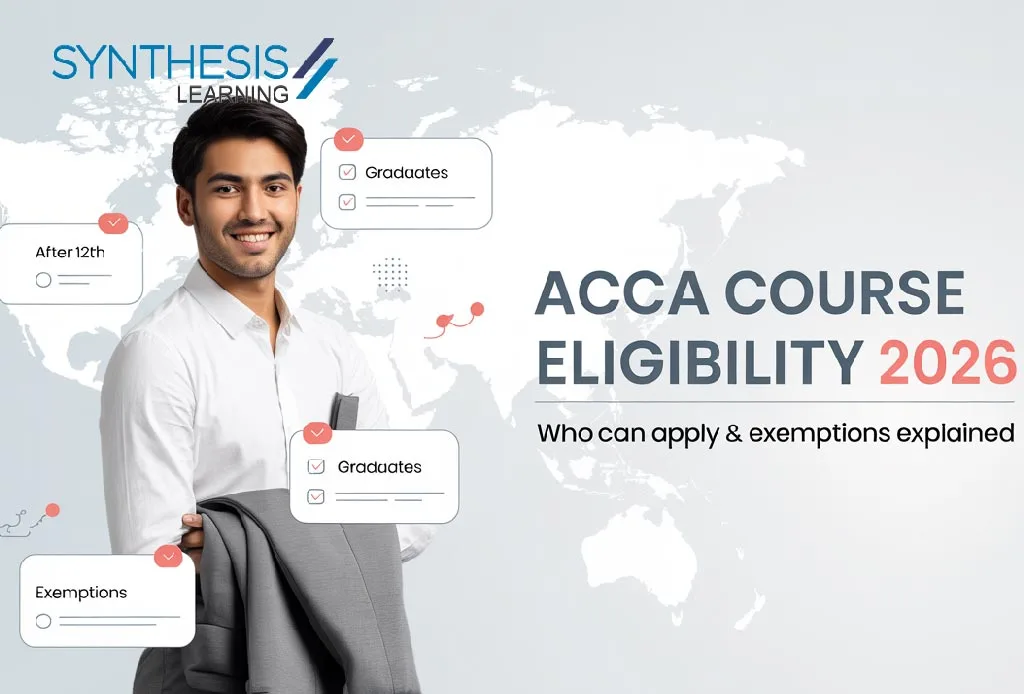
ACCA Eligibility 2026: Complete Criteria, Entry Routes & Exemptions
If you’re planning to pursue a global career in accounting or finance, ACCA is likely already on your radar. But before registering, one step matters more than anything else – clearly understanding ACCA eligibility.
Eligibility rules decide when you can start, which exams you must write, and whether you qualify for exemptions. For students applying in 2026, this clarity is especially important because many applicants apply either too early or without knowing the exact entry route they qualify for.
This guide breaks down ACCA course eligibility in a simple, structured way so you can check where you stand and plan confidently, without confusion or guesswork.
What is ACCA?
The Association of Chartered Certified Accountants (ACCA) is a globally recognized professional accounting body based in the UK. The ACCA qualification is designed to build strong foundations in accounting, finance, audit, taxation, and business strategy, while also focusing on ethics and professional skills.
What makes ACCA relevant for today’s students is its global acceptance, flexible exam structure, and compatibility with graduation. ACCA eligibility is intentionally broad, allowing students from different academic backgrounds to enter the program through clearly defined routes.
The ACCA Course is widely pursued by commerce students, graduates, and working professionals who want international exposure and career mobility across countries and industries.
ACCA Eligibility 2026 – Complete Criteria
Who can apply for ACCA in 2026?
The short answer: students after Class 12, graduates, postgraduates, and professionals – all can apply, provided they meet the relevant criteria. Below is a detailed breakdown of ACCA eligibility criteria.
Age and Other Requirements
- Minimum age: 16 years at the time of registration
- Language proficiency: ACCA exams are conducted in English. There is no separate English test, but students should be comfortable reading and writing professional-level English.
- No upper age limit: ACCA eligibility does not restrict older students or working professionals.
Academic Qualification Requirements
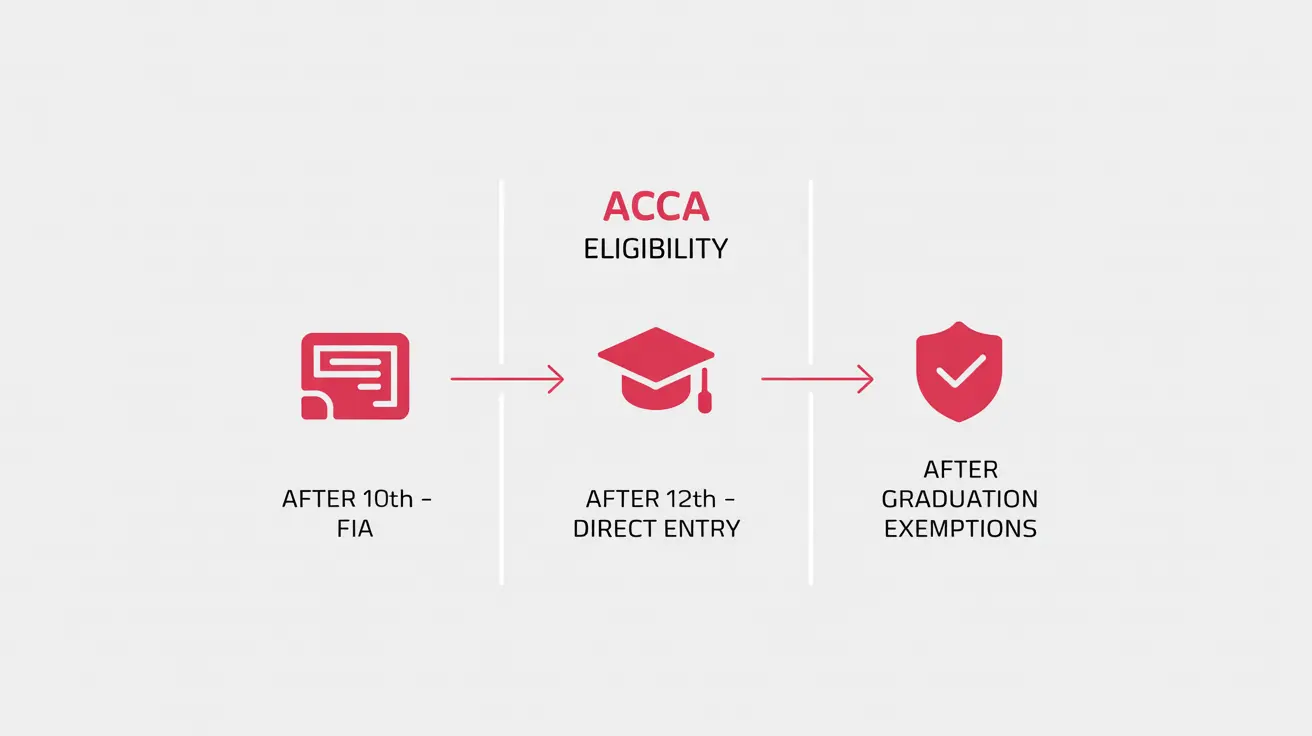
ACCA does not follow a rigid “one qualification fits all” model. Instead, eligibility depends on whether a student is applying:
- After 10th (via the foundation route)
- After 12th (direct entry)
- After graduation or post-graduation
Each route aligns students with the ACCA pathway at an appropriate level, ensuring they build concepts progressively.
ACCA Foundation Diploma (FIA): An Entry Path After 10th
For students who are not yet eligible for the main ACCA qualification, ACCA offers an official foundation-level pathway called Foundations in Accountancy (FIA).
What is FIA?
FIA is an ACCA-designed entry program that acts as a structured bridge into ACCA. It is particularly suitable for:
- Students who have completed Class 10
- Students without a commerce background
- Students who want early exposure to accounting fundamentals
FIA is not a shortcut—it is a preparatory pathway that aligns students with the core concepts required for ACCA.
FIA Structure at a Glance
| Level | Focus Areas | Outcome |
| Introductory | Business basics & accounting fundamentals | Conceptual clarity |
| Intermediate | Financial & management accounting | Core technical skills |
| Diploma Level | Applied accounting & business concepts | Progression to ACCA |
After completing the relevant FIA components, students can progress into ACCA Applied Knowledge, bringing them onto the same track as direct-entry ACCA students.
For students considering ACCA after 10th, FIA provides structure—but timing and pacing should be carefully planned, especially alongside school studies, to avoid academic overload.
ACCA Eligibility After 12th Commerce
Students who complete Class 12 (Commerce stream) can apply directly for ACCA through the Direct Entry Route, provided they meet the academic criteria.
As per publicly available ACCA guidelines:
- Minimum 65% in Accounts or Mathematics
- Minimum 65% in English
- At least 50% in other subjects
Why starting ACCA immediately after 12th matters
From a career-planning perspective, the period right after 12th boards is one of the most underutilized windows. Students who begin ACCA as soon as their board exams are over gain a clear edge:
- They start professional papers before graduation even begins
- They can comfortably combine ACCA with B.Com or similar degrees
- They build technical confidence early, instead of waiting until the final year
This early start doesn’t mean rushing—it means using time strategically. Students who begin ACCA after 12th often stand out earlier in internships, interviews, and entry-level roles within the commerce field.
ACCA Eligibility After Graduation / Post-Graduation
Graduates and postgraduates—especially from commerce, accounting, finance, or management backgrounds—are eligible to apply directly for ACCA.
In addition to eligibility, many graduates also qualify for paper exemptions based on their prior studies. Exemptions reduce the number of ACCA exams a student needs to attempt.
For example:
- Degrees like B. Com, BAF, offer exemptions at the Applied Knowledge and Applied Skills level [minimum 5 papers exemptions out of a total of 13 papers]
- MBA or M.Com graduates may be eligible for additional exemptions, depending on the subjects studied
Exact exemptions are determined individually after document evaluation by ACCA.
ACCA Eligibility in India
ACCA eligibility in India follows the same global standards set by the ACCA body. There are no India-specific entry restrictions beyond academic requirements.
Key points for students in India:
- ACCA exams are computer-based and can be taken at authorized exam centers across India
- Students can pursue ACCA alongside Indian degrees
- ACCA eligibility in India does not require prior work experience to start exams
The criteria remain consistent worldwide, making the qualification portable and globally relevant.
Summary Table: ACCA Eligibility Routes
|
Entry Route |
Minimum Qualification |
Key Criteria |
| After 12th | Class 12 (Commerce) | Subject-wise percentage requirements |
| After Graduation | Bachelor’s degree | Degree relevance determines exemptions |
| Working Professional | Any recognized degree | Eligibility + experience helps in later stages |
ACCA Exemptions Explained
Exemptions are one of the most important aspects of ACCA eligibility. They recognise your prior learning and prevent duplication of subjects you’ve already studied.
In simple terms, exemptions allow eligible students to skip certain ACCA exams based on previous qualifications, while still completing the full ACCA Course requirements.
How Exemptions Work
- Exemptions typically apply at the Applied Knowledge and Applied Skills levels
- No exemptions are granted at the Strategic Professional level
- Exemptions are awarded after ACCA reviews your academic transcripts
For example, a commerce graduate may receive exemptions from subjects like Financial Accounting or Business and Technology, depending on syllabus overlap.
ACCA eligibility for exemptions is assessed individually; there is no one-size-fits-all rule.
Eligibility for Exemptions
Students commonly eligible for exemptions include:
- B. Com / BAF / BMS graduates
- M.Com or MBA (Finance) graduates
- CA Inter-qualified or partially qualified professionals
- Other recognised accounting or finance degrees
The final exemption list is always confirmed by ACCA after document submission, not by coaching institutes.
How to Apply for ACCA (Step by Step)
Applying correctly is just as important as meeting ACCA eligibility.
Step 1: Choose your eligibility route (after 12th or after graduation)
Step 2: Create an ACCA account on the official website
Step 3: Upload academic documents (mark sheets, certificates, ID proof)
Step 4: Pay registration fees (as per the latest ACCA fee structure for 2026)
Step 5: Receive confirmation and exemption status
Many students find this process confusing, especially when exemptions are involved. Synthesis Learning supports students by guiding them through eligibility checks, document preparation, ACCA registration, and structured exam planning, ensuring nothing is missed in the process.
As a long-standing ACCA-focused institute, Synthesis Learning helps students avoid common registration errors that can delay exam attempts.
Conclusion
Understanding ACCA eligibility before applying can save you time, money, and unnecessary stress. Whether you’re a Class 12 commerce student, an undergraduate, or a graduate, ACCA offers flexible entry routes designed to suit different academic stages.
Before you apply, always verify your eligibility route, exemption status, and documentation. Doing this early helps you plan the best possible start to your ACCA journey in 2026.
At Synthesis Learning, students also have the option to explore structured coaching for the following:
FAQs on ACCA Eligibility
1. Can I apply for ACCA after Class 12 without Math?
Yes, provided you meet the subject-wise percentage requirements in Accounts and English.
2. Does ACCA eligibility require work experience?
No. Work experience is required only to become an ACCA member, not to start exams.
3. Is ACCA eligibility different for Indian students?
No. The eligibility rules are global and apply equally in India.
4. Will my graduation guarantee exemptions?
Not automatically. Eligibility for exemptions depends on the subjects studied and ACCA’s evaluation.
5. Can I check my eligibility before registering?
Yes. You can assess ACCA eligibility using ACCA’s official exemption calculator or with guided support to ensure accuracy.