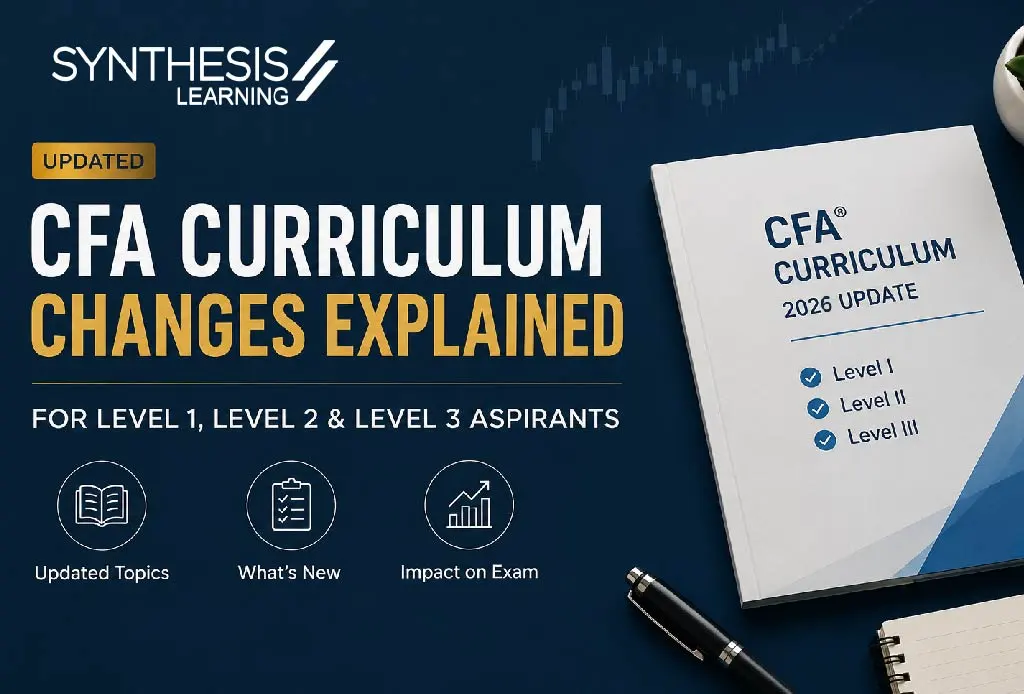
CFA Curriculum Changes Explained for Level 1, Level 2 and Level 3 Aspirants
The CFA curriculum keeps evolving because finance careers are changing.
Today, investment professionals are expected to understand valuation, portfolio decisions, ethics, data, AI, practical tools, and real-world application — not just textbook concepts.
That is why every CFA aspirant should understand the latest CFA curriculum changes before starting preparation.
The 2027 CFA curriculum updates especially focus on making Level 1 more practical and career-oriented.
In this guide, we’ll explore what has changed, how the CFA curriculum works across Levels 1, 2, and 3, and how students should prepare more effectively.
To know CFA eligibility, click here
CFA Curriculum Changes: Quick Snapshot
| Area | What Students Should Know |
|---|---|
| Level 1 Quantitative Methods | Updated with more real-world applications, simulations, Q&A, examples, and tool-based learning. |
| Level 1 Equity Investments | Updated to focus more on practical equity valuation, industry analysis, and analyst-style thinking. |
| Equation Explorer | New interactive lessons to help students understand formulas visually. |
| Ethics | Updated across all three levels with clearer module-wise structure. |
| Practical Skills Modules | Candidates must complete a practical module at each level. |
| Level 3 Pathways | Candidates can choose Portfolio Management, Private Wealth, or Private Markets. |
| Exam-style progression | Level 1 tests foundations, Level 2 tests analytical skills through vignettes, and Level 3 tests portfolio judgement through essay-style responses and item sets. |
Quick insight:
The CFA curriculum is moving from “know the concept” to “understand, apply, and explain the concept in a finance context.”
Why the CFA Curriculum Keeps Changing
CFA Institute updates the curriculum to keep the CFA Program aligned with the skills expected in modern investment and finance roles.
Finance careers now expect candidates to be comfortable with:
- Financial analysis
- Valuation
- Data interpretation
- portfolio thinking
- practical tools
- ethical judgement
- AI and technology awareness
So, CFA preparation cannot be only reading-heavy anymore.
| Old Preparation Mindset | Better Preparation Mindset |
|---|---|
| Memorise formulas | Understand relationships between variables |
| Finish readings once | Revise and apply concepts repeatedly |
| Study theory separately | Connect concepts to market situations |
| Practise only near the exam | Practise questions from the beginning |
| Treat CFA as only an exam | Treat CFA as finance skill-building |
For most CFA aspirants, the Access Scholarship is the most important one to understand because it is need-based and not limited only to students from affiliated universities.
The Student and Professor Scholarships are useful, but they apply to more specific candidate categories.
Important 2027 CFA Curriculum Updates Aspirants Should Know
The latest CFA curriculum changes are especially important for students preparing for Level 1 from 2027 onwards.
| Curriculum Area | What Has Changed | What It Means for Students |
|---|---|---|
| Quantitative Methods | More real-world applications, Q&A, knowledge checks, and targeted examples. | Quant becomes more practical and less purely formula-based. |
| Estimation and Simulation | Expanded coverage of historical simulation, bootstrapping, and Monte Carlo methods using Excel and Google Sheets. | Students need to understand practical implementation. |
| Portfolio Optimization | Expanded and aligned with the Python Fundamentals Practical Skills Module. | Students build a stronger base for Python-based optimization. |
| Financial Data Science, AI and LLMs | New reading introduced. | Students get early exposure to modern finance technology vocabulary. |
| Equation Explorers | Interactive lessons for Time Value of Money. | Helps students understand formula relationships visually. |
| Equity Investments | Updated with more practical valuation and industry-based examples. | Equity becomes more analyst-oriented. |
| Ethics | Updated across all levels, with each Standard as its own module. | Ethics becomes easier to navigate and practise. |
These changes show a clear direction: CFA preparation is becoming more application-led, tool-aware, and career-connected.
CFA Curriculum Across Level 1, Level 2 and Level 3
Each CFA level has a different purpose.
| CFA Level | Main Curriculum Focus | How It Is Tested |
|---|---|---|
| Level 1 | Finance and investment foundations | Multiple-choice questions that test concepts, formulas, and basic understanding. |
| Level 2 | Valuation, analysis, and application | Vignette-supported questions that test analytical thinking and application. |
| Level 3 | Portfolio management, wealth planning, and professional judgement | Essay-style constructed responses and item sets that test portfolio decision-making. |
This is why CFA difficulty does not increase only because the syllabus becomes larger.
The difficulty increases because the thinking required becomes deeper.
What Has Changed in the CFA Level 1 Curriculum?
The CFA Level 1 curriculum still builds the foundation for finance and investment analysis.
But the 2027 updates make Level 1 more practical, especially in Quantitative Methods and Equity Investments.
Level 1 Quantitative Methods: More Practical and Application-Led
Quantitative Methods is no longer only about formulas and calculations.
The updated curriculum gives more attention to:
| Updated Area | Why It Matters |
|---|---|
| Real-world examples | Helps students connect Quant to finance situations. |
| Knowledge checks | Improves active recall and concept testing. |
| Historical simulation | Builds practical risk and data understanding. |
| Bootstrapping | Helps students understand sampling and estimation. |
| Monte Carlo methods | Builds comfort with uncertainty and modelling. |
| Excel and Google Sheets implementation | Makes Quant more tool-based and practical. |
| Python alignment | Supports the Practical Skills Module direction. |
| AI and LLM vocabulary | Introduces modern finance technology themes. |
What this means:
Level 1 Quant is becoming less about “solve this formula” and more about “understand how this method works in a real finance setting.”
Equation Explorers: A Smarter Way to Understand Formulas
CFA Institute is also introducing Equation Explorers in the Level 1 online learning ecosystem.
These are interactive lessons connected to Time Value of Money.
Instead of only memorising formulas, students can adjust variables and see how results change through tables and graphs.
| Traditional Problem | How Equation Explorers Help |
|---|---|
| Students memorise formulas mechanically | Students understand how variables interact. |
| Time Value of Money feels abstract | Dynamic tables and graphs make it visual. |
| Formula-based learning feels passive | Guided exploration makes it active. |
This can be especially useful for students who struggle with the maths-heavy parts of CFA Level 1.
Level 1 Equity Investments: More Analyst-Oriented
The Equity Investments update is also important.
The updated curriculum includes more practical and career-ready examples across industries such as:
- Airlines
- Pharmaceuticals
- Technology
- Consumer goods
- Utilities
It also strengthens valuation learning by connecting equity valuation with financial statement forecasting.
| Equity Update | What Students Learn |
|---|---|
| Disaggregated financial models | Projecting revenue, margins, investment, and financing separately. |
| Scenario analysis | Using probability-weighted outcomes in valuation. |
| Porter’s Five Forces and PESTLE | Linking industry analysis to valuation narratives. |
| Equity research reports | Understanding initiating coverage, buy-side, sell-side, and activist short sellers. |
| CAPM and multi-factor models | Applying cost of equity concepts using market data. |
Quick insight:
Equity at Level 1 is becoming more connected to how analysts actually think, forecast, and build valuation stories.
How the CFA Level 2 Curriculum Builds Analytical Skill
The CFA Level 2 curriculum builds deeper analytical ability.
If Level 1 teaches students the language of finance, Level 2 expects them to use that language in valuation and investment analysis.
At Level 2, candidates are tested through vignette-supported questions, which means they must read a case-like situation and apply concepts analytically rather than answer direct standalone questions.
Level 2 focuses more on:
| Area | How It Is Tested |
|---|---|
| Financial analysis | Understanding company performance and reporting quality. |
| Equity valuation | Applying models to real business situations. |
| Fixed income | Analysing bond valuation and interest rate risk. |
| Derivatives | Applying pricing and risk concepts. |
| Portfolio concepts | Connecting investment tools to portfolio decisions. |
| Ethics | Applying judgement in practical scenarios. |
The updated Level 1 focus on practical Quant and Equity can help students enter Level 2 with a stronger base.
Reality check:
Level 2 is where CFA becomes less about remembering concepts and more about applying them accurately.
Why the CFA Level 3 Curriculum Is More Career-Aligned
The CFA Level 3 curriculum focuses on portfolio management, wealth planning, and investment decision-making.
At this stage, students are expected to think like professionals handling portfolios, clients, risk, constraints, and long-term financial goals.
At Level 3, the exam checks whether candidates can apply portfolio management concepts through essay-style constructed responses and item sets, where reasoning, recommendation, and decision-making become important.
A major development at Level 3 is the introduction of specialised pathways.
| Level 3 Pathway | Best Suited For Aspirants Interested In |
|---|---|
| Portfolio Management | Institutional portfolios, asset allocation, and portfolio strategy. |
| Private Wealth | Wealth planning, client advisory, and private client portfolios. |
| Private Markets | Private equity, private credit, alternatives, and private investments. |
The CFA charter remains the same. The pathway simply allows candidates to study content more aligned with their career interests.
Most aspirants miss this:
Level 3 is where finance knowledge must turn into portfolio judgement.
Ethics Updates Across All CFA Levels
Ethics remains one of the most important parts of the CFA curriculum.
The updated Ethics curriculum reflects the Standards of Practice Handbook v12.
Each Standard is now presented as its own module with targeted practice problems.
| What Changed | Why It Helps |
|---|---|
| Each Standard has its own module | Easier to navigate. |
| More targeted practice | Better exam preparation. |
| Updated guidance | Stronger alignment with current professional standards. |
| Ethics updated across all levels | Students need to take Ethics seriously throughout the CFA journey. |
Quick insight:
Ethics should not be treated as a last-minute revision topic. It is a scoring and judgement-building area across all three levels.
How These CFA Curriculum Changes Affect Preparation Strategy
The updated CFA curriculum clearly rewards active learning.
Students preparing for CFA should now focus on:
| Curriculum Reality | Better Preparation Strategy |
|---|---|
| Quant is more practical | Learn methods through examples and tools. |
| Equity is more analyst-oriented | Practise valuation logic, not just formulas. |
| Level 2 uses vignette-supported questions | Practise case-style item sets early and learn to extract relevant data quickly. |
| Level 3 uses essay-style constructed responses and item sets | Practise concise written answers, recommendations, and portfolio reasoning. |
| Ethics is module-wise | Revise Standards consistently. |
| Practical Skills Modules are required | Plan them early instead of leaving them for the end. |
| Level 3 has pathways | Choose based on career interest. |
| CFA is application-heavy | Practise questions throughout preparation. |
Students preparing through CFA classes in Mumbai, live online CFA coaching, or self-paced learning should check whether their preparation includes:
- Structured study planning
- Faculty-led concept clarity
- Question practice
- Mock exams
- Doubt-solving
- Revision support
- Exam strategy
Best Preparation Strategy for Completing the CFA Curriculum
The CFA curriculum is manageable when preparation is structured.
| Preparation Area | What Students Should Do |
|---|---|
| Concept learning | Understand why a method works. |
| Question practice | Practise regularly from the beginning. |
| Revision | Revisit difficult areas multiple times. |
| Mocks | Use mocks to test readiness. |
| Ethics | Revise across the preparation period. |
| Practical Skills Module | Complete it before result requirements become stressful. |
| Weak area tracking | Maintain a list of topics that need repeated work. |
Avoid this mistake:
Completing the CFA curriculum once does not mean you are exam-ready.
Students need practice, revision, mocks, and correction cycles before the exam.
How Synthesis Learning Helps CFA Aspirants Prepare Better
CFA aspirants often need more than syllabus access.
They need structure, mentoring, and exam-focused guidance.
Synthesis Learning supports CFA students through:
- Structured CFA preparation
- Expert faculty guidance
- Concept-focused teaching
- Question practice and mock support
- Mentorship for study planning
- Live online and classroom learning options
- Career-oriented guidance for finance aspirants
For students searching for a CFA course in Mumbai, CFA coaching in Mumbai, CFA Level 1 classes in Mumbai, or a CFA training institute in Mumbai, Synthesis Learning helps create a preparation path that is realistic, consistent, and aligned with exam expectations.
The focus is not just on completing the CFA curriculum. It is on helping students understand it, practise it, and apply it with confidence.
Final Thoughts
The latest CFA curriculum changes show a clear direction.
CFA preparation is becoming more practical, more specialised, and more connected to real finance careers.
Level 1 is becoming more application-led through updated Quantitative Methods, Equity Investments, Equation Explorers, and AI-related exposure.
Level 2 builds analytical skill through vignette-supported questions.
Level 3 builds portfolio judgement through essay-style constructed responses, item sets, and specialised pathways.
Students should not prepare for CFA only by asking:
“How much syllabus is left?”
They should also ask:
- Can I apply what I studied?
- Am I practising enough?
- Have I planned my Practical Skills Module?
- Do I understand the updated Level 1 focus?
- Do I know how each level builds my financial skills?
The CFA journey becomes clearer when students understand the purpose behind the curriculum, not just the list of subjects.
FAQs on CFA Curriculum Changes
1. What is the CFA curriculum?
The CFA curriculum is the official syllabus for the CFA Program. It covers finance, investment analysis, ethics, valuation, portfolio management, and professional skills across three levels.
2. What are the major CFA curriculum changes for 2027?
The major 2027 CFA curriculum changes include updates to Level 1 Quantitative Methods, Level 1 Equity Investments, Equation Explorers, and Ethics across all three levels.
3. What changed in CFA Level 1 Quantitative Methods?
Level 1 Quantitative Methods now includes more real-world applications, knowledge checks, examples, simulation methods, Excel and Google Sheets implementation, Python alignment, and exposure to AI and large language models.
4. What are Equation Explorers in CFA Level 1?
Equation Explorers are interactive lessons in the Level 1 online learning ecosystem. They help students understand formula relationships through dynamic tables, graphs, and guided exploration.
5. What changed in the CFA Level 1 Equity curriculum?
Level 1 Equity has become more practical and analyst-oriented. It now includes stronger links to financial statement forecasting, scenario analysis, industry analysis, equity research reports, and cost of equity estimation.
6. Has CFA Ethics changed?
Yes. Ethics has been updated across all CFA levels to reflect the Standards of Practice Handbook v12. Each Standard is now presented as its own module with targeted practice problems.
7. What does the CFA Level 2 curriculum focus on?
The CFA Level 2 curriculum focuses on deeper valuation, financial analysis, asset classes, and application-based problem solving through vignette-supported questions.
8. What does the CFA Level 3 curriculum focus on?
The CFA Level 3 curriculum focuses on portfolio management, wealth planning, investment decisions, essay-style constructed responses, item sets, and specialised pathways.
9. Are Practical Skills Modules compulsory in CFA?
Yes. Candidates need to complete a Practical Skills Module at each level to receive their exam result.
10. Where can I join CFA classes in Mumbai?
Students looking for CFA classes in Mumbai can consider Synthesis Learning for structured CFA preparation, expert guidance, mocks, and study planning support.
11. How should I prepare for the updated CFA curriculum?
Focus on concept clarity, application-based question practice, mock exams, Ethics revision, practical tools, and completing your Practical Skills Module on time.