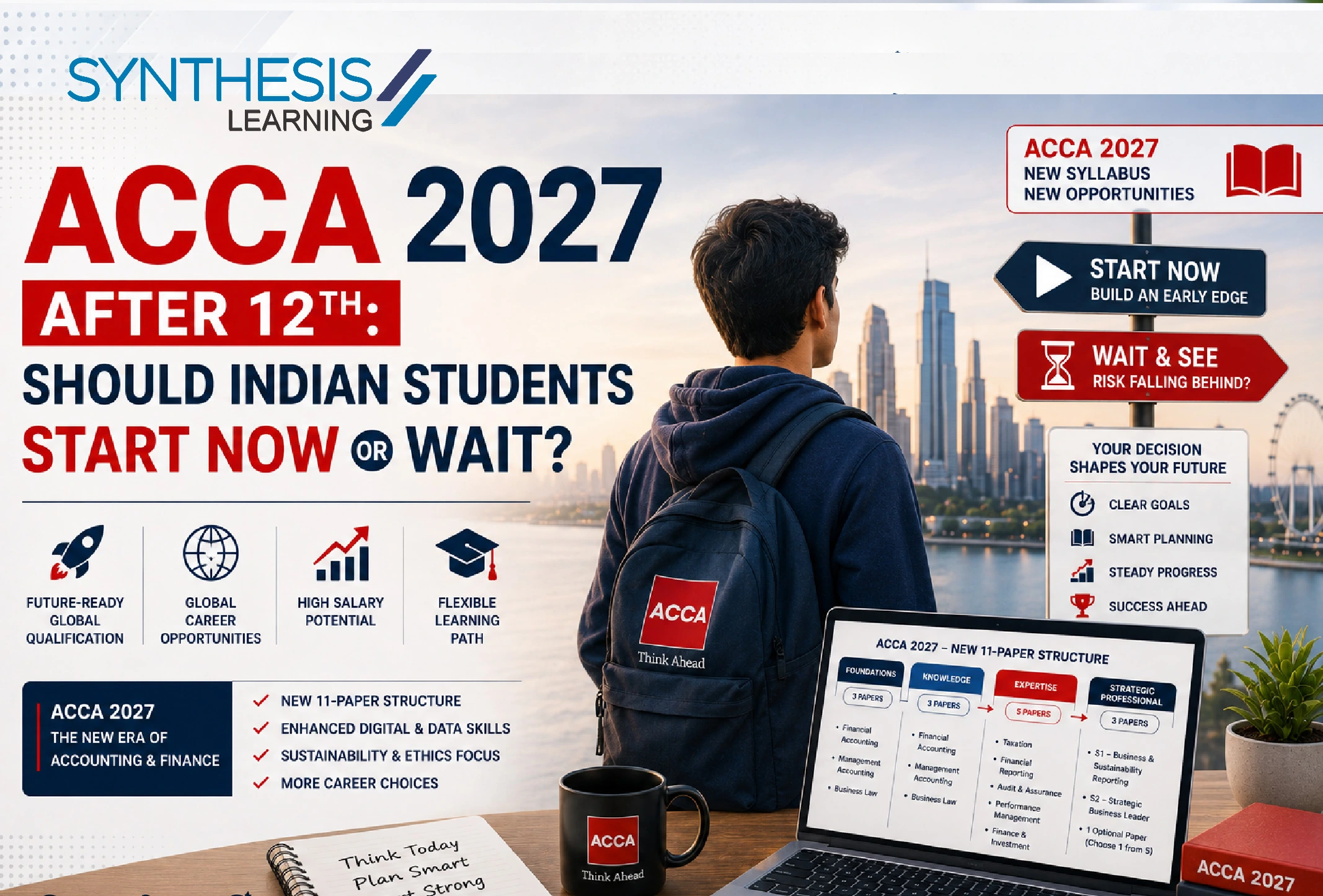
The Association of Chartered Certified Accountants (ACCA) qualification stands as one of the most respected credentials in global finance and accounting. Recognised in over 180 countries and held by more than 250,000+ members worldwide, ACCA opens doors to senior positions in multinational corporations, Big Four accounting firms, and entrepreneurial ventures.
This comprehensive guide provides everything you need to navigate the registration process, understand the complete fee structure, and strategically plan your examination schedule for 2025-2026. Starting correctly is not merely advisable—it is fundamental to your success in this rigorous yet rewarding qualification journey.
Who Can Pursue ACCA?
ACCA’s inclusive framework accommodates candidates from remarkably diverse educational and professional backgrounds. Whether you have just completed secondary education, hold an undergraduate degree, or possess professional qualifications such as CA Inter, ACCA provides tailored entry points that acknowledge your existing knowledge through exemptions. This flexibility ensures that the qualification remains accessible whilst maintaining its rigorous standards.
| Candidate Profile | Eligibility/Entry Point | Key Advantage |
| 10th Grade Completers | FIA pathway: complete Diploma in Accounting & Business first | Structured foundation building from an early stage |
| 12th Grade Completers | Direct entry after 12th requires 65% in Accounts/Maths, English; 50% others. | Begin professional qualification immediately after school |
| Undergraduates (any discipline) | Direct registration; exemptions possible based on degree modules | Simultaneous pursuit of degree and professional qualification |
| Commerce Graduates | Register directly; claim up to 9 exemptions depending on university accreditation | Significant time and cost savings on foundational papers |
| CA Inter Qualified | Eligible for substantial exemptions (typically 5-9 papers) | Leverage existing accounting knowledge effectively |
| Qualified Chartered Accountants | Can claim maximum exemptions and fast-track to strategic level | Accelerated pathway to global credential |
| Working Professionals & Entrepreneurs | No restrictions; flexible study options accommodate work commitments | Career advancement without employment disruption |
Before proceeding with registration, candidates must utilise the official ACCA Exemptions Calculator available on the ACCA website. This critical step ensures you claim all eligible exemptions based on your specific educational credentials, potentially saving thousands in examination fees whilst reducing the overall duration of your qualification journey.
How to Do ACCA in India: Your Complete Pathway
Indian students and professionals possess excellent opportunities to pursue ACCA without leaving the country. The qualification enjoys strong recognition among multinational corporations, Big Four firms, and financial institutions operating in India. Understanding the India-specific pathway ensures you maximise the benefits of this global credential whilst navigating local educational and professional contexts.
Indian Education System Alignment:
- Students completing Class 12th with the commerce stream typically meet direct entry requirements
- Commerce graduates from recognised Indian universities can claim substantial exemptions (up to 9 papers)
- CA Foundation, CA Inter, and CA qualified professionals receive progressively higher exemptions
- Engineering and other non-commerce graduates can register but start from Applied Knowledge level
Study Options in India:
- Numerous ACCA Approved Learning Partners operate across major cities, including Mumbai, Delhi, Bangalore, Hyderabad, and Chennai
- Classroom, live online, and self-paced study modes accommodate different learning preferences and geographical constraints
- Computer-based examination centres available in metropolitan and tier-2 cities for Applied Knowledge papers
- Strategic Professional examinations are conducted quarterly at designated centres in major cities
Career Prospects Post-ACCA:
- Strong demand in multinational corporations establishing shared services centres in India
- Preferred qualification for finance roles in technology companies, consulting firms, and investment banks
- Facilitates international career mobility for professionals seeking opportunities in the Middle East, Singapore, UK, and other markets
- Complements CA qualification for those seeking dual credentials and enhanced career prospects
The ACCA registration fee structure remains identical for Indian candidates, with payments processed in GBP through international payment methods. Many learning partners in India offer guidance throughout the registration process and may negotiate instalment facilities or bundled packages that ease the financial commitment.
Pre-Registration Checklist: Documents You Need
Thorough preparation of documentation streamlines the ACCA course registration process considerably. Having high-quality digital scans of all documents readily accessible eliminates frustrating interruptions during the application process and prevents delays in verification that could postpone your examination scheduling.
Essential Documents Required for ACCA Course Registration:
- Valid proof of identity (passport or national ID card)
- Complete educational certificates, including transcripts showing individual subject marks
- Professional certificates if claiming exemptions based on qualifications like CA Inter or other accounting credentials
- Recent passport-sized photograph in digital format (JPEG or PNG)
- Reliable payment method such as an international credit or debit card
How to Apply for ACCA: The Complete Process For ACCA Registration Online
Understanding how to apply for ACCA requires careful attention to the sequential steps that ensure your application proceeds smoothly. The ACCA registration online process is accessible from anywhere globally, though attention to detail proves essential for avoiding delays or complications.
Initial Preparation Phase:
Before beginning your formal application, spend time on the ACCA website familiarising yourself with the qualification structure, exemptions you might be eligible for, and the current ACCA registration fee schedule. Create a dedicated folder on your computer or cloud storage containing all required documents in high-resolution digital format. Ensure your payment method has sufficient international transaction capability and that you have noted any applicable service charges your bank might levy.
Account Creation and Profile Building:
Navigate to the official ACCA website and locate the registration portal clearly marked for new students. The account creation process requires basic personal information including your full legal name (exactly as it appears on identity documents), date of birth, contact details, and chosen password. ACCA sends a verification email to confirm your address—complete this step before proceeding further. Once verified, log into your newly created account and begin completing your student profile, which captures more detailed information about your educational background and professional experience if applicable.
Application Form Completion:
The comprehensive application form represents the core of your registration. Work through each section methodically, providing accurate information about your secondary education, undergraduate or postgraduate degrees, and any professional qualifications. This information determines your eligibility and potential exemptions, so accuracy proves absolutely critical. The form also captures your preferred examination centre location and contact preferences for ACCA communications.
Document Upload and Verification:
The system prompts you to upload supporting documents for each educational or professional qualification you have declared. Ensure files meet the specified format requirements (typically PDF or JPEG) and size limitations. Poor quality scans or images may result in rejection and processing delays. If claiming exemptions based on professional qualifications like CA Inter, ensure you upload both the certificate and detailed mark sheets showing individual subject performance.
Exemptions Claiming Process:
After uploading relevant documents, access the exemptions section where you formally claim papers you wish to skip based on your prior learning. The exemptions calculator provides guidance, but you must actively select each exemption you wish to claim. Remember that each exemption beyond the automatic ones carries the ACCA registration fee component specific to exemptions (£86 or £114 per paper depending on level). Review your selections carefully—incorrectly claimed exemptions require formal amendment processes involving additional fees.
Review and Payment:
Before proceeding to payment, the system presents a comprehensive summary of your application including personal details, educational information, claimed exemptions, and the total fee payable. Scrutinise every detail—corrections after payment involve administrative processes and potential fees. The initial payment includes your registration fee (£89) plus any exemption fees for papers you have claimed. Proceed to the secure payment gateway and complete the transaction using your international credit or debit card.
Post-Payment Confirmation:
Upon successful payment, ACCA sends an immediate automated confirmation email acknowledging receipt of your application. This does not constitute approval—your documents now enter the verification queue where ACCA staff review them for authenticity and eligibility determination. Processing typically requires 5-10 working days, though peak periods may extend this timeline. Once approved, you receive your unique ACCA student registration number via email, marking the formal commencement of your ACCA journey.
The Step-by-Step Online Registration Process
The ACCA course exam registration journey follows a logical sequence designed to capture essential information whilst verifying your credentials.
Connecting with an ACCA Approved Learning Partner can simplify the acca course registration process. These institutions assist with documentation, exemptions queries, and may also offer discounts or bundled packages.
Complete Registration Steps:
Create an Account –
Navigate to the official ACCA website and establish secure login credentials by providing basic personal details
Complete the Application Form –
Fill in comprehensive information about your educational background, professional experience, and contact details with meticulous accuracy
Upload Supporting Documents –
Submit all required documents in specified formats, ensuring clarity and legibility of scanned certificates
Claim Exemptions –
Utilise the exemptions calculator results to formally claim any eligible papers, reviewing each exemption carefully before submission
Review and Pay –
Examine your entire application thoroughly before proceeding to pay the initial ACCA registration fee using your prepared payment method
Receive Confirmation –
Obtain your unique ACCA student registration number via email, which serves as your identifier throughout the qualification journey
ACCA Course Registration Fee: Complete 2025-2026 Breakdown
Understanding the complete financial commitment enables effective budgeting and prevents unwelcome surprises. The ACCA registration fee structure comprises several components that candidates must account for throughout their qualification journey. Always verify fees on the official ACCA Global website, as they are subject to annual revision and may vary based on geographical location and currency fluctuations.
ACCA Exams Registration and Subscription Fees:
- Initial registration fee: £89 (one-time payment when joining ACCA)
- Re-registration fee: £89 (applicable if resuming after a break)
- Annual subscription fee from January 2026: £140 (mandatory regardless of examination activity)
Examination Fees (March 2026 Session):Other Mandatory Costs:
| Examination Level | Paper | Standard Entry Fee | Late Entry Fee |
| Applied Knowledge | BT (Business and Technology) | £99 | £131 |
| Applied Knowledge | MA (Management Accounting) | £99 | £131 |
| Applied Knowledge | FA (Financial Accounting) | £99 | £131 |
| Applied Skills | LW (Corporate and Business Law) | £129 | £181 |
| Applied Skills | PM (Performance Management) | £129 | £181 |
| Applied Skills | TX (Taxation) | £129 | £181 |
| Applied Skills | FR (Financial Reporting) | £129 | £181 |
| Applied Skills | AA (Audit and Assurance) | £129 | £181 |
| Applied Skills | FM (Financial Management) | £129 | £181 |
| Strategic Professional | SBL (Strategic Business Leader) | £257 | £333 |
| Strategic Professional | SBR (Strategic Business Reporting) | £257 | £333 |
| Strategic Professional | AFM (Advanced Financial Management) | £257 | £333 |
| Strategic Professional | APM (Advanced Performance Management) | £257 | £333 |
| Strategic Professional | ATX (Advanced Taxation) | £257 | £333 |
| Strategic Professional | AAA (Advanced Audit and Assurance) | £257 | £333 |
- Applied Knowledge exemption fee: £86 per paper
- Applied Skills exemption fee: £114 per paper
- Ethics and Professional Skills Module (EPSM): £81 (mandatory online module before membership)
Early ACCA exams registration at standard rates rather than late entry rates represents a saving of £32-£76 per paper—a substantial amount when multiplied across multiple examinations. The total ACCA registration fee investment depends significantly on your exemptions profile and how efficiently you progress through examinations.
ACCA Registration Last Date: Understanding Critical Deadlines
Unlike many professional qualifications with fixed annual registration windows, ACCA operates continuous registration throughout the year—there is no absolute ACCA registration last date that closes enrolment permanently. However, strategic timing of your registration relative to examination sessions proves crucial for optimal progression and cost management.
Registration Timing Considerations:
Students planning to commence their ACCA journey should ideally complete registration at least 8-10 weeks before their intended first examination session. This buffer accommodates the 5-10 working day processing period for registration approval, provides adequate preparation time once you receive study materials, and ensures you book examinations during the standard entry period rather than the more expensive late entry window. Rushing registration immediately before examination booking deadlines creates unnecessary stress and may compromise your preparation quality.
Session-Specific Booking Deadlines:
Whilst registration itself remains open continuously, each examination session enforces strict booking deadlines that function as practical “last dates” for entering that particular sitting. Missing these deadlines means waiting an additional three months for the next available session, potentially delaying your entire qualification timeline by a quarter. The consequences extend beyond mere delay—maintaining your annual subscription without sitting examinations represents poor financial efficiency.
Standard vs Late Entry Implications:
ACCA operates a two-tier booking system designed to encourage early commitment and planning. Standard entry deadlines typically close approximately 10-11 weeks before the examination period, offering lower fees that reward proactive candidates. Late entry deadlines close approximately 6-7 weeks before examinations, charging premium fees (approximately 30-40% higher) for the administrative accommodation of last-minute registrations. There is no entry possible after the late deadline—missing it entirely means automatic deferral to the next session.
Applied Knowledge Flexibility:
Computer-based Applied Knowledge examinations offer significantly more flexibility than the quarterly Applied Skills and Strategic Professional papers. These can be booked and taken at authorised centres with just a few weeks’ notice, operating on a continuous schedule rather than fixed sessions. This flexibility means the concept of an ACCA registration last date holds less urgency for candidates beginning at the Applied Knowledge level, though efficient progression still requires disciplined planning.
Key Exam Dates & Planning Your Schedule (2025-2026)
Strategic planning of your examination schedule balances preparation time with progression momentum. Missing standard entry deadlines incurs unnecessary financial penalties whilst inadequate preparation time jeopardises examination success. Applied Knowledge papers are available on-demand throughout the year at computer-based testing centres, offering greater flexibility for these foundational examinations.
| Exam Session | Standard Entry Deadline | Late Entry Deadline | Examination Period | Withdrawal Deadline |
| September 2025 | 31st July 2025 | 14th August 2025 | 2nd – 6th September 2025 | 21st August 2025 |
| December 2025 | 28th October 2025 | 11th November 2025 | 2nd – 6th December 2025 | 18th November 2025 |
| March 2026 | 27th January 2026 | 10th February 2026 | 2nd – 6th March 2026 | 17th February 2026 |
| June 2026 | 28th April 2026 | 12th May 2026 | 1st – 5th June 2026 | 19th May 2026 |
Important Scheduling Considerations:
Understanding the complete examination cycle enables smarter planning decisions. After each session’s standard entry deadline passes, candidates have an additional two-week window to register during the late entry period, though at significantly inflated costs. Beyond the late entry deadline, the withdrawal deadline becomes relevant—this represents the final date by which candidates can withdraw from a booked examination and receive a partial refund (typically 50% of the examination fee). After the withdrawal deadline, no refunds are available regardless of attendance.
Deferral and Absence Policies:
ACCA does not offer examination deferrals in the traditional sense—if you cannot attend a booked examination, your only option is to withdraw before the withdrawal deadline for partial fee recovery. Simply not attending results in complete forfeiture of fees paid and registers as an absence rather than a fail on your record. Some candidates mistakenly believe that special circumstances allow deferral, but ACCA’s policy remains firm: withdrawal with partial refund before the deadline, or complete loss of fees after.
Strategic Examination Booking:
Candidates should register ACCA exam sessions immediately upon feeling adequately prepared rather than waiting until deadlines approach, as this provides psychological commitment and focuses preparation efforts. Creating a realistic study calendar that accounts for professional commitments, personal circumstances, and the genuine difficulty of each paper prevents overambitious scheduling that leads to examination failures and demoralisation. Most successful candidates book 2-3 papers per session, allowing adequate depth of preparation rather than superficial coverage of 4+ papers simultaneously.
How to Register ACCA Exam: Booking Your Examinations
Once you have completed your initial student registration and received your ACCA number, the process to register ACCA exam bookings for specific sessions becomes straightforward through your myACCA portal. Understanding this distinct process prevents confusion—student registration is separate from examination booking, and mastering both ensures smooth progression.
Accessing the Examination Booking System:
Log into your myACCA account using your registration credentials. Navigate to the “Exams” section clearly visible in the main menu. The system displays your current examination status, showing which papers you are eligible to attempt based on progression rules (you must complete Applied Knowledge before Applied Skills, and Applied Skills before Strategic Professional). The available examination sessions appear with their respective booking deadlines prominently displayed.
Selecting Your Examinations:
Choose the session you wish to target—September, December, March, or June—and click through to view available papers. The system only displays papers you are currently eligible to attempt based on your progression status and any exemptions. Select your chosen examinations carefully, considering your preparation timeline and the syllabus content for each paper. You can book multiple papers within a single session, though realistic assessment of your study capacity proves crucial.
Choosing Examination Centres:
ACCA operates examination centres globally, allowing candidates to sit examinations in locations convenient to their circumstances. The system displays available centres within your selected country or region. For Applied Skills and Strategic Professional papers held during the quarterly sessions, centre capacity is finite—popular locations in major cities may fill quickly during peak demand. Booking early ensures your preferred centre remains available. Applied Knowledge computer-based examinations offer more flexibility with numerous permanent centres operating year-round.
Payment and Confirmation:
After selecting your papers and preferred centre, the system calculates your total examination fees based on whether you are booking during the standard or late entry period. Review the summary carefully before proceeding to payment. Once payment processes successfully, you receive immediate email confirmation of your booking including your examination timetable. This timetable specifies the exact date and time you must report to the examination centre for each paper. Download and save this document securely—you will need to present it alongside identification on examination day.
Post-Booking Modifications:
Should your circumstances change after booking, you have limited options. Before the withdrawal deadline, you can cancel your examination booking and receive 50% refund of the examination fee. No refunds apply after this deadline regardless of reason. ACCA does not accommodate requests to change examination centres after booking, so ensure your centre selection accounts for any potential travel or logistical considerations. If you need to change which papers you are sitting, you must withdraw from originally booked papers (subject to deadlines) and book alternative papers as separate transactions.
How Can the Right Learning Partner Transform Your ACCA Journey?
After completing registration formalities, candidates face a critical strategic decision: how to approach their examination preparation. Whilst self-study using ACCA-approved textbooks remains theoretically possible, statistics consistently demonstrate that candidates enrolled with ACCA Approved Learning Partners achieve significantly higher pass rates, particularly in the challenging Strategic Professional papers where global pass rates often hover around 30-40 per cent.
Advantages of Structured Learning Environments:
- Expert instructors with recent examination experience decode complex technical content and examination techniques
- Regular attendance creates disciplined study habits that self-directed learners struggle to maintain
- Peer communities offer motivation during difficult preparation periods and networking opportunities
- Access to extensive question banks, mock examinations, and personalised feedback identifies weaknesses early
- Placement assistance supports candidates in securing relevant practical experience
At Synthesis Learning, we’ve been building next-gen professionals for the new business & finance world for 25+ years. Unlike others, our students don’t just study—they get first preference for internships & jobs at our in-house ACCA Approved Employer – InCorp Advisory (Ascentium Group).
How Synthesis Learning Supports Your ACCA Ambition from Start to Finish
Synthesis Learning exemplifies the comprehensive support model that transforms ACCA aspirants into confident, competent professionals. Their involvement begins even before registration, with experienced counsellors guiding candidates through eligibility assessment, exemptions claiming, and documentation preparation.
Four Integrated Support Pillars:
- Counselling Services – Ongoing academic guidance for subject selection, examination scheduling, and career pathway decisions
- Coaching Delivery – Technical knowledge through experienced faculty who blend conceptual clarity with practical application
- Mentoring Connections – Links with qualified ACCA members and senior finance professionals for real-world perspectives
- Placement Assistance – Active support in securing relevant practical experience that fulfils the PER requirement
This multi-modal delivery system ensures that regardless of personal circumstances, geographical location, or learning preferences, quality preparation remains accessible. The recorded lecture libraries allow students to revisit complex topics multiple times, whilst regular assessments and progress tracking ensure accountability that independent study lacks.
What Happens After Registration? Your Roadmap
Upon receiving your ACCA student registration number, immediate access to myACCA portal becomes available. This personalised dashboard serves as your command centre throughout the qualification journey. Financial planning continues beyond initial registration, and setting up payment reminders prevents the unfortunate situation of losing examination bookings due to missed payment deadlines.
Immediate Post-Registration Actions:
- Familiarise yourself with myACCA portal navigation and update profile information
- Review your exemptions status if applicable and verify accuracy
- Identify your starting examination point based on exemptions or entry level
- Budget for annual subscription fees, upcoming examination fees, and outstanding exemption fees
- Book your first examination once you have prepared adequately
Complete ACCA Qualification Structure:
- Applied Knowledge – 3 papers covering business fundamentals
- Applied Skills – 6 papers addressing core accounting competencies
- Strategic Professional – 4 papers including 2 mandatory essentials and 2 optional specialisation papers
- Ethics and Professional Skills Module – Online interactive course addressing professional dilemmas (after Applied Skills)
- Practical Experience Requirement – 3 years of relevant employment demonstrating development across 9 performance objectives
This experience must demonstrate development across technical, professional, and business skills—merely completing three years of employment is insufficient without documented evidence of skill development across nine specific performance objectives.
Important Tips to Avoid Common Pitfalls
Several frequently encountered mistakes unnecessarily complicate the ACCA journey. The ACCA Global website remains the sole authoritative source for accurate, current information regarding all aspects of registration, fees, and examination regulations.
Critical Reminders:
- Exemptions are never automatically applied you must actively claim them during registration or through subsequent formal application
- Allowing your annual subscription to lapse results in suspension of myACCA access and inability to book examinations
- Procrastinating on examination booking until late entry periods inflates costs by approximately 25-30 percent per paper
- Relying on unofficial websites, forums, or secondhand information frequently leads to costly misunderstandings
- Missing the withdrawal deadline means complete loss of examination fees if you cannot attend
- Not updating your contact details can result in missing critical communications from ACCA
Take the next confident step towards ACCA success
The path to ACCA membership is demanding yet clearly structured. When you understand eligibility, organise documentation, review the full fee framework, and plan examinations strategically, uncertainty reduces and confidence grows. The initial investment is meaningful, but the long-term career mobility and earning potential are far greater. Your action plan: verify eligibility and exemptions, prepare clear digital documents, budget using current fees, track exam deadlines, evaluate ACCA Approved Learning Partners, complete online registration, and book exams only after setting a realistic study timeline. ACCA membership places you among globally trusted professionals, opening opportunities across industries and borders. Start your application today with clarity and purpose.
FAQs
1. How do I apply to be an ACCA student?
You can apply online at any time of the year through the ACCA website. Online registration allows you to upload documents, speeding up processing and confirming your entry level sooner. Ensure all supporting documents are submitted at the time of application to avoid delays.
2. What are the entry requirements for the ACCA Qualification?
You need a minimum of two A-Levels and three GCSEs or equivalent, across five subjects including English and maths. If you are unsure, you should check your qualifications against the ACCA minimum entrance requirements database.
3. What are the entry requirements for the Foundation-level?
There are no minimum entry requirements for Foundation-level qualifications. However, ACCA recommends starting with the Diploma in Financial and Management Accounting (RQF Level 2) if you have no formal qualifications, as this improves performance at higher levels.
4. What documents do I need to register as a student?
You must submit educational certificates and transcripts, valid proof of identity, and official name-change documents if applicable. Non-English documents require certified translations. All documents can be uploaded during the online application, along with payment of the registration fee.
5. How long does it take to register as a student?
The online application takes around 10 minutes if the documents are ready. Full online applications are usually processed within 5–7 working days, while applications requiring emailed documents may take up to 10 working days.
6. What fees are payable?
You must pay an initial registration fee and an annual subscription fee in your first year. Exam entry fees are tiered based on booking time, and exemptions carry additional charges. Tuition fees are separate and paid directly to learning providers.
7. Can I submit my registration form and pay at a later date?
No, your application cannot be completed without payment. You will not be able to book exams or tuition until your registration is officially confirmed.
8. What exemptions can I apply for?
Exemptions depend on your existing qualifications and are assessed during your application. You can estimate likely exemptions using the ACCA Exemptions Calculator, but exemptions are only confirmed after document verification.
9. How to register for ACCA?
Start by creating an account on the official ACCA website and completing the online registration form. Upload your academic documents, select your qualification route, and pay the registration fee. Once approved, you can book your ACCA exams and begin your preparation.