The Chartered Financial Analyst or CFA designation is widely considered the gold standard in the global finance and investment industry. It is particularly valued for its depth, ethical focus, and real-world application of financial concepts. Students and professionals in India often look for clear answers around CFA course duration, CFA duration in India, and whether it is possible to pursue CFA after 12th. This guide addresses those questions in detail while helping aspirants understand how the CFA fits into long-term career planning, especially in financial hubs such as Mumbai.
What is the CFA Program? Understanding the Global Gold Standard
The CFA Program is a professional qualification awarded by the CFA Institute, a globally recognised body that sets ethical and professional standards for investment professionals. The curriculum focuses on investment analysis, portfolio management, financial reporting, and ethical decision-making. With recognition in more than 162 countries, the CFA charter holds consistent value across global financial markets. Employers often regard it as one of the best credentials for roles involving long-term investment responsibility.
What sets the CFA apart is its emphasis on both technical knowledge and ethical conduct. Candidates are tested not only on what they know, but also on how responsibly they apply that knowledge. This balance makes the program highly relevant for real-world finance roles.
Why the CFA Program is globally respected
- Recognised across more than 162 countries
- Strong focus on ethics and professional standards
- Curriculum aligned with investment industry needs
- Highly valued by employers in India and abroad
Breaking Down the CFA Course Duration and Time Commitment
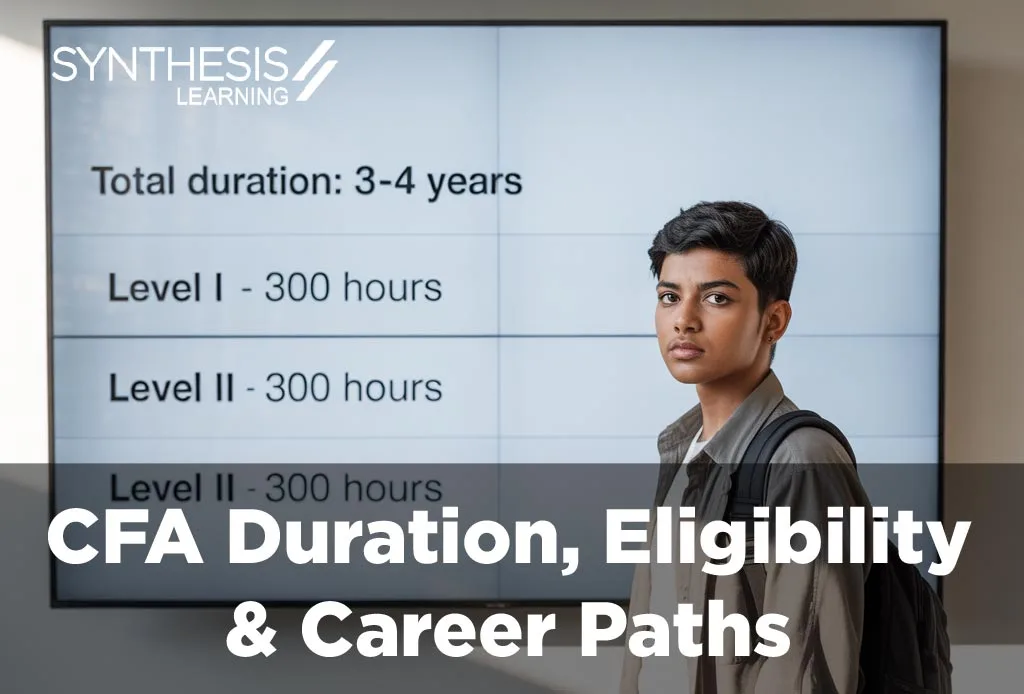
The CFA Program typically takes between three and four years to complete for most candidates. The CFA course duration includes exam preparation, exam scheduling, and the mandatory gaps required between attempts. While it is possible to complete the program faster, doing so requires careful planning and consistent performance at each level. For most students and working professionals, a steady pace leads to better understanding and long-term success.
The overall CFA course duration also depends on personal factors such as academic workload or professional commitments. Candidates who understand this timeline early are better prepared to balance studies with other responsibilities.
Factors that influence total CFA duration
- Weekly study time availability
- Success on first exam attempts
- College or work schedules
- Choice of exam windows
Average completion timelines
Completion style | Typical duration |
| Fast-track approach | Around 2.5 years |
| Most candidates | 3 to 4 years |
| Flexible or retake path | 4 years or more |
Understanding the CFA Time Duration for Each Level
Each CFA level requires a substantial time investment, with candidates spending more than 300 hours on average per level. The syllabus becomes progressively more analytical, moving from foundational concepts to advanced portfolio decision-making. Exams are conducted multiple times a year, offering flexibility in scheduling. However, mandatory waiting periods ensure that candidates prepare thoroughly before advancing.
Understanding the time commitment at each level helps candidates distribute their effort evenly. This reduces stress and improves concept retention.
Study expectations across levels
- Level I builds strong foundations in finance and accounting
- Level II focuses on application and valuation techniques
- Level III emphasises portfolio management and real-world judgement
Level-wise time structure
CFA Level | Average study time | Exam availability |
| Level I | 300+ hours | Feb, May, Aug, Nov |
| Level II | 300+ hours | May, Aug, Nov |
| Level III | 300+ hours | Feb, Aug |
Can We do CFA After 12th?
Many students in India start exploring the CFA Program immediately after completing 12th grade. While the exams cannot be attempted right away, early awareness offers a clear advantage. The CFA Institute requires candidates to be close to completing an undergraduate degree before registering for the exams. This makes planning undergraduate education a crucial first step.
Students who align their academic path with CFA subjects often find the syllabus more manageable later. Early planning also spreads preparation over time instead of creating last-minute pressure.
Why planning after 12th matters
- Better alignment between college studies and CFA topics
- Reduced academic overload in later years
- More time for concept clarity
- Smoother transition into Level I preparation
Answering: Can I Do CFA After 12th?
Yes, but only with a structured and realistic plan. You cannot directly appear for CFA exams immediately after 12th unless you meet the eligibility requirements. Most candidates begin their CFA journey during college, once they are approaching completion of their undergraduate degree. This approach allows students to balance academic learning with CFA preparation more effectively.
Starting without a plan often leads to time management challenges. A structured approach improves consistency and confidence.
Essential CFA Course Details After 12th
Choosing the right undergraduate degree plays a key role in preparing for the CFA Program. Degrees such as B.Com, BBA, or economics-based programs complement CFA subjects well. Many students register for CFA Level I during their second or third year of college. This timing allows academic knowledge to reinforce CFA concepts naturally.
Recommended undergraduate pathways
- B.Com or B.Com Honours
- BBA with a finance focus
- Bachelor’s degree in economics or finance
Suggested academic timeline
Stage | Recommended focus |
| After 12th | Select a finance-aligned degree |
| First year of college | Build accounting and economics basics |
| Second or third year | Register and prepare for CFA Level I |
The CFA Course Duration in India:
The CFA duration in India remains the same as in other countries because the program follows a global structure. However, Indian candidates benefit from multiple exam centres across major cities and easier access to coaching support.
Fees are paid in INR, which helps candidates plan financially. Time management becomes particularly important due to academic and professional commitments.
Indian candidates often balance CFA studies alongside college or full-time work. A realistic schedule and disciplined preparation help maintain consistency throughout the journey.
India-specific advantages
- Exam centres in major cities
- Fee payments in INR
- Growing access to experienced coaching providers
- Increasing employer demand for CFA professionals
CFA Course Duration in India and Career Outcomes
The time invested in the CFA Program often leads to strong long-term career outcomes. CFA charterholders in India are employed by investment banks, asset management firms, consulting organisations, and global financial institutions.
Mumbai stands out as a key destination for finance aspirants due to its exposure to international markets and top employers. It also offers strong career opportunities after completing the CFA course duration in India. The structured duration of the program aligns well with steady career progression rather than short-term job changes.
Common career paths after CFA
- Equity research and analysis
- Portfolio and fund management
- Investment banking and consulting
- Risk management and wealth advisory
Beyond CFA: Exploring Related Finance Certifications
While the CFA Program focuses on investment management, other certifications cater to different finance career goals. The US CMA Course is suitable for professionals interested in management accounting, corporate finance, and strategic decision-making. The ACCA Course is ideal for those aiming for global roles in accounting, audit, and compliance. These certifications can either complement the CFA or serve as alternative pathways based on individual aspirations.
Understanding these options helps candidates make informed choices rather than following trends.
Popular finance certification options
- CFA for investment and portfolio management
- US CMA for corporate finance and cost management
- ACCA for accounting and audit careers
How to Prepare: Choosing the Right Coaching Partner
Preparing for the CFA requires consistency, structure, and expert guidance. Self-study alone can become challenging due to syllabus depth and exam pressure. A strong coaching partner provides clarity, structured study plans, and exam-focused practice. Choosing the right institute directly impacts preparation efficiency and confidence.
This is where a trusted partner like Synthesis Learning can meaningfully support CFA aspirants.
Accelerate Your CFA Success with Synthesis Learning
Navigating the CFA course duration and extensive syllabus requires strategic guidance. For over 22 years, Synthesis Learning has supported more than 20,000 students across 25+ Indian cities such as Mumbai and over 10 countries. Their approach focuses on reducing effective preparation time while maintaining conceptual clarity.
Complete Support
Get expert coaching at every stage of your learning journey. The programme also includes 100 percent job assistance.
Flexible Learning
Opt for classroom-based sessions or attend live online classes. Both formats are designed to fit varied schedules.
Exam Preparation
Prepare with exam-focused mock tests and personalised study plans. This approach helps improve confidence and performance.
Smart eCampus
Access lectures and study notes anytime through the smart eCampus platform. Learning stays uninterrupted and convenient.
Ready to master the CFA Program? Explore the CFA Course programs offered by Synthesis Learning.
Conclusion
The CFA Program remains one of the most respected qualifications in global finance. Understanding the CFA course duration, eligibility requirements, and time commitment allows candidates to plan realistically and avoid unnecessary stress. For Indian students, especially those planning early after 12th, a structured approach creates a strong foundation. With the right preparation strategy and guidance, the CFA becomes a powerful long-term career investment. At Synthesis Learning, students also have the option to explore structured coaching for the following:
Frequently Asked Questions (FAQs)
What is the total CFA course duration?
The CFA course duration usually ranges from three to four years, depending on preparation pace and exam performance.
Can I do CFA after 12th grade directly?
You cannot attempt CFA exams immediately after 12th, but early planning during undergraduate studies is strongly recommended.
What are the CFA course details after 12th that I should know?
Students should choose a relevant undergraduate degree and plan to register for Level I during college.
How long is the CFA duration in India compared to other countries?
The CFA duration in India is the same as globally, as the program follows a standard international structure.
What is the best way to manage the CFA time duration in India?
Consistent study schedules, structured coaching, and early planning help manage CFA preparation effectively.
Is pursuing a CFA in Mumbai advantageous for my career?
Yes, Mumbai offers strong exposure to financial institutions and long-term career opportunities for CFA candidates.