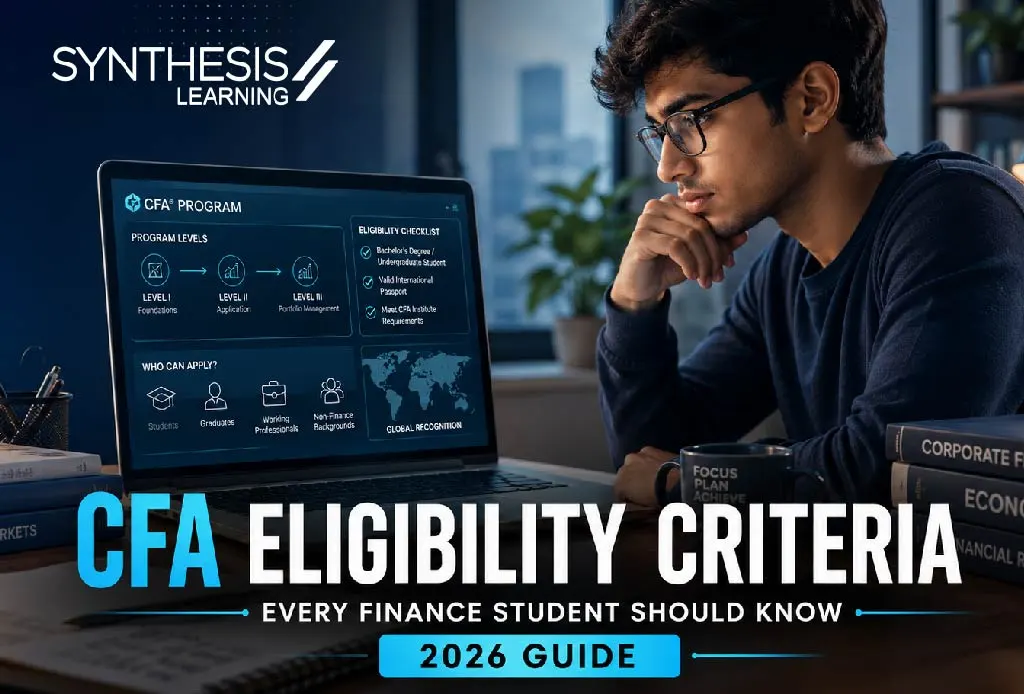
CFA Eligibility Criteria Every Finance Student Should Know (2026 Guide)
Thinking about pursuing the CFA Program, but unsure whether you’re eligible?
You’re not alone.
One of the most common questions students and professionals ask is:
“Can I start CFA now, or do I need to wait until graduation?”
The good news is that the CFA Program is accessible to students from various academic backgrounds, not just finance graduates.
However, understanding the CFA eligibility criteria is important before planning your journey.
In this guide, you’ll learn:
- Who can pursue the CFA
- Eligibility requirements for Levels I, II, and III
- Requirements for students, graduates, and professionals
- Common myths and misconceptions
- The best time to start your CFA journey
Quick Eligibility Snapshot
If you’re looking for a quick answer, start here.
| Applicant Type | Eligible for CFA Level I? |
|---|---|
| Undergraduate student (within eligibility window) | ✅ Yes |
| Graduate | ✅ Yes |
| Working professional | ✅ Yes |
| Engineer | ✅ Yes |
| Commerce student | ✅ Yes |
| MBA student | ✅ Yes |
| Non-finance graduate | ✅ Yes |
Quick insight:
CFA eligibility is broader than many students assume. The programme is designed for individuals from diverse academic and professional backgrounds.
What Is CFA and Why Eligibility Matters?
The Chartered Financial Analyst (CFA) Program is one of the world’s most recognised qualifications in investment management and finance.
The programme consists of:
| CFA Stage | Focus |
|---|---|
| Level I | Investment tools and financial concepts |
| Level II | Asset valuation and analysis |
| Level III | Portfolio management and wealth planning |
Understanding eligibility early helps students:
- Plan exam timelines correctly
- Avoid registration mistakes
- Align CFA preparation with graduation or work commitments
- Build a realistic career roadmap
Reality check:
Being eligible for CFA and being ready for CFA are not always the same thing.
CFA Eligibility Criteria Requirements for Students and Professionals Explained
The CFA Institute provides multiple pathways to become eligible for the CFA Program.
Educational Requirement
Candidates generally need one of the following:
- A bachelor’s degree
- Undergraduate student status within the approved graduation window
- Relevant professional work experience pathway
Work Experience Pathway
Professionals who do not meet the academic pathway may still qualify through relevant work experience requirements as permitted by CFA Institute policies.
Passport Requirement
All candidates must possess:
- A valid international passport
The name used for CFA registration must exactly match the passport details.
Most aspirants miss this:
Many registration issues happen because of document mismatches, not academic eligibility.
Who Can Pursue CFA?
One of the biggest misconceptions is that CFA is only for finance students.
That isn’t true.
Commerce Students
Students pursuing:
- B.Com
- BAF
- BBI
- BMS
Commonly choose CFA because of its relevance to finance and investment careers.
Engineering Students
Many engineers pursue CFA to transition into:
- Investment research
- Equity analysis
- Corporate finance
- Financial consulting
CA and ACCA Students
Professional accounting students often pursue the CFA to complement their expertise in:
- Valuation
- Investments
- Portfolio management
MBA Students
MBA students frequently use CFA to strengthen technical finance knowledge and improve credibility in finance-focused roles.
Reality check:
CFA welcomes candidates from multiple academic backgrounds, not just finance graduates.
CFA Course Eligibility for Graduates and Undergraduate Students
Understanding CFA course eligibility becomes easier when viewed by category.
Undergraduate Students
Students can register for CFA Level I if they are within the prescribed graduation eligibility window specified by CFA Institute.
This allows many students to begin CFA while still completing their degree.
Graduates
Graduates can directly register for CFA Level I after completing their bachelor’s degree.
This remains one of the most common entry points.
Working Professionals
Professionals from finance and non-finance backgrounds may also be eligible through the applicable educational or professional experience routes.
CFA Level 1 Eligibility Criteria: Every Applicant Must Understand
The CFA Level 1 eligibility criteria are often the most important because this is where your CFA journey begins.
To register for Level I, candidates generally need:
- A bachelor’s degree OR
- Undergraduate student status within the approved graduation window OR
- A qualifying professional pathway
Documents Required
Candidates should typically keep:
- Valid passport
- Academic documents (if applicable)
- Personal identification details
Quick insight:
For most students, Level I is the only eligibility checkpoint that requires planning. Once you’re in the programme, progression becomes more straightforward.
CFA Level 2 Eligibility Rules After Clearing Level 1
A common misconception is that clearing Level I automatically makes everyone eligible for Level II.
While passing Level I is mandatory, candidates must also satisfy the academic progression requirements established by CFA Institute.
CFA Level 2 Eligibility Requirements
| Requirement | Status |
|---|---|
| Pass CFA Level I | Mandatory |
| Meet academic progression rules | Mandatory |
| Complete the registration process | Mandatory |
What This Actually Means
By the time most students reach Level II, they are already close to completing or have completed their graduation requirements.
The registration process itself is straightforward once the eligibility criteria are met.
CFA Level 3 Eligibility Requirements for the Final CFA Programme Stage
The eligibility requirements for the final CFA Program stage, CFA Level 3, are simpler.
CFA Level 3 Requirements
| Requirement | Status |
|---|---|
| Pass CFA Level II | Mandatory |
| Meet programme requirements | Mandatory |
| Complete the registration process | Mandatory |
Level III represents the final examination stage of the CFA Program.
Does Passing Level III Make You a CFA Charterholder?
Not immediately.
To become a CFA Charterholder, candidates must also satisfy additional requirements such as relevant professional work experience and membership requirements prescribed by the CFA Institute.
CFA Exam Eligibility vs CFA Charterholder Requirements
Many students use these terms interchangeably.
They are not the same.
| Stage | Requirement |
|---|---|
| CFA Exam Eligibility | Allows you to register and sit for exams |
| CFA Charterholder Eligibility | Requires passing all levels and meeting professional requirements |
Most aspirants miss this:
Passing exams is only one part of becoming a CFA Charterholder.
CFA Eligibility in India for Commerce and Finance Students
The CFA eligibility in India follows the same global standards set by the CFA Institute.
Indian students commonly pursue CFA alongside:
- B.Com
- BAF
- BMS
- BBA
- CA
- ACCA
- MBA
Popular Career Paths in India
CFA candidates often target:
- Equity Research
- Investment Banking
- Corporate Finance
- Wealth Management
- Asset Management
- Financial Consulting
- Risk Management
The qualification continues to gain popularity among students seeking careers in capital markets and finance.
Why Many Students Start CFA After Graduation
Students often ask:
“Should I start CFA during college or after graduation?”
There is no universal answer.
However, many candidates prefer starting after graduation because:
- They can dedicate more time to preparation
- Academic commitments reduce
- Career goals become clearer
Starting During College
This can work well if:
- You are disciplined
- You can balance academics and CFA preparation
- You have a clear interest in finance
Quick insight:
The best time to start CFA is usually when you can consistently dedicate time to preparation, not necessarily the earliest possible moment.
Common CFA Eligibility Questions and Myths
Myth 1: CFA Is Only for Finance Students
False.
Candidates from engineering, commerce, science, and business backgrounds regularly pursue CFA.
Myth 2: Work Experience Is Mandatory for Level I
False.
Many students begin CFA without professional work experience.
Myth 3: You Need an MBA Before CFA
False.
CFA and MBA serve different purposes and can be pursued independently.
Myth 4: CFA Is Only Useful Abroad
False.
The CFA Program is widely recognised in India and valued across multiple finance roles.
How Synthesis Learning Supports CFA Aspirants
Choosing to pursue CFA is one decision.
Navigating the journey successfully is another.
At Synthesis Learning, the focus extends beyond exam preparation to helping students build long-term finance careers.
Students receive support through:
- Expert faculty and industry mentors
- Structured study plans
- Mock tests and performance tracking
- Personalised guidance
- Doubt-solving support
- Flexible learning options
- Career-focused mentoring
Students preparing through:
- CFA coaching classes
- CFA Level 1 preparation programmes
- CFA online coaching
- CFA mock tests
- CFA exam preparation strategies
Benefit from a structured ecosystem designed to improve consistency and confidence.
What this actually means:
The CFA curriculum is rigorous. A structured preparation approach often makes a significant difference.
Final Clarity: CFA Eligibility Is Broader Than Most Students Think
By now, you’ve probably realised something important:
The CFA Program is accessible to far more students than most people assume.
Whether you’re:
- A commerce student
- An engineer
- A graduate
- A working professional
There is often a pathway available.
The bigger question is not:
“Am I eligible?
It’s:
“Am I prepared to commit to the journey?”
Because eligibility gets you through the door.
Consistent preparation is what ultimately helps you succeed.
FAQs on CFA Eligibility
Who is eligible for the CFA Program?
Students within the approved graduation window, graduates, and eligible professionals can generally pursue the CFA Program subject to CFA Institute requirements.
Can I pursue CFA after graduation in India?
Yes. Graduates can directly register for CFA Level I and begin their CFA journey.
Is work experience mandatory for CFA Level I?
No. Many students register for CFA Level I without prior professional work experience.
Can engineering students apply for CFA?
Yes. Engineering graduates and students frequently pursue the CFA to transition into finance careers.
What documents are required for CFA registration?
A valid international passport is the most important requirement. Additional academic details may also be required.
Is CFA recognised globally?
Yes. CFA is one of the most recognised finance qualifications worldwide.
Can I pursue CFA after graduation?
Yes. In fact, graduation remains one of the most common entry points into the CFA Program.
How many levels are there in the CFA Program?
The CFA Program consists of three examination levels:
- Level I
- Level II
- Level III
followed by the requirements necessary to become a CFA Charterholder.