ACCA Employability Modules 2027 Explained: Essential vs Optional Modules
One of the biggest changes in the redesigned ACCA 2027 Qualification is happening outside the 11 exams.
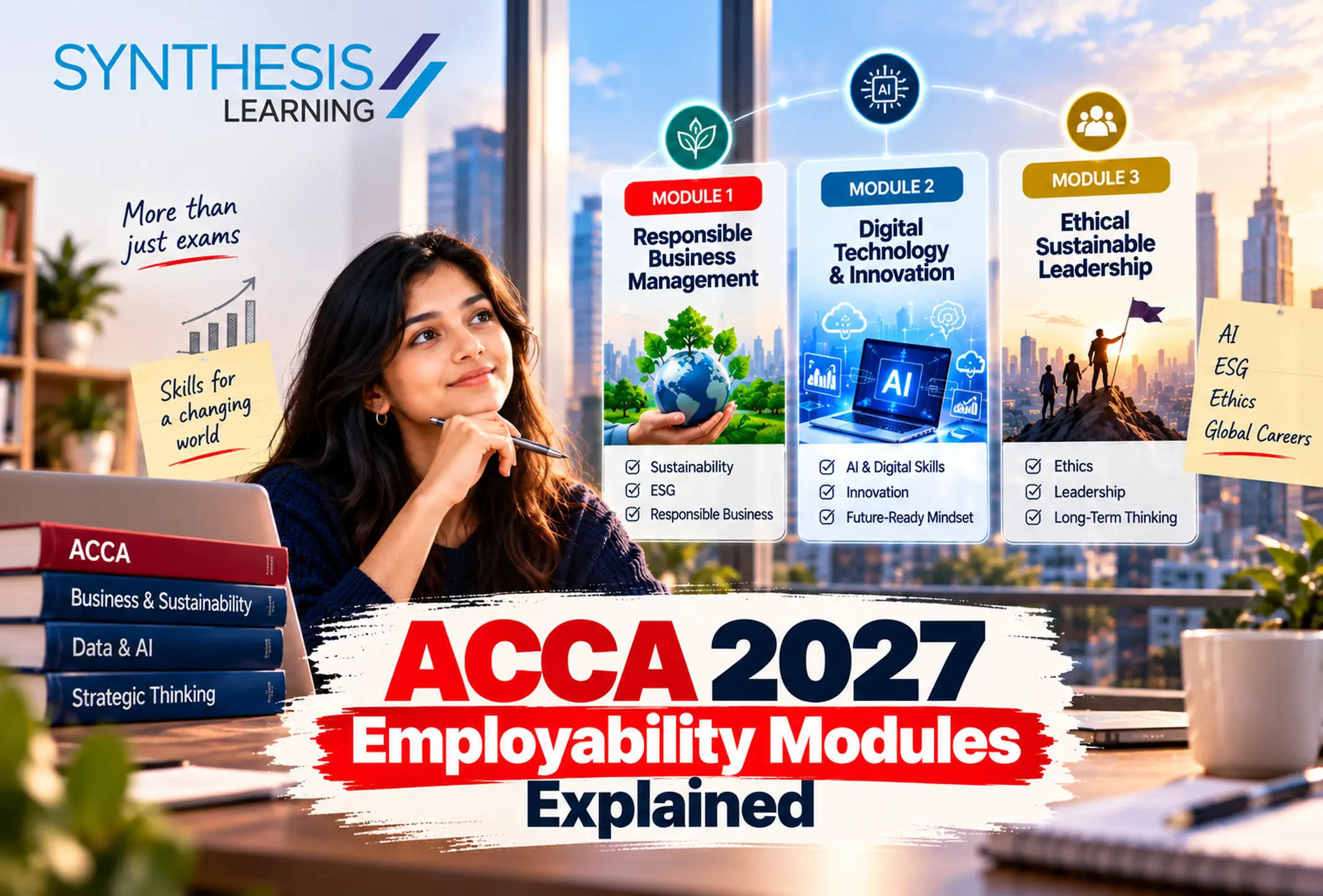
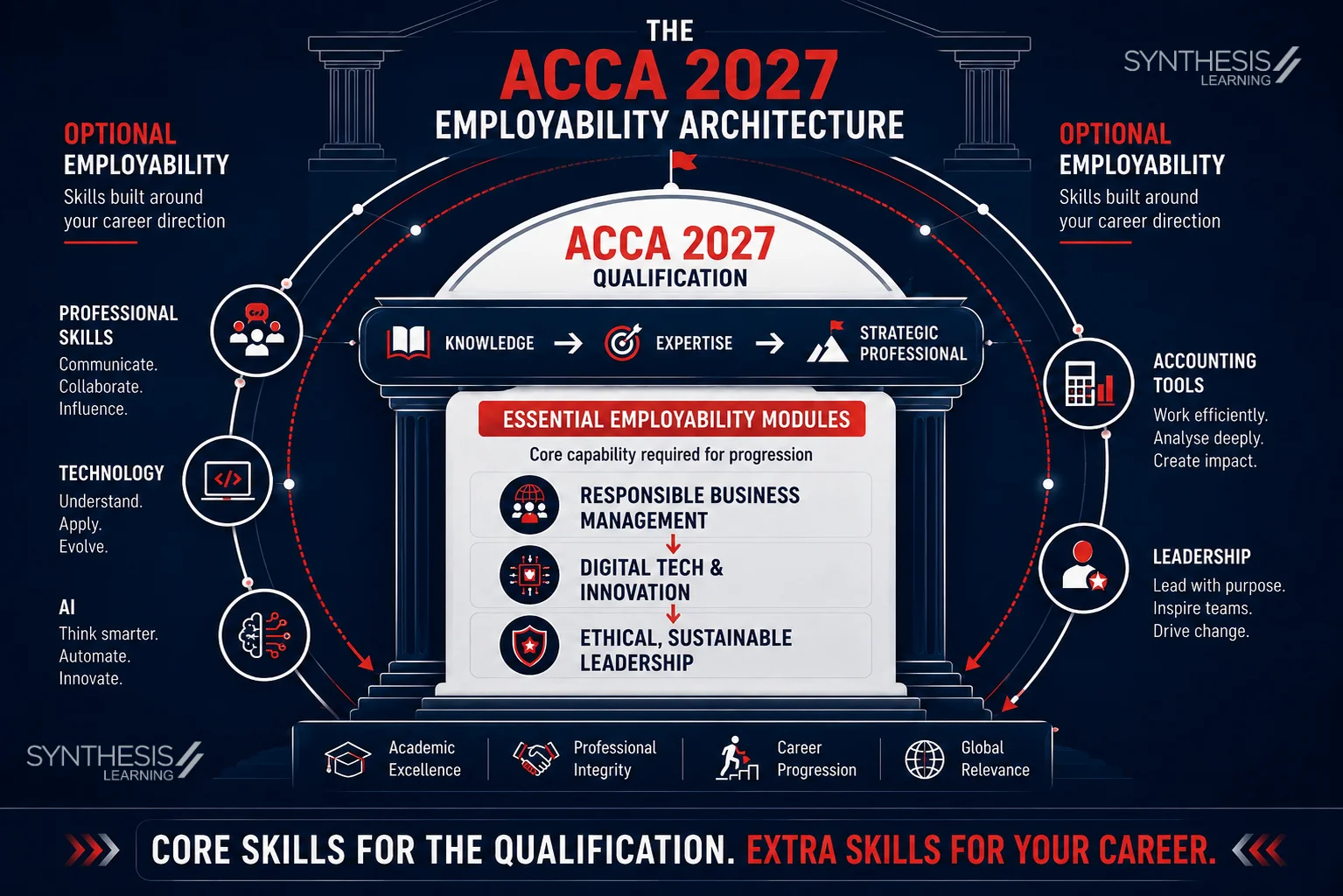
ACCA is introducing a new Employability Module framework designed to develop the skills finance professionals increasingly need at work; from business judgement and ethical leadership to AI, digital technology, data and sustainability.
There are two very different types:
- Essential Employability Modules → part of qualification progression
- Optional Employability Modules → additional career-focused learning
Understanding that difference is important, especially if you are already an ACCA student transitioning into the new qualification.
What Are ACCA’s Employability Modules?
ACCA Employability Modules are online learning modules designed to connect technical finance knowledge with workplace capability.
- Essential Employability Modules are mandatory components linked to qualification levels and include integrated assessment.
- Optional Employability Modules allow students to develop additional professional, technical and technology-related skills according to their career interests.
A simple way to think about them:
- Essential = what ACCA wants every relevant student to develop.
- Optional = additional skills you choose around the career you want.
Essential vs Optional ACCA Employability Modules: What’s the Difference?
| Feature | Essential Employability Modules | Optional Employability Modules |
|---|---|---|
| Mandatory? | Yes, subject to entry point, exemptions and transition credit | No |
| Part of qualification progression? | Yes | No |
| Assessment? | Yes – formative and summative assessment | Full assessment details still to be confirmed |
| When can you take them? | Within the relevant qualification level | At any stage |
| Main purpose | Core technical, business and professional capability | Additional career-relevant skills |
| Number | 4 across the full pathway including Foundations | A wider portfolio |
| Fees | Yes | Yes – current ACCA guidance says fees will apply |
| PER potential | No separate simulated-experience credit announced | Certain future modules may contribute simulated experience |
| Who are they for? | Students progressing through relevant stages. | Students, affiliates and members |
ACCA’s current FAQ confirms that fees will apply to both Essential and Optional Employability Modules, although detailed pricing has not yet been released.
Optional does not mean free. It means not required to complete the ACCA Qualification.
What Are the Four Essential Employability Modules?
There are four Essential Employability Modules across the full redesigned pathway, including Foundations.
Not every ACCA student will necessarily complete all four. Your starting level, prior-learning exemptions and transition credits can change what is required.
| Stage | Essential Employability Module | What it develops |
|---|---|---|
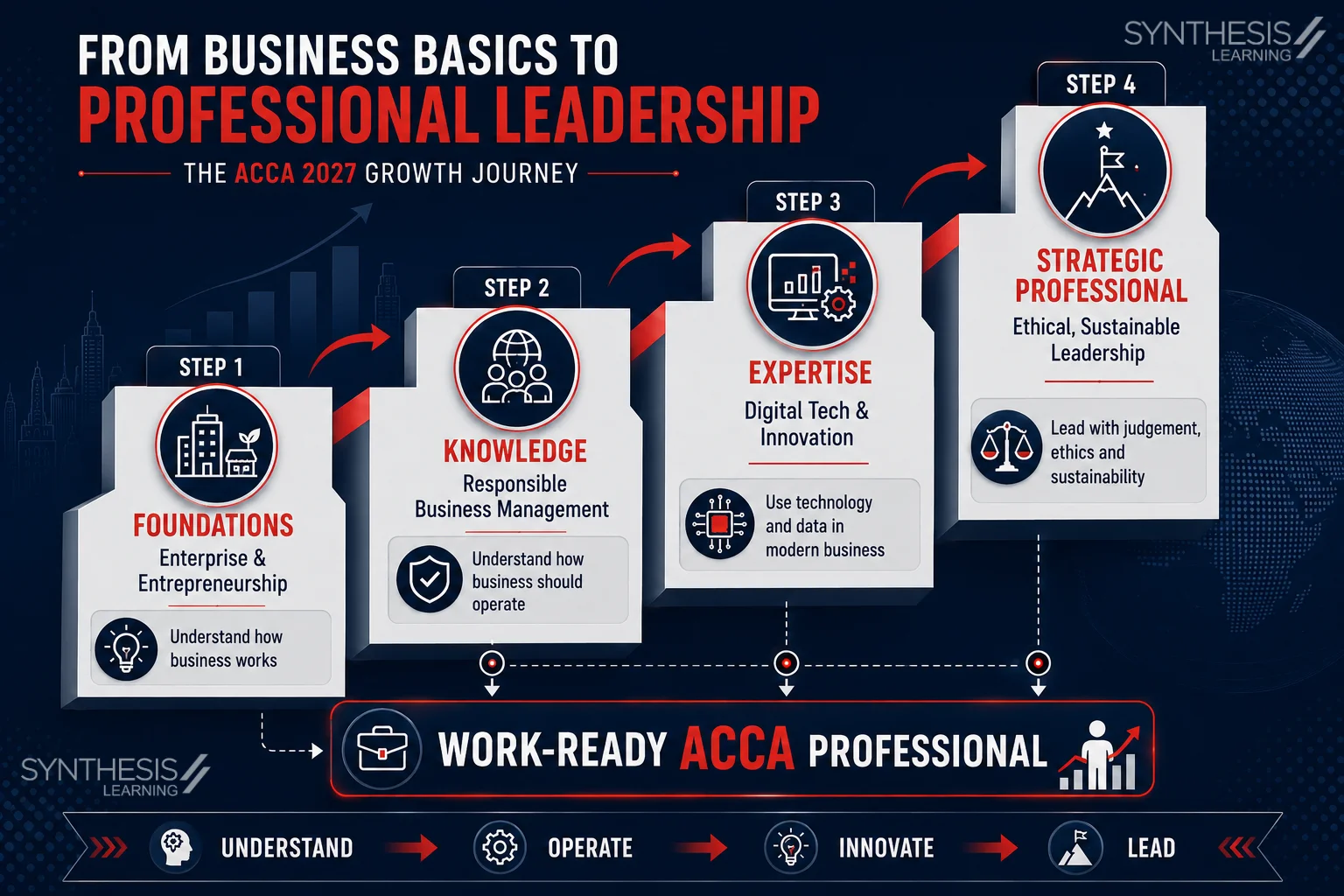
| Foundations | Enterprise and Entrepreneurship | Understanding business activity, enterprise, entrepreneurship and the wider business environment |
| Knowledge | Responsible Business Management | How businesses operate responsibly, ethically and sustainably |
| Expertise | Digital Tech and Innovation | Emerging technology, contemporary business practices and fundamental practical data-science capability |
| Strategic Professional | Ethical, Sustainable Leadership | Leadership, ethics, sustainability and professional judgement |
This progression is reflected directly in ACCA’s educator material.
There is an interesting professional journey underneath the names:
UNDERSTAND → OPERATE RESPONSIBLY → INNOVATE → LEAD
That is arguably the bigger idea behind the modules.
How Do Essential Employability Modules Actually Work?
These are not simply short video courses added beside ACCA exams.
ACCA’s educator guidance describes them as online, self-paced modules combining:
- Learning units
- Interactive activities and quizzes
- Formative assessments
- Reflective tasks
- Case-study application
- Professional responsibility for completing the learning appropriately
Students can work at their own pace, and ACCA’s educator material specifically states that they may use AI tools of their choice during the learning journey.
How long do Essential Employability Modules take?
The educator guidance currently indicates approximately:
40 – 100 hours depending on the module
and says an Essential Module should be completed within 12 months of purchase.
The exact workload is not identical for every module.
For example, ACCA’s current transition guidance specifically says the Digital Tech and Innovation module is expected to take approximately 100 hours for students who need to complete it after transition.
ACCA separately indicates that Enterprise and Entrepreneurship is expected to take around 40 hours in relevant Foundations transition scenarios.
Are Essential Employability Modules paid?
Yes.
ACCA’s latest FAQ says fees will apply to Essential Employability Modules, with detailed pricing to follow. For transition students needing Digital Tech and Innovation, ACCA currently says the price will be confirmed in January 2027.
These are substantial assessed learning modules – not five-hour add-ons.
Are ACCA Employability Modules Replacing EPSM?
Not directly.
EPSM – the Ethics and Professional Skills Module – is part of the current ACCA Qualification.
ACCA specifically says the new Essential Employability Modules should not be viewed simply as a replacement for EPSM, because the content, learning experience, time commitment and progression rules are substantially different.
However, there is an important transition connection:
Complete EPSM before transition → receive credit for Ethical, Sustainable Leadership.
So EPSM can still materially affect what an existing student needs to complete after the redesign.
What Optional Employability Modules Can Students Choose?
Optional Employability Modules are designed differently.
They are not mandatory qualification requirements. Students can choose them according to the knowledge or career skills they want to develop. ACCA says they can be taken at any stage, regardless of the level currently being studied.
Current public ACCA guidance gives examples including:
- Accounting software
- Cloud accounting
- Personal effectiveness and leadership
- Technology and AI
ACCA’s educator material has also illustrated potential areas including Python, data analytics, Power BI, FinTech, AI in accounting, communication, storytelling and resilience – but importantly labels that broader portfolio as a “current vision – details tbc.”
So we should not treat every illustrated topic as a final confirmed module yet.
Do Optional Employability Modules have a deadline?
ACCA currently says they can be taken at any time during the qualification journey and are also intended to be available to affiliates and members.
Unlike the educator guidance for Essential Modules, ACCA has not currently published a comparable 12-month-from-purchase completion rule for Optional Modules in its public FAQ.
Are Optional Employability Modules free?
Current ACCA public guidance says no – fees will apply to both Essential and Optional Modules, although prices are still to be announced.
This is worth clarifying because earlier ACCA educator material described Optional Modules as free, while the newer public FAQ now states that a fee will apply.
For publication, the latest public ACCA guidance should take priority.
Do ACCA Employability Modules Count as Exams?
No – they are not part of the 11 ACCA exam count.
But that does not mean the Essential Modules are unassessed.
Essential Employability Modules
Students need to demonstrate competence through integrated assessment. ACCA says both formative and summative assessments will be used.
Optional Employability Modules
ACCA has not yet published the final assessment structure.
Not an ACCA exam paper ≠ not assessed.
Are Employability Modules Required to Become an ACCA Member?
Again, the answer depends on the type.
Essential Modules: Yes, where applicable
Students must complete the relevant Essential Employability Module alongside each stage’s exam requirements before progressing.
At Strategic Professional, Ethical, Sustainable Leadership is part of the requirements students complete alongside their Strategic Professional exams before progressing towards membership with PER.
Optional Modules: No
Optional Employability Modules are not required to complete the ACCA Qualification or become an ACCA member.
They exist to help students develop additional skills relevant to their role or career direction.
Can You Get Exemptions From ACCA Employability Modules?
Yes – but only from certain Essential Modules through relevant prior learning.
ACCA currently says prior-learning exemptions may be available for:
| Essential Module | Prior-learning exemption? |
|---|---|
| Enterprise and Entrepreneurship | Potentially yes |
| Responsible Business Management | Potentially yes |
| Digital Tech and Innovation | No |
| Ethical, Sustainable Leadership | No |
ACCA specifically keeps Digital Tech and Innovation within the core journey because technology and digital capability are considered important emerging areas for future professionals.
Do not confuse this with transition credit, which applies to existing ACCA students based on progress already completed.
What Happens to Current ACCA Students?
This is probably the most important section for anyone already studying ACCA.
You may not need to complete every new Essential Employability Module.
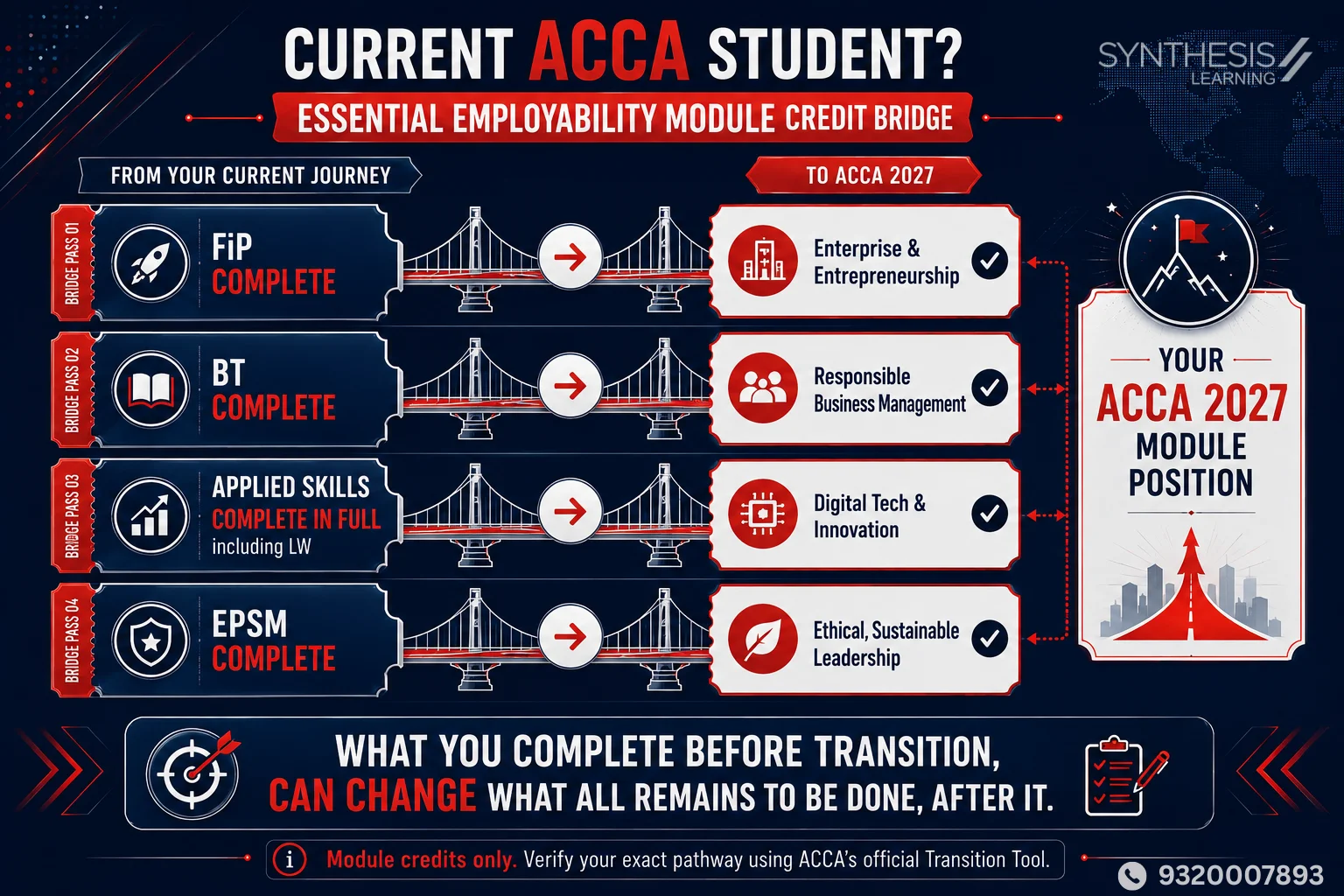
Your current progress can provide transition credit:
| Current ACCA element completed | ACCA 2027 Essential Module credit |
|---|---|
| Foundations in Professionalism (FiP) | Enterprise and Entrepreneurship |
| Business and Technology (BT) | Responsible Business Management |
| Applied Skills completed in full, including LW | Digital Tech and Innovation |
| Ethics and Professional Skills Module (EPSM) | Ethical, Sustainable Leadership |
This mapping appears in ACCA’s educator transition material and current student transition guidance.
The Applied Skills rule matters particularly.
If you do not complete all Applied Skills exams, including LW, before transition, ACCA says you will need to complete Digital Tech and Innovation.
That module:
- Will be chargeable
- Has pricing due to be confirmed in January 2027
- Is expected to take approximately 100 hours
- Must be purchased before you can enter for Strategic Professional exams under the progression rules.
What you complete before transition can change both your future module workload and cost.
For detailed paper-by-paper transition rules, see ACCA 2027 Transition Rules Explained.
Can Optional Employability Modules Count Towards ACCA PER?
This is one of the most important areas to explain carefully.
The standard PER remains 36 months
To become an ACCA member, students will still need:
Minimum 36 months of supervised relevant practical experience + Performance Objectives.
In future, selected Optional Modules may help.
ACCA plans to allow certain Optional Employability Modules containing simulated experiential learning to contribute towards that 36-month requirement.
The maximum planned credit is:
Up to 6 months
But this does not take effect automatically from September 2027. ACCA says implementation timing will be announced later.
Even when introduced:
- Only selected Optional Modules will qualify
- Simulated-experience credit will be capped at six months
- It will not replace Performance Objectives
- It will not count towards experience requirements for an Audit Qualification or Practising Certificate.
ACCA is not reducing PER to 30 months in September 2027. The standard requirement remains 36 months.
Why Do Employability Modules Matter in an AI-Enabled Finance Career?
Because technical accounting knowledge alone is no longer the entire job.
ACCA’s educator guidance says Essential Employability Modules are intended to prepare students for AI-enabled professional environments while developing judgement, decision-making, reflection and work-ready capability.
That combination matters.
AI can help professionals process information, automate workflows and work with data.
Finance professionals still need to:
question → interpret → judge → communicate → decide
The future ACCA pathway therefore brings skills such as technology, data, sustainability, ethics and leadership closer to the technical qualification itself.
ACCA is not asking future accountants to compete with technology. It is preparing them to become better professionals with technology around them.
Building Employability Beyond the ACCA Modules: The Synthesis Learning Approach
The direction ACCA is taking reinforces something important:
Passing exams and being ready for the workplace are connected – but they are not the same thing.
Synthesis Learning, a House of Global Courses with 25+ years of legacy in business and finance education, approaches ACCA preparation with that wider professional journey in mind.
As an ACCA Platinum Approved Learning Partner, SL combines concept-focused exam preparation with:
- 1-on-1 mentorship and paper planning
- Structured doubt-solving and mocks
- Career-focused guidance
- Practical digital confidence and data-led thinking
- Professional communication and workplace readiness
- Campus-to-Corporate exposure
- Employer perspective through its wider industry ecosystem, including Ascentium India
The intention is not to duplicate ACCA’s Employability Modules.
It is to help students develop broader professional capabilities around the qualification so that what they learn translates more effectively into interviews, internships, and eventually finance roles.
The future ACCA professional will need to understand finance, use technology intelligently, communicate professionally and exercise judgement. Preparation should reflect all four.
What Should You Take Away?
ACCA Employability Modules are much more than extra courses being added in 2027.
Essential Employability Modules become part of qualification progression, bringing business responsibility, digital technology, AI-era capability, sustainability and leadership into the student journey.
Optional Employability Modules allow students to build additional career-relevant skills and may eventually provide limited simulated-experience credit towards PER.
For current ACCA students, the most important step is to check your transition credit position – especially your BT, Applied Skills and EPSM status.
The bigger shift is clear:
ACCA 2027 is moving from “learn the technical syllabus, then think about employability”, towards building technical and workplace capability together.
Frequently Asked Questions
Q1. What are ACCA Employability Modules?
They are online learning modules introduced within the redesigned ACCA Qualification to develop technical, business and professional capability. Essential Modules are mandatory parts of progression, while Optional Modules provide additional career-focused learning.
Q2. Are ACCA Essential Employability Modules compulsory?
Yes, subject to your starting point, exemptions and transition credits. The relevant Essential Module must be passed alongside each level’s exam requirements before progression.
Q3. Do ACCA Employability Modules have exams?
They are not counted as ACCA exam papers. However, Essential Employability Modules include integrated formative and summative assessment. ACCA has not yet published full assessment details for Optional Modules.
Q4. How long do ACCA Employability Modules take?
ACCA educator guidance currently indicates approximately 40–100 hours for Essential Modules depending on the module. Digital Tech and Innovation is specifically expected to take around 100 hours for transition students who need it.
Q5. Is EPSM being replaced in ACCA 2027?
Not directly. ACCA says the Essential Employability Modules differ substantially from EPSM. However, students who complete EPSM before transition receive credit for the future Ethical, Sustainable Leadership module.
Q6. Can current ACCA students get credit for the new Employability Modules?
Yes. Transition credits depend on current progress. For example, BT gives credit for Responsible Business Management; full Applied Skills completion including LW gives credit for Digital Tech and Innovation, and EPSM gives credit for Ethical, Sustainable Leadership.
Q7. Can Optional Employability Modules count towards ACCA PER?
ACCA plans for selected Optional Modules to provide simulated-experience credit worth up to six months of the 36-month PER. This will not take effect immediately from September 2027, and implementation timing is still to be announced.
Q8. Are Optional Employability Modules compulsory?
No. They are designed as additional career-focused learning and can be taken at any stage. They are not required to complete the ACCA Qualification.