

ACCA Pass Percentage & Exam Insights for 2026
Understanding ACCA pass rates can feel overwhelming, particularly when you encounter conflicting figures online and mixed opinions about how difficult the qualification actually is. This blog presents the official ACCA pass percentage for 2026, drawn directly from ACCA’s published results for the March and June sittings. It explains what these numbers mean, how to interpret them across levels, and what they indicate for your preparation strategy. Whether you are a student planning your next attempt, a graduate evaluating ACCA as a career pathway, or a professional considering the qualification, this guide is structured to give you clarity, context, and actionable direction.
What Is the ACCA Pass Percentage and Why Does It Matter?
The ACCA pass percentage refers to the proportion of candidates who successfully pass a specific paper in a given exam session. If 1,000 candidates sit a paper and 450 pass, the pass rate for that paper is 45%. It is a straightforward metric, but one that is routinely misread.
ACCA does not publish a single overall course pass rate. Instead, it releases paper-specific pass percentages for every exam session. These must always be read in context; comparing a Knowledge-level paper to a Strategic Professional paper without accounting for their respective difficulty thresholds is a common and costly mistake.
Why pass rate data matters for ACCA students:
- It reveals the relative difficulty of each paper, helping you allocate study time realistically
- It demonstrates how exam complexity escalates across levels, so you can set appropriate expectations
- It confirms that ACCA maintains consistent marking standards, so preparation quality, not luck, drives results
- It helps you plan paper combinations and avoid underestimating technically demanding subjects such as PM, AA, and AFM
ACCA Qualification Structure at a Glance
Before diving into pass rate data, it is essential to understand how the ACCA qualification is structured. Pass rates are a direct reflection of each level’s design intent, and interpreting them out of context leads to unnecessary anxiety.
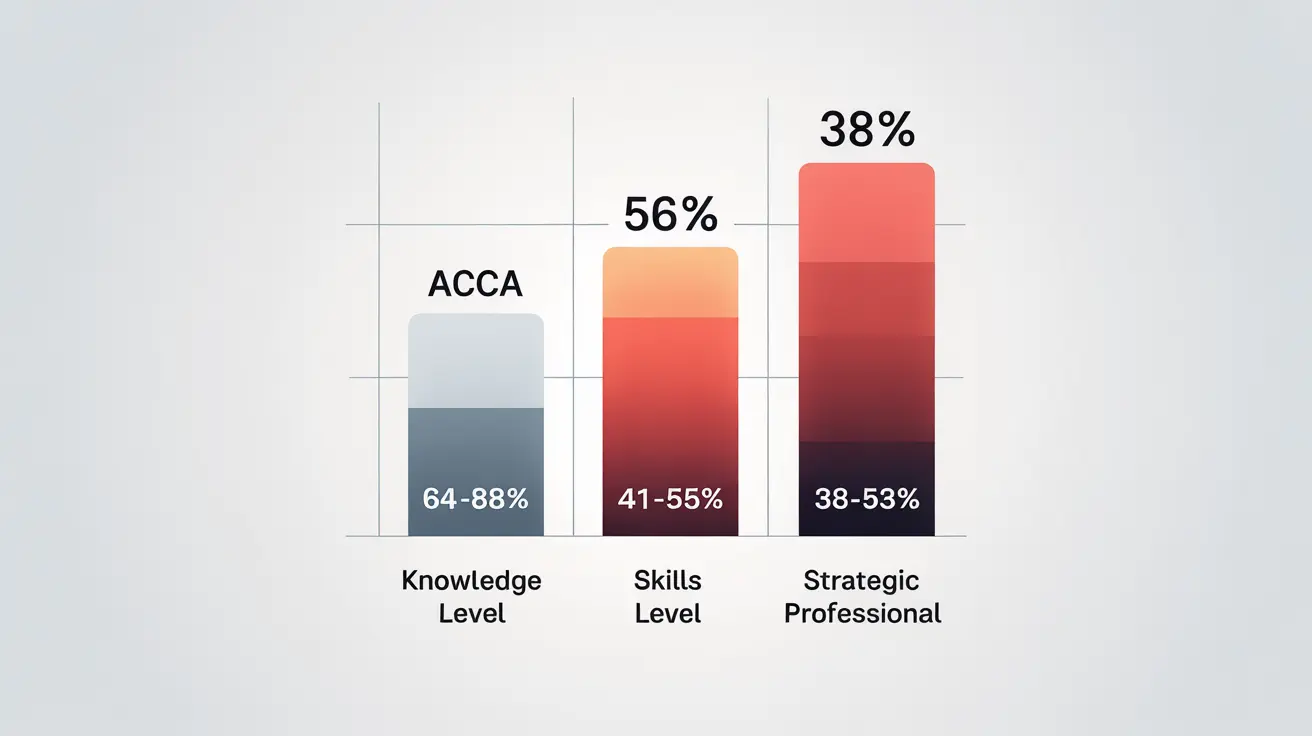
| ACCA Level | Papers Included | Focus | Typical Pass Range |
| Applied Knowledge | BT, MA, FA, LW | Core business, accounting and finance fundamentals | ~65% to 89% |
| Applied Skills | PM, TX, FR, AA, FM | Scenario-based application and exam technique | ~41% to 55% |
| Strategic Professional | SBL, SBR, AFM, APM, ATX, AAA | Strategic judgement, ethics, real-world decisions | ~39% to 52% |
Each level is deliberately more demanding than the last. A lower pass rate at the Strategic Professional level is not a red flag; it is an accurate reflection of the professional maturity the qualification is designed to test.
ACCA Pass Rates: March 2026 (Official Results)
The March 2026 session is the first exam sitting of the year and typically attracts students beginning fresh attempts after year-end planning, as well as those returning with renewed focus. A total of 92,224 students entered for the March sitting, resulting in 103,785 exams completed, with 3,334 students completing their final exams to become ACCA affiliates. acca global
The March session did not include Applied Knowledge papers, as these are available on demand. The results below cover Applied Skills and Strategic Professional papers.
March 2026: Applied Skills Pass Rates
| Paper | Pass Rate (%) |
| TX – Taxation | 53% |
| FR – Financial Reporting | 50% |
| PM – Performance Management | 45% |
| FM – Financial Management | 50% |
| AA – Audit and Assurance | 43% |
March 2026: Strategic Professional Pass Rates
| Paper | Pass Rate (%) |
| SBL – Strategic Business Leader | 52% |
| SBR – Strategic Business Reporting | 50% |
| AAA – Advanced Audit and Assurance | 42% |
| AFM – Advanced Financial Management | 44% |
| APM – Advanced Performance Management | 40% |
| ATX – Advanced Taxation | 50% |
Key takeaways from March 2026:
- TX and FR delivered solid mid-range results, reflecting their structured, technique-driven nature
- PM and AA continued to record lower figures, consistent with their scenario-heavy format
- APM recorded the lowest Strategic Professional pass rate at 40%, underlining the judgement and application demands of this paper
- SBL and SBR held steady above 50%, indicating that students with structured preparation can achieve consistent results at the highest level
ACCA Pass Rates: June 2026 (Official Results)
June is consistently the largest ACCA exam session of the year, attracting a broad cross-section of students, from first-time Knowledge-level candidates to experienced professionals attempting Strategic Professional options. A total of 119,662 students entered for the June sitting, with 136,544 exams completed, and 4,690 students completing all their exams to move to affiliate status. acca global
June 2026: Applied Knowledge Pass Rates
| Paper | Pass Rate (%) |
| BT – Business and Technology | 89% |
| FA – Financial Accounting | 71% |
| MA – Management Accounting | 65% |
June 2026: Applied Skills Pass Rates
| Paper | Pass Rate (%) |
| LW – Corporate and Business Law | 82% |
| TX – Taxation | 55% |
| FR – Financial Reporting | 52% |
| PM – Performance Management | 41% |
| FM – Financial Management | 48% |
| AA – Audit and Assurance | 47% |
June 2026: Strategic Professional Pass Rates
| Paper | Pass Rate (%) |
| SBL – Strategic Business Leader | 51% |
| SBR – Strategic Business Reporting | 47% |
| AAA – Advanced Audit and Assurance | 39% |
| AFM – Advanced Financial Management | 47% |
| APM – Advanced Performance Management | 42% |
| ATX – Advanced Taxation | 47% |
Key takeaways from June 2026:
- BT posted the highest pass rate at 89%, confirming the accessibility of Knowledge-level entry points
- LW at 82% and FA at 71% demonstrate that structured self-study remains effective at the foundational stage
- PM dropped to 41% in June, its lowest 2026 figure, highlighting the paper’s consistently demanding analytical requirements
- AAA recorded a 39% pass rate, the lowest across all 2026 sessions to date, reflecting its advanced judgement demands
- ATX improved meaningfully between March (50%) and June (47% across sessions), showing stable examiner expectations
June 2026: Foundation Level Pass Rates
| Paper | Pass Rate (%) |
| FA1 – Recording Financial Transactions | 79% |
| MA1 – Management Information | 80% |
| FA2 – Maintaining Financial Records | 75% |
| MA2 – Managing Costs and Finance | 72% |
| FBT – Business and Technology | 80% |
| FFA – Financial Accounting | 75% |
| FMA – Management Accounting | 66% |
| FAU – Foundations in Audit | 42% |
| FTX – Foundations in Taxation | 51% |
| FFM – Foundations in Financial Management | 40% |
March vs June 2026: Session-Wise Comparison
Understanding how results shift between sessions is a powerful planning tool. The table below compares Applied Skills and Strategic Professional pass rates across both 2026 sittings for papers that featured in both.
| Paper | March 2026 | June 2026 |
| TX – Taxation | 53% | 55% |
| FR – Financial Reporting | 50% | 52% |
| PM – Performance Management | 45% | 41% |
| FM – Financial Management | 50% | 48% |
| AA – Audit and Assurance | 43% | 47% |
| SBL – Strategic Business Leader | 52% | 51% |
| SBR – Strategic Business Reporting | 50% | 47% |
| AAA – Advanced Audit and Assurance | 42% | 39% |
| AFM – Advanced Financial Management | 44% | 47% |
| APM – Advanced Performance Management | 40% | 42% |
| ATX – Advanced Taxation | 50% | 47% |
What this comparison reveals:
- Pass rates across 2026 sessions are remarkably stable, confirming that ACCA maintains consistent marking standards across the year
- PM is the only Applied Skills paper to record a notable decline between sessions, dropping four percentage points from March to June
- AAA continues to trend lower across both sittings, making it one of the most challenging options in the Strategic Professional tier
- AA improved from 43% to 47% between sessions, suggesting growing candidate preparedness with this paper
- No paper recorded extreme fluctuation, which is reassuring for students planning future attempts
ACCA Pass Percentage by Level: What Each Range Means
One of the most common errors students make is analysing individual pass rates without understanding the design intent behind each level. The pass percentage of ACCA papers is not arbitrary; it reflects what each level is built to test.
Applied Knowledge Level:
Typical range: 65% to 89% (2026 data)
This level focuses on building foundational confidence in business, accounting and finance. High pass rates here are intentional; they signal that ACCA is designed to be accessible to students with diverse academic backgrounds. Difficulties at this stage typically point to foundational preparation gaps, not inherent exam difficulty.
Applied Skills Level:
Typical range: 41% to 55% (2026 data)
At this level, ACCA transitions from knowledge recall to professional application. Candidates must interpret business scenarios, manage time under pressure, and structure answers with precision. Papers such as PM, AA and FM demand strong numerical fluency alongside conceptual clarity. This is the stage where exam technique begins to differentiate candidates.
Strategic Professional Level:
Typical range: 39% to 52% (2026 data)
These papers assess strategic thinking, ethical reasoning, and the capacity to make well-argued professional decisions in complex, ambiguous situations. Lower pass rates here are by design; they reflect the maturity of thought expected of candidates approaching full ACCA membership. Passing these papers requires not just knowledge, but the ability to apply it with professional judgement and structured analysis.
ACCA Pass Rates in India: What to Expect
ACCA does not publish country-specific pass rate data. However, observable trends among Indian students indicate that the overall ACCA pass percentage in India broadly aligns with global averages across all three levels.
Patterns observed among Indian ACCA students:
- Performance at the Applied Knowledge level is consistently strong, with most students clearing papers such as BT, FA and MA without significant difficulty
- At the Applied Skills level, challenges tend to arise not from academic ability, but from gaps in exam technique, answer structure, and time management
- Strategic Professional papers present the greatest challenge, particularly for students who have not built habits of analytical writing and scenario-based thinking across the earlier levels
- Cities such as Mumbai, Pune and Delhi, which have access to structured coaching ecosystems, tend to produce students who progress more efficiently through the qualification
The most significant differentiator for Indian students at every level is the quality of preparation, not geography.
Why ACCA Pass Percentages Vary Across Papers?
Pass rate variation across ACCA papers is not random. Each paper has a specific professional purpose, and the pass rate is a natural outcome of how well candidates have internalised and applied that purpose under exam conditions.
The key reasons pass rates differ:
- Depth of professional application required: Papers such as APM and AAA demand judgement-based responses, not just accurate calculations. The higher the level of application required, the more nuanced the pass rate tends to be.
- Exam technique vs. subject knowledge: Many students underperform not because they lack understanding, but because they cannot translate that understanding into well-structured, mark-scoring responses within time constraints.
- Time management pressure: ACCA exams are deliberately time-pressured. Candidates who cannot allocate time efficiently across requirements leave marks on the table, regardless of their subject knowledge.
- Preparation quality and consistency: The stability of pass rates across 2026 sessions confirms that ACCA exams reward sustained, structured preparation, not last-minute cramming.
In short, ACCA pass percentages are a reflection of professional readiness, and they respond predictably to the quality of preparation that precedes them.
How to Improve Your ACCA Pass Percentage?
Improving your ACCA results is fundamentally about refining your preparation strategy, not simply increasing study hours. Candidates who consistently pass ACCA papers share a distinct set of habits and approaches that separate them from those who repeat attempts.
What high-performing ACCA candidates do differently:
- They treat each paper as a distinct professional skill to be developed, not merely a subject to be memorised
- They study examiner reports and mark schemes to understand precisely how marks are awarded and lost
- They complete mock exams under timed, exam-condition pressure, then analyse their answers critically against marking guides
- They plan paper combinations carefully, avoiding clustering technically demanding papers in a single sitting
- They build their exam technique progressively across sessions, learning from each attempt rather than simply repeating the same approach
- They study within a structured learning ecosystem that provides guidance, accountability, and access to expert feedback
Preparation quality is the single most consistent predictor of ACCA pass rates, both at the individual level and across global cohorts.
How Synthesis Learning Can Help You Clear ACCA?
For students who want more than self-study materials, professional coaching makes a measurable difference, particularly at the Applied Skills and Strategic Professional levels where exam technique and structured thinking matter most.
At Synthesis Learning, ACCA coaching is designed around the way ACCA actually examines its candidates. Every element of the programme is aligned to examiner expectations, not generic accountancy content.
What Synthesis Learning offers ACCA students:
- Comprehensive coverage of all ACCA papers from Applied Knowledge through to Strategic Professional
- Subject-specific coaching from experienced tutors with deep understanding of ACCA’s marking philosophy
- Structured mock exam practice with personalised feedback to refine answer quality and time management
- Examiner report analysis incorporated into class sessions, so students understand exactly how marks are allocated
- Flexible learning modes to accommodate working professionals and full-time students
- A proven track record of global rankers and consistent pass rate performance across cohorts
Whether you are beginning your ACCA course in India, struggling with a specific paper, or preparing for your final Strategic Professional attempt, Synthesis Learning provides the structure and expertise to help you move forward with confidence.
Conclusion
The official ACCA pass percentage data for 2026 paints a clear and consistent picture. Applied Knowledge papers remain highly accessible, with pass rates reaching as high as 89%. Applied Skills papers occupy a mid-range of 41% to 55%, where exam technique becomes a defining variable. Strategic Professional papers sit between 39% and 52%, reflecting the professional judgement demanded at the highest level of the qualification.
What the 2026 data confirms, most importantly, is that ACCA results are stable and predictable. They do not fluctuate dramatically between sessions, and they respond reliably to the quality of preparation that candidates bring to each attempt. For students who invest in structured coaching, consistent practice, and examiner-aligned preparation, ACCA remains one of the most achievable and globally respected finance qualifications available today.
FAQs on ACCA Pass Percentage 2026
1. What is the ACCA pass percentage in 2026?
ACCA does not publish a single overall figure. In 2026, Applied Knowledge papers recorded pass rates between 65% and 89%, Applied Skills papers between 41% and 55%, and Strategic Professional papers between 39% and 52%, based on official March and June results.
2. Which ACCA paper had the highest pass rate in June 2026?
BT (Business and Technology) recorded the highest pass rate at 89% in the June 2026 sitting.
3. Which ACCA paper had the lowest pass rate in 2026?
AAA (Advanced Audit and Assurance) recorded the lowest pass rate across both 2026 sessions, reaching 39% in the June sitting.
4. Is the ACCA pass percentage in India different from the global average?
ACCA does not publish country-specific data, but observed trends indicate that Indian students perform broadly in line with global averages, with preparation quality being the primary differentiating factor.
5. Do ACCA pass rates change significantly between sessions?
No. The 2026 data confirms that ACCA pass rates remain remarkably stable across sessions, reflecting consistent marking standards rather than exam difficulty fluctuations.
6. Why is the PM pass rate consistently low?
PM (Performance Management) requires strong numerical application, scenario interpretation, and time management. Students who underperform typically lack practice with examiner-style questions, not subject knowledge.
7. How can Synthesis Learning help me improve my ACCA results?
Synthesis Learning provides structured ACCA coaching aligned to examiner expectations, with mock exam practice, subject-expert tutors, and personalised feedback designed to help students progress efficiently through the qualification.