Is Maths Compulsory for ACCA? A Clear, Student-Friendly Guide
If you’re considering ACCA and this question keeps bothering you, is math compulsory for ACCA? – You’re not alone.
A large number of students hesitate to explore ACCA because they assume it’s meant only for “math geniuses” or students with an advanced quantitative background. That assumption often stops capable commerce students from even researching the qualification properly.
This guide is written to clear that confusion, calmly, honestly, and without exaggeration. By the end, you’ll know exactly where math fits into ACCA, where it doesn’t, and whether your current background is good enough to succeed.
ACCA Eligibility: The Formal Math Requirement
Let’s start with the official stance, not opinions or coaching-industry myths.
What does ACCA officially require?
Association of Chartered Certified Accountants does not mandate Mathematics as a compulsory subject at the 10+2 (Class 12) level for registration.
As per the official entry requirements, students can register for ACCA if they have completed 10+2 with:
- 65% in English and Accounts or Mathematics, and
- 50% in the remaining subjects
That means:
- If you had Accounts but not Math → you’re still eligible
- If you had Math but not Accounts → you’re still eligible
- You do not need both subjects compulsorily
This is a key reason the ACCA course remains accessible to a wide range of commerce students.
The Type of Math You’ll Encounter in ACCA
Understanding eligibility is one thing. Understanding the actual syllabus reality is more important.
How much math is really there in ACCA?
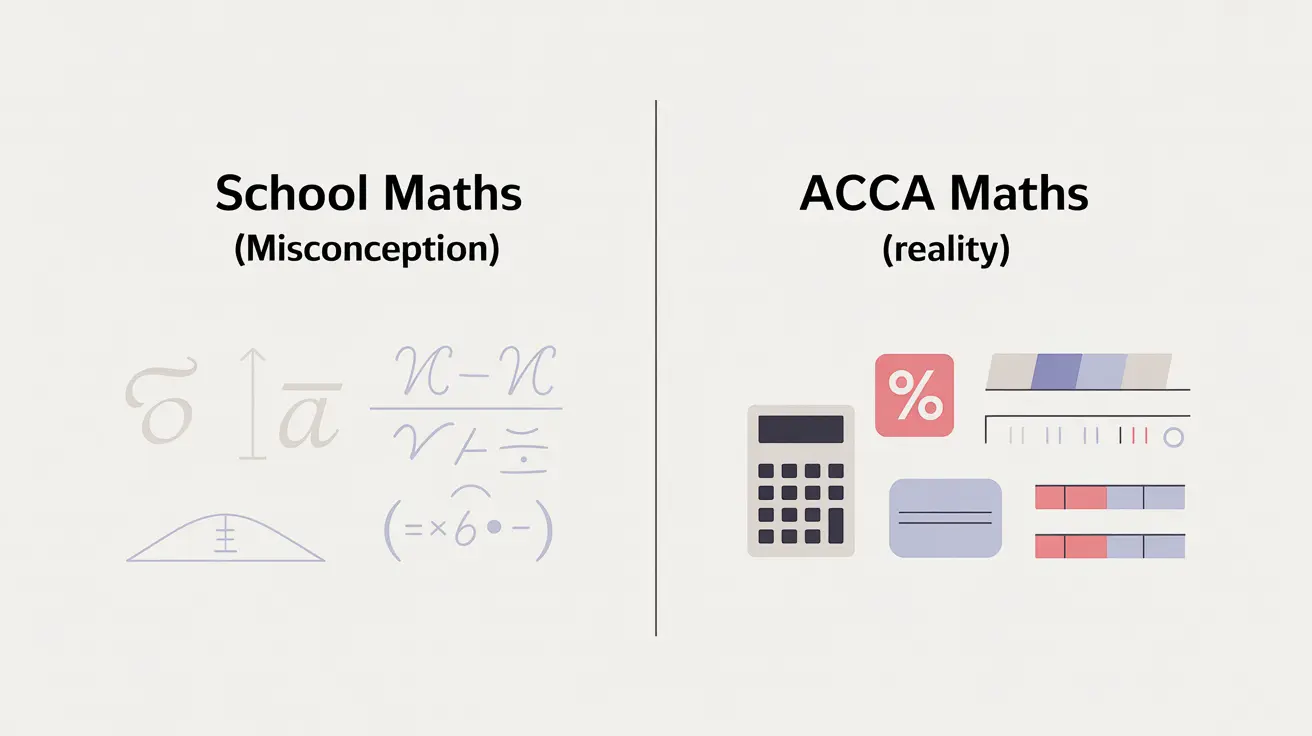
ACCA does include quantitative elements – but not advanced mathematics.
You’ll mainly encounter:
- Basic arithmetic
- Percentages and ratios
- Algebraic rearrangements
- Interpretation of numbers
- Logical and financial reasoning
There is no calculus, no trigonometry, and no abstract mathematical theory.
Where does math appear in the syllabus?
Some papers where numerical application is more visible include:
- Performance Management (PM) – cost analysis, variances, decision-making
- Financial Management (FM) – time value of money, investment appraisal
- Financial Reporting (FR) – numerical interpretation of financial statements
- Advanced Financial Management (AFM) – advanced application, not complexity
The emphasis is always on:
“Can you apply financial logic to numbers?”
Note:
“Can you solve complex mathematical problems?”
This is why many students complete ACCA even if math was not their strongest subject in school.
Can I Do ACCA Without Math?
Succeeding in ACCA Without a Strong Math Background
This is one of the most searched questions by students – and the honest answer is: yes, you can do ACCA without math, if you approach it the right way.
Here’s what actually helps:
Conceptual clarity over memorization
Once you understand why a formula works, applying it becomes easier.
Approved calculators & spreadsheet use
ACCA allows approved calculators. You are never tested on manual computation speed.
Practice with purpose
Solving past exam questions trains your brain for application-based thinking.
Structured mentoring & doubt resolution
Guided learning environments reduce fear and build confidence – especially for students coming from a non-math background.
Internal link cue:
When mentioning structured guidance, link Synthesis Learning
How Do Other Premier Finance Courses Compare?
To put things in perspective, it helps to see how ACCA compares with other popular global finance qualifications, which are also offered by Synthesis learning:
CFA Course
The Chartered Financial Analyst Program involves a much heavier quantitative load.
Students encounter:
- Statistics and probability
- Financial mathematics
- Portfolio theory
- Quantitative methods (especially in Levels I & II)
For students who actively enjoy numbers, analytics, and investment modelling, CFA can be a great fit – but it is significantly more math-intensive than ACCA.
[add link to the existing CFA blog or CFA vs. ACCA blog]
US CMA Course
A Certified Management Accountant sits closer to ACCA in terms of math demand.
While the US CMA includes:
- Managerial accounting
- Financial decision-making
- Performance analysis
The focus remains application-based, not on advanced mathematical theory.
If math anxiety is your concern, ACCA and US CMA are generally perceived as more approachable than CFA.
[add link to the existing CMA blog or CMA vs. ACCA blog]
Final Takeaway: Should Fear of Math Stop You from ACCA?
To summarize clearly:
- Math is not compulsory to register for ACCA
- The math within ACCA is practical, applied, and learnable
- With structured preparation and regular practice, most students manage it well
If you enjoy accounting, finance, business analysis, and professional decision-making, ACCA deserves serious consideration — regardless of whether math was your favorite subject in school.
Ready to start your ACCA journey?
Get in touch with our advisors to understand how you can plan your ACCA pathway confidently and realistically.
At Synthesis Learning, students also have the option to explore structured coaching for the following:
Your Questions on ACCA and Math, Answered
1. Can I start ACCA after 12th commerce without Math?
Yes. As long as you meet the subject and percentage criteria explained in the eligibility section, you can register.
2. Is the math in ACCA very difficult?
No. The challenge lies in application, not complexity. With consistent practice, most students adapt comfortably.
3. Which ACCA papers involve the most math?
Performance Management (PM), Financial Management (FM), and Advanced Financial Management (AFM) involve more numerical applications than others.
4. Is ACCA harder for students who are weak in maths?
No. ACCA is not harder for students weak in maths because the focus is on application and understanding, not complex calculations. With regular practice and concept clarity, most students manage the maths comfortably.
5. Do I need strong maths skills to clear ACCA exams on the first attempt?
Strong maths skills are not required to clear ACCA exams. What matters more is consistent practice, exam strategy, and comfort with basic numerical application rather than advanced maths.