
Aspiring to become a Certified Management Accountant but worried about the challenge?
You’re not alone. One of the most searched and discussed questions around the US CMA course is its pass percentage – and what it actually means for your chances of success.
Pass rates matter because they set expectations. But they don’t tell the full story. This guide breaks down the CMA USA pass percentage with a clear global view, a closer India-specific lens, and – most importantly – a practical insight into what really influences individual outcomes.
Understanding the Global CMA USA Pass Percentage
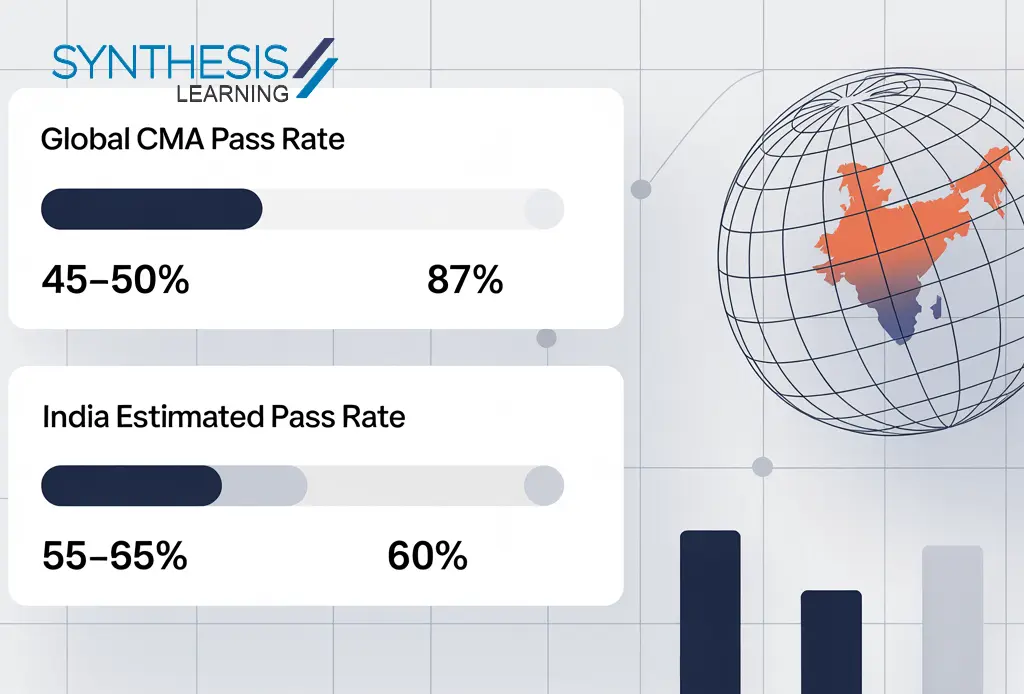
Globally, the CMA USA pass percentage typically falls in the 45% – 50% range per exam part. This figure represents a long-term historical average, not a fixed benchmark that applies uniformly to every exam window or candidate group.
It’s important to read this number correctly. A 45 – 50% US CMA pass percentage does not mean the exam is unpredictable or arbitrary. It reflects the professional depth the certification expects from candidates across different countries, academic systems, and work backgrounds.
Why is the CMA exam considered rigorous?
Several factors contribute to the global CMA passing rate:
Exam complexity
The CMA does not test rote learning. Questions are application-heavy, scenario-based, and often require multi-step reasoning.
Analytical depth
Candidates are expected to interpret data, evaluate options, and make management-level decisions – not just compute numbers.
Consistent global standards
The syllabus and evaluation criteria are uniform worldwide, regardless of where you take the exam.
In short, the CMA exam is designed to assess whether a candidate can think like a finance professional, not just pass a test.
CMA US Pass Percentage in India: A Detailed View
When we narrow the lens to Indian candidates, an interesting pattern emerges. Based on publicly available data and trends reported by training providers and candidate cohorts, the CMA US pass percentage in India is generally higher than the global average.
While exact official country-wise figures are not published annually, the US CMA pass percentage in India is often estimated to be in the 55% – 65% range per part.
Global vs India: A simple comparison
| Category | Approximate Pass Percentage |
| Global Average | 45% – 50% |
| India (Estimated) | 55% – 65% |
Why do Indian candidates perform better on average?
This difference in the CMA passing rate in India is usually attributed to a few structural advantages:
Strong academic foundation
Many Indian CMA aspirants come from commerce, accounting, engineering, or finance backgrounds, making it easier to adapt to quantitative and analytical content.
Exam-oriented preparation culture
Indian students are generally accustomed to structured study plans, mock testing, and disciplined revision cycles.
Early-career candidates
A large portion of Indian test-takers pursue the CMA alongside graduation or in the early stages of work, when study momentum is high.
That said, a higher average does not guarantee individual success. Preparation quality still plays the deciding role.
Key Factors That Determine Your CMA Passing Rate
Statistics provide context – but your personal CMA passing rate depends far more on how you prepare than on where you’re from.
Here are the most influential factors:
Quality of study material
CMA questions test application, not memory. Study material that explains concepts through business scenarios, decision-making frameworks, and integrated examples prepares you better than theory-heavy notes alone.
Consistency of study hours
Regular study over a longer period builds retention and confidence. Even 1.5–2 focused hours daily over several months is far more effective than irregular, high-intensity preparation close to the exam.
Practical exposure and conceptual clarity
Candidates who understand why a concept is used in business—rather than just how to calculate it—find it easier to handle case-based and essay-style questions.
Mock test performance and analysis
Writing mocks under timed conditions helps develop exam temperament. More importantly, analysing mock results highlights weak areas early, allowing targeted improvement before the actual exam.
Faculty guidance and coaching support
Good mentoring helps candidates interpret questions correctly, avoid common traps, and refine their exam approach—especially for structured and scenario-based responses.
Quick insight:
Most CMA failures are linked to exam strategy gaps, not lack of intelligence or effort.
After the Exam: Understanding Your CMA Result Percentage
Unlike many Indian exams, the CMA does not declare results as a simple percentage.
How the CMA scoring system works
- Scores are reported on a scaled range of 0 to 500
- The passing score is 360
- Results reflect both multiple-choice performance and essay evaluation
Because of this structure, the term CMA result percentage is often used informally. In reality, your score indicates how well you met the competency standard, not how many questions you got “right.”
What should you do after your results?
-
If you pass:
Move ahead with the next exam part or focus on completing experience requirements and certification formalities.
-
If you don’t clear:
Use the diagnostic score report to identify weak topic areas. Many candidates pass comfortably on their second attempt with targeted improvement.
-
Use the score constructively:
A score close to 360 usually signals conceptual gaps – not a lack of ability.
How Does CMA Compare to CFA and ACCA?
Many candidates evaluating the US CMA course also explore other global finance qualifications. Understanding the differences helps put pass rates into perspective.
The CFA Course
Offered by the CFA Institute, the CFA course is investment-focused and heavily oriented toward portfolio management, equity research, and financial analysis.
- Syllabus depth is extensive and theory-heavy
- Historical pass rates are generally lower, especially at Level I
- Best suited for capital markets and investment roles
The ACCA Course
The ACCA course, administered by ACCA, offers a broader accounting and audit framework.
- Modular structure with multiple papers
- Covers accounting, audit, taxation, and finance
- Pass rates vary significantly by paper and skill level
Compared to both, CMA stands out for its management accounting and strategic finance orientation, making it particularly relevant for corporate decision-making roles.
Conclusion: What the CMA Pass Percentage Really Tells You
The CMA pass percentage is a useful reference point – but it should never be the sole factor in your decision.
What matters more is how strategically you prepare, how well you understand application-based concepts, and how effectively you use feedback and mock performance to improve. Thousands of candidates clear the CMA exam every year – not because it is easy, but because it rewards structured, focused preparation.
If you approach the US CMA course with clarity and discipline, the statistics begin to work in your favour.
At Synthesis Learning, we support this structured preparation through expert-led coaching and personalised guidance. We also offer coaching for the
FAQ’s
1. Is the CMA USA pass percentage very low?
Not really. A 45 – 50% global average indicates a professional-level exam, not an unreasonably difficult one. Prepared candidates clear it consistently.
2. Is the US CMA pass percentage in India higher than the global?
Yes. Based on available trends, Indian candidates often record higher-than-average pass rates due to strong academic and preparation backgrounds.
3. Does failing once reduce future chances?
No. Many candidates clear the CMA on a second attempt after refining their study approach using the score report.
4. Is CMA easier than CFA or ACCA?
Each course tests different competencies. CMA focuses more on practical management decisions, while CFA and ACCA have different depth and scope. “Easier” depends on your career alignment and strengths.
Not really. A 45 – 50% global average indicates a professional-level exam, not an unreasonably difficult one. Prepared candidates clear it consistently.
Yes. Based on available trends, Indian candidates often record higher-than-average pass rates due to strong academic and preparation backgrounds.
No. Many candidates clear the CMA on a second attempt after refining their study approach using the score report.
Each course tests different competencies. CMA focuses more on practical management decisions, while CFA and ACCA have different depth and scope. “Easier” depends on your career alignment and strengths.