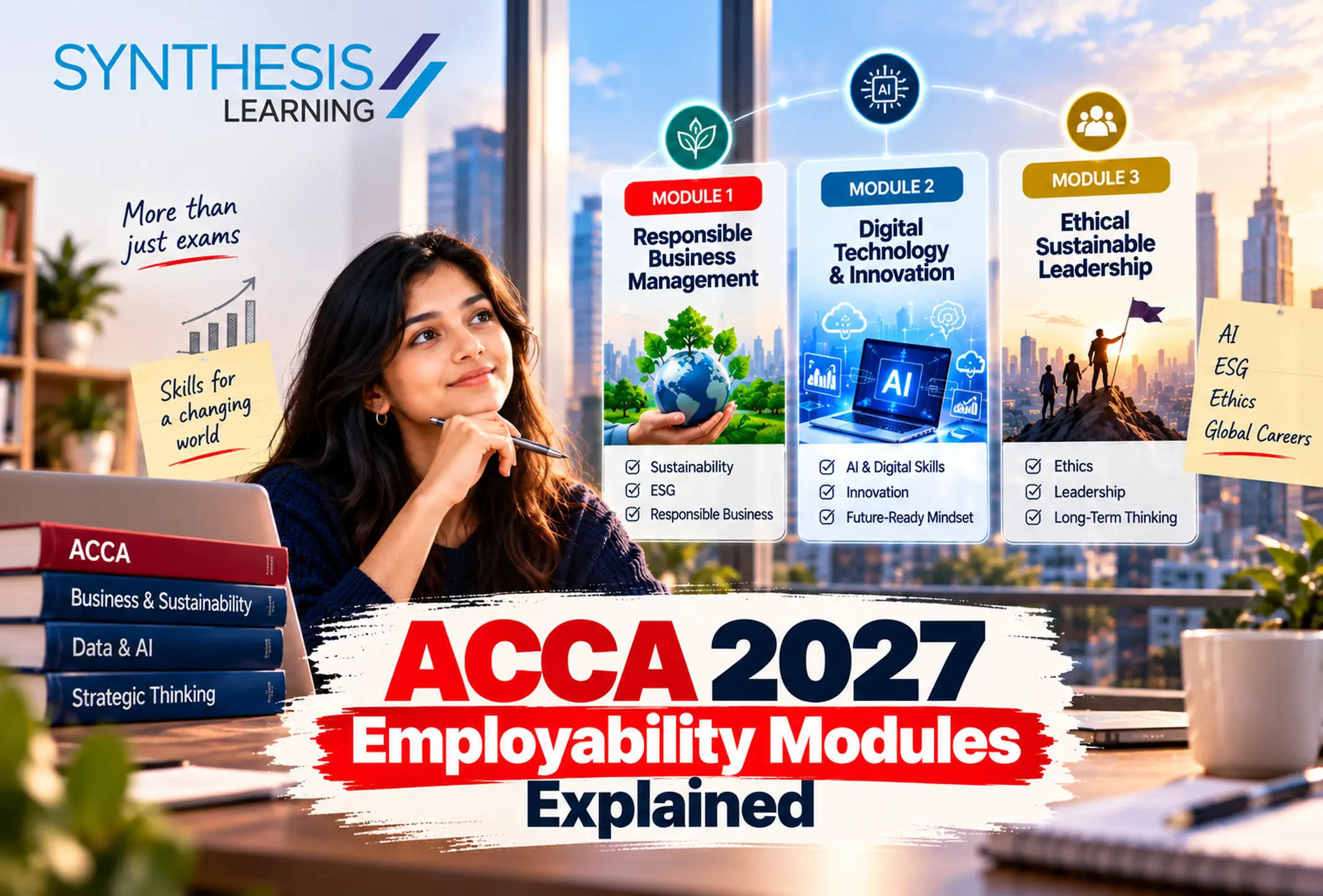

Choosing a professional accounting qualification is not just about exams.
It shapes:
- Your career direction
- Work style
- Geographic opportunities
- Learning experience for the next few years
Two qualifications that often come up in this conversation are ACCA and ACA.
Both are respected. Both can lead to strong careers in finance and accounting.
But they are built differently, and suit different types of students and career goals.
This guide will help you:
- Understand the real differences between ACCA and ACA
- Compare flexibility, structure, duration, costs, and career opportunities
- Decide which qualification aligns better with your long-term plans
Table of Contents
- What is ACCA PER? (Quick Overview)
- What is ACCA PER and Why It Matters
- How Many Months of Experience Do You Need?
- Understanding the Nine Performance Objectives
- How to Write Strong ACCA PER Statements
- ACCA Practical Experience Examples (Role-Based)
- What Does a PER Supervisor Do?
- How the PER Journey Changes with an ACCA Approved Employer
- Common Mistakes Students Make in PER
- PER and ACCA 2027: What Changes for Students?
- How Synthesis Learning Supports You Through PER
- Final Clarity: How to Approach PER Smartly
- FAQs on ACCA PER Examples
Quick Snapshot: ACCA vs ACA
Before going deeper, here’s a simple comparison overview:
| Factor | ACCA | ACA |
|---|---|---|
| Full Form | Association of Chartered Certified Accountants | Associate Chartered Accountant |
| Offered By | ACCA Global | ICAEW (Institute of Chartered Accountants in England and Wales) |
| Global Recognition | Strong globally | Strongest in the UK ecosystem |
| Flexibility | High | Moderate |
| Entry After 12th | Yes | Usually, an employer/training route |
| Exam Structure | Flexible exam attempts | Structured progression |
| Work Experience Model | Flexible PER | Formal training contract |
| Suitable For | Global finance careers | Traditional accounting/audit route |
| Popularity in India | Rapidly growing | Comparatively niche |
Quick insight:
This is not a “better vs worse” comparison.
It’s a “which ecosystem fits your goals better” decision.
What Is ACCA and Why Is It Popular?
Before comparing ACCA vs ACA, it helps to understand what ACCA actually offers.
What is ACCA?
ACCA stands for:
Association of Chartered Certified Accountants
It is one of the world’s most recognised accounting and finance qualifications.
ACCA professionals work across:
- Accounting
- Audit
- Consulting
- Financial analysis
- Corporate finance
- Multinational companies
Why ACCA Has Become Popular
ACCA has evolved beyond a traditional accounting qualification and is now widely associated with modern finance careers across multinational and global business environments.
ACCA Course Structure
| ACCA Level | Focus |
|---|---|
| Applied Knowledge | Accounting & business fundamentals |
| Applied Skills | Core finance and accounting subjects |
| Strategic Professional | Advanced professional-level concepts |
Students can begin ACCA after Class 12, subject to eligibility criteria.
Reality check:
ACCA offers flexibility, but flexibility also requires consistency and self-discipline.
Understanding ACA and Its Career Value
A common confusion among Indian students:
ACA here refers to the qualification offered by ICAEW (UK), not CA India.
What is ACA?
ACA stands for: Associate Chartered Accountant
It is offered by the Institute of Chartered Accountants in England and Wales (ICAEW)
What Does ACA Focus On?
ACA has a strong focus on:
- Accounting
- Audit
- Taxation
- Corporate finance
- Professional ethics
It is particularly respected within:
- UK accounting firms
- Traditional audit ecosystems
- Employer-led finance environments
How ACA Typically Works
Unlike ACCA’s flexible structure, ACA usually operates through:
- Employer-sponsored training contracts
- Structured progression pathways
- Integrated workplace training + exams
What this actually means:
ACA is often closely tied to your employer and training environment from the beginning.
ACCA vs ACA Course Structure and Exam Pattern
One of the biggest practical differences between the two qualifications is how the learning journey is structured.
| Area | ACCA | ACA |
|---|---|---|
| Number of Exams | 13 papers (before exemptions) | 15 modules |
| Exam Flexibility | Students choose an attempt pace | More structured progression |
| Study Mode | Independent or coaching-based | Usually employer-linked |
| Work Experience | Flexible PER model | Structured training agreement |
| Entry Route | Open entry pathways | Often tied to employer sponsorship |
ACCA Exam Structure
ACCA allows students to:
- Attempt exams one at a time every quarter.
- Plan papers based on comfort level
- Study alongside college or work
This creates more flexibility for students balancing multiple commitments.
ACA Exam Structure
ACA follows a more structured route:
- Exams are linked with training progression
- Students often study alongside employer training schedules
- Learning is more integrated into workplace development
Most aspirants miss this:
The qualification structure affects your daily lifestyle as much as your career outcome.
ACCA vs ACA Duration Comparison
A very common question:
“How long does ACCA or ACA realistically take?”
The answer depends heavily on:
- Exemptions
- Exam pace
- Work commitments
- Training structure
Typical Completion Time
| Qualification | Approximate Duration |
|---|---|
| ACCA | Around 2.5 – 4 years (depending on exemptions) |
| ACA | Around 3 – 5 years (no exemptions available) |
Why ACCA Duration Varies More
Because ACCA is flexible:
- Faster students can accelerate attempts
- Some students intentionally slow down alongside graduation or work
Why ACA Often Feels More Structured
ACA progression is usually linked with:
- Employer timelines
- Training contracts
- Organised exam schedules
This can create a more guided – but less flexible – experience.
Reality check:
The fastest route is not always the smartest route.
Sustainability matters more than speed.
ACCA vs ACA Differences Explained
Here’s a more detailed breakdown of ACCA vs ACA differences:
| Area | ACCA | ACA |
|---|---|---|
| Learning Style | Flexible & modular | Structured & employer-linked |
| Exam Attempts | Flexible scheduling | More fixed progression |
| Career Mobility | High internationally | Strongest within the UK ecosystem |
| Accessibility | More accessible globally | More employer-driven |
| Student Lifestyle Fit | Easier alongside college/work | Better for structured work environments |
| Finance Exposure | Broader corporate finance ecosystem | Traditional accounting focus |
The Biggest Practical Difference
ACCA gives students:
- More flexibility
- More independence
- Broader pacing control
ACA gives students:
- More structure
- More employer guidance
- Traditional professional training alignment
Neither system is inherently better.
They simply suit different types of learners.
ACCA vs ACA Cost Comparison
Cost is another major decision factor students should evaluate realistically.
Since fees can change yearly, exact figures vary depending on:
- Country
- Coaching provider
- Exam pace
- Exemptions
But here’s a broader comparison:
| Area | ACCA | ACA |
|---|---|---|
| Registration & Exam Fees | Moderate to high | Moderate to high |
| Coaching Costs | Flexible, depending on the provider | Often employer-supported |
| Additional Costs | Membership, exemptions, subscriptions | Training & professional fees |
| Overall Flexibility | Higher control over pacing & spending | More structured cost environment |
What This Actually Means
ACCA students often have:
- More flexibility in managing costs gradually
ACA students may experience:
- More employer-supported structures
- But less flexibility in pacing
Quick insight:
Students should evaluate not just the total cost, but also:
“How manageable is this financially over time?”
How the PER Journey Changes with an ACCA Approved Employer
One detail many students discover late is this:
Not all PER journeys feel the same.
ACCA has a network of organisations recognised as Approved Employers. These companies meet ACCA’s standards for areas such as:
- Training quality
- Work exposure
- Professional development
- Learning and support systems
What’s Different in This Setup?
| Aspect | Regular Workplace | ACCA Approved Employer |
|---|---|---|
| PER awareness | Depends on the manager | Structured and understood |
| Objective tracking | Student-driven | Often supported internally |
| Supervisor familiarity | May vary | Typically well-aligned with ACCA |
| Documentation process | Can sometimes feel unclear | More streamlined |
| Training framework | Varies by organisation | Built around professional development |
A Major Advantage: Simplified Performance Objective Sign-Off
There is another important benefit many students are unaware of.
If you work with an ACCA Approved Employer that has Trainee Development approval at Gold or Platinum level, you may be able to complete your Performance Objectives (POs) through a simplified route.
Why does this exist?
ACCA recognises that some organisations already have structured training programs, mentoring systems, and work exposure processes that naturally help trainees achieve the skills required under PER.
If your employer provides this level of support, ACCA may consider that training framework is sufficient to meet the Performance Objective requirements.
What this can mean for you:
✅ You may not need to individually record each Performance Objective in MyExperience
✅ You may achieve the objectives through the employer’s training and development process
✅ The PER process can become significantly simpler from a documentation perspective
However, there are a few important things to remember:
- You will still need to complete the minimum 36 months of relevant work experience
- You must still use MyExperience to record your employment information and indicate that you are working with an Approved Employer
Once your 36 months of experience are completed, MyExperience will guide you through downloading the Approved Employer PER confirmation form required for the process.
Why This Matters
In many cases:
- Students in regular roles often need to understand the PER process and manage documentation independently
- Students working in qualifying Approved Employer environments usually receive clearer guidance and more structured support
This does not automatically make one path better than the other, but having a workplace that already understands ACCA requirements can reduce confusion and administrative effort.
Reality check:
PER is manageable anywhere, but the environment can either
simplify it
or
make it unnecessarily confusing
What You Should Do as a Student
- Check if your company is an ACCA Approved Employer
- If not, ensure your role still provides:
Relevant exposure
A supportive supervisor
Most aspirants miss this:
Your job role matters, but your learning environment matters just as much.
Common Mistakes Students Make in PER
These are patterns seen across student discussions and forums:
- Writing vague or generic statements
- Copying examples from the internet
- Updating PER at the last moment
- Not aligning objectives with actual work
- Ignoring supervisor communication
- Forgetting to update MyExperience regularly
Reality check:
PER doesn’t become difficult because of complexity.
It becomes difficult when it’s delayed and rushed.
PER and ACCA 2027: What Changes for Students?
As ACCA gradually moves toward its broader qualification evolution around 2027, PER is expected to become more integrated with workplace learning.
Under the currently announced direction, students may see:
- 30 months of practical work experience
- 6 months of relevant workplace learning/training
- Greater emphasis on workplace application
- Stronger focus on digital and technology-enabled finance work
| Current Structure | Emerging 2027 Direction |
|---|---|
| 36 months of relevant experience | 30 months of experience + 6 months of relevant learning/training |
| Performance objectives | Broader workplace capability focus |
| Traditional role exposure | Greater technology, AI, and business applications |
Quick insight:
The objective isn’t simply reducing experience requirements.
It’s making professional learning more aligned with modern finance careers.
What this actually means:
Future finance professionals may increasingly need to demonstrate not only technical accounting skills, but also workplace adaptability and technology awareness.
How Synthesis Learning Supports You Through PER
Most students realise this late:
Clearing exams is one part. Structuring your journey is another.
At Synthesis Learning, the focus is on helping students connect:
study → skills → career outcomes
Here’s how that translates into PER support:
- Platinum Approved Learning Partner (ACCA) → structured academic foundation
- In-house ACCA Approved Employer (Ascentium India InCorp Advisory) → real exposure to work environments
- 1-on-1 mentorship & paper planning → guidance beyond classes
- Campus to Corporate Program → early career readiness
- Indian Tax Module → practical relevance in Indian roles
- 25+ years of experience supporting finance careers
What this actually means:
Many students figure out PER on their own.
Some complete it faster because they’re guided from the start.
Final Clarity: How to Approach PER Smartly
By now, you’ve probably realised:
- PER is not complicated, but it is unstructured
- There’s no single “right answer” – only clear, honest documentation
- Most delays happen because students start late
So a smarter approach looks like this:
- Start tracking your work early
- Choose objectives aligned with your role
- Write and update regularly (not at the end)
- Stay in touch with your supervisor
The question is no longer:
“How do I complete PER?”
It becomes:
“How do I approach it early enough to make it easy?”
FAQs on ACCA PER Examples
1. Can internships count toward ACCA PER?
Yes, internships can count if the work is relevant to accounting, finance, tax, or audit. The key is whether your responsibilities align with ACCA performance objectives.
2. Can I complete PER before finishing my ACCA exams?
Yes. PER can be completed before, during, or after your exams. Many students complete both in parallel.
3. How many performance objectives do I need for PER?
You need to complete 9 objectives – 5 essential and 4 technical – based on your work experience.
4. Can I use experience from different companies for PER?
Yes. ACCA allows you to combine experience from multiple employers, as long as the work is relevant and properly recorded.
5. What happens if my supervisor does not sign off my PER?
You may need to approach another qualified supervisor or move into a role where your work can be properly verified and approved.