
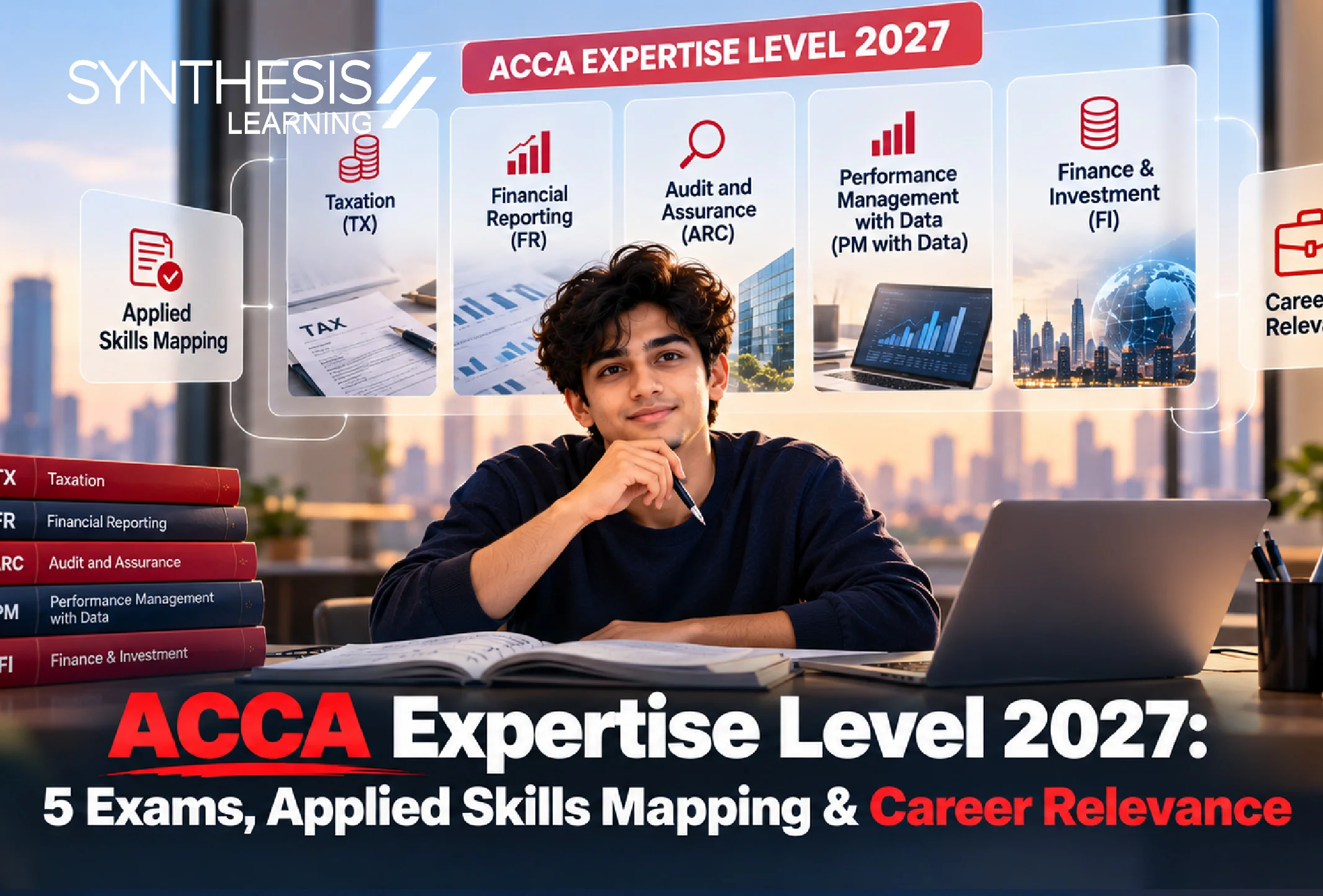
The ACCA Expertise Level is one of the biggest structural changes in the redesigned qualification launching from 2027.
It replaces the current Applied Skills stage – but this is more than a name change.
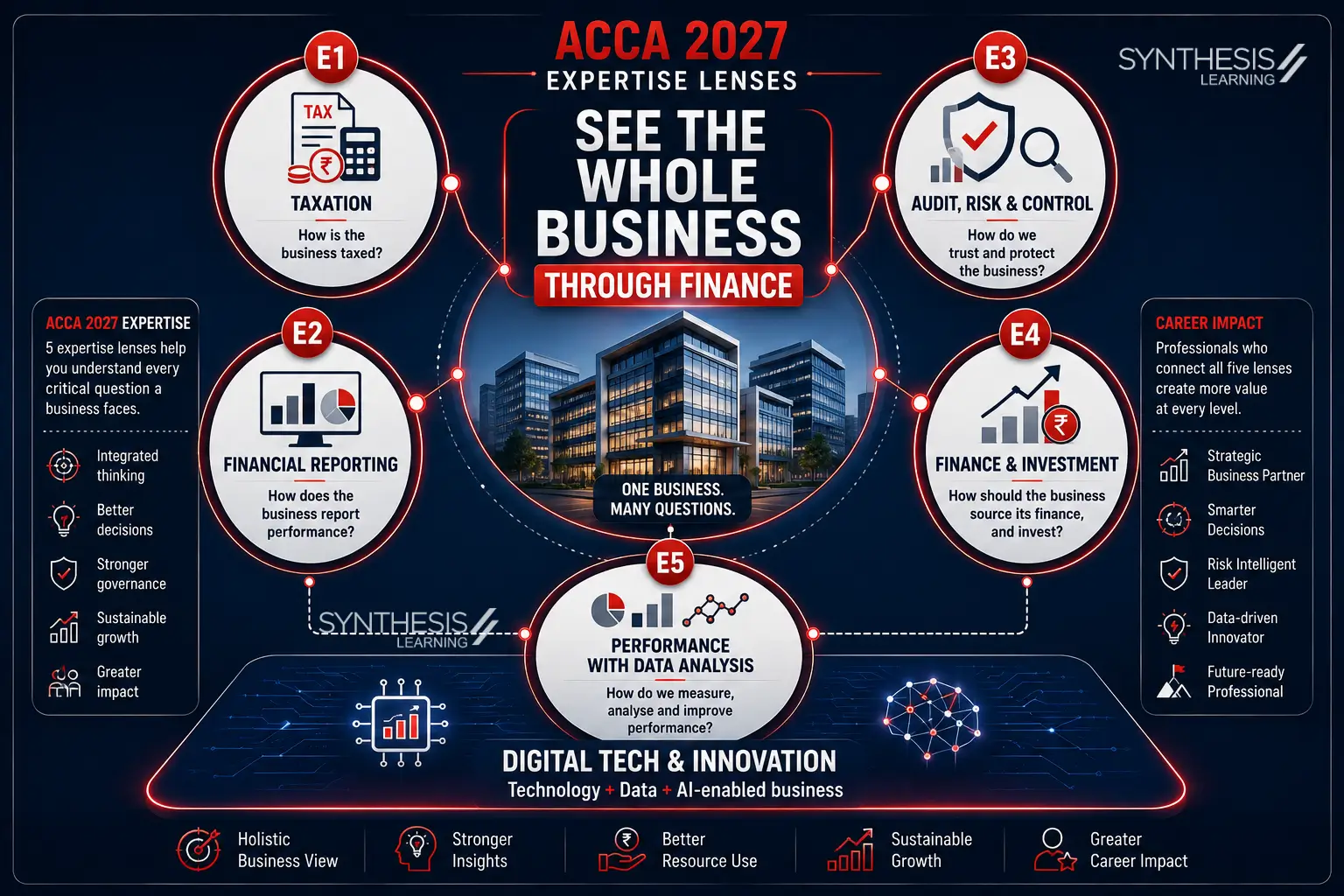
Expertise is designed to develop broad, practical finance capability across taxation, reporting, audit and risk, finance, performance and data.
Students will also complete a dedicated Digital Tech and Innovation Essential Employability Module, bringing technology and modern workplace capability directly into the level.
The bigger idea is simple:
Knowledge teaches the foundations. Expertise is where students increasingly learn to apply finance knowledge inside a real organisation.
What Is the ACCA Expertise Level?
Expertise is the middle level of the redesigned ACCA Qualification.
ACCA says it is designed to develop the strong, broad and practical finance qualities required of professional accountants across sectors and industries.
Students should be able to identify organisational issues, apply technical expertise and provide advice that adds value.
The level includes:
5 mandatory exams + 1 Essential Employability Module
Students complete these requirements before progressing to Strategic Professional.
Quick insight:
Expertise is not simply about knowing more technical rules. It is about knowing how to use finance knowledge professionally.
Where Does Expertise Fit in ACCA 2027?
The redesigned main ACCA Qualification has three levels:
KNOWLEDGE
Build core accounting, management accounting and business-law foundations.
↓
EXPERTISE
Develop broad practical finance, data and technology capability.
↓
STRATEGIC PROFESSIONAL
Develop strategic judgement, leadership and professional specialisation.
ACCA’s progression rules require students to progress through these levels sequentially, although exams within a level can generally be attempted in any order.
When does ACCA Expertise start?
- Digital Tech and Innovation:available from July 2027
- First Expertise exam sitting:September 2027
What Are the Five ACCA Expertise Exams?
Students at Expertise complete five mandatory exams.
| ACCA 2027 Expertise exam | Core focus |
| E1 Taxation | Applying taxation knowledge in professional and business contexts |
| E2 Financial Reporting | Preparing, analysing and interpreting financial information using relevant reporting principles |
| E3 Audit, Risk and Control | Assurance, audit judgement, risk assessment and internal controls |
| E4 Finance and Investment | Financing, investment and financial decision-making |
| E5 Performance with Data Analysis | Planning, performance evaluation, decision-making and data analysis |
These five areas give students a broad view of how finance operates across an organisation. ACCA describes the level as developing technical expertise that can contribute to longer-term business plans, systems, processes and strategic objectives.
Plus: Digital Tech and Innovation
The five exams sit alongside the Digital Tech and Innovation Essential Employability Module.
That matters because Expertise is not built around technical exams alone.
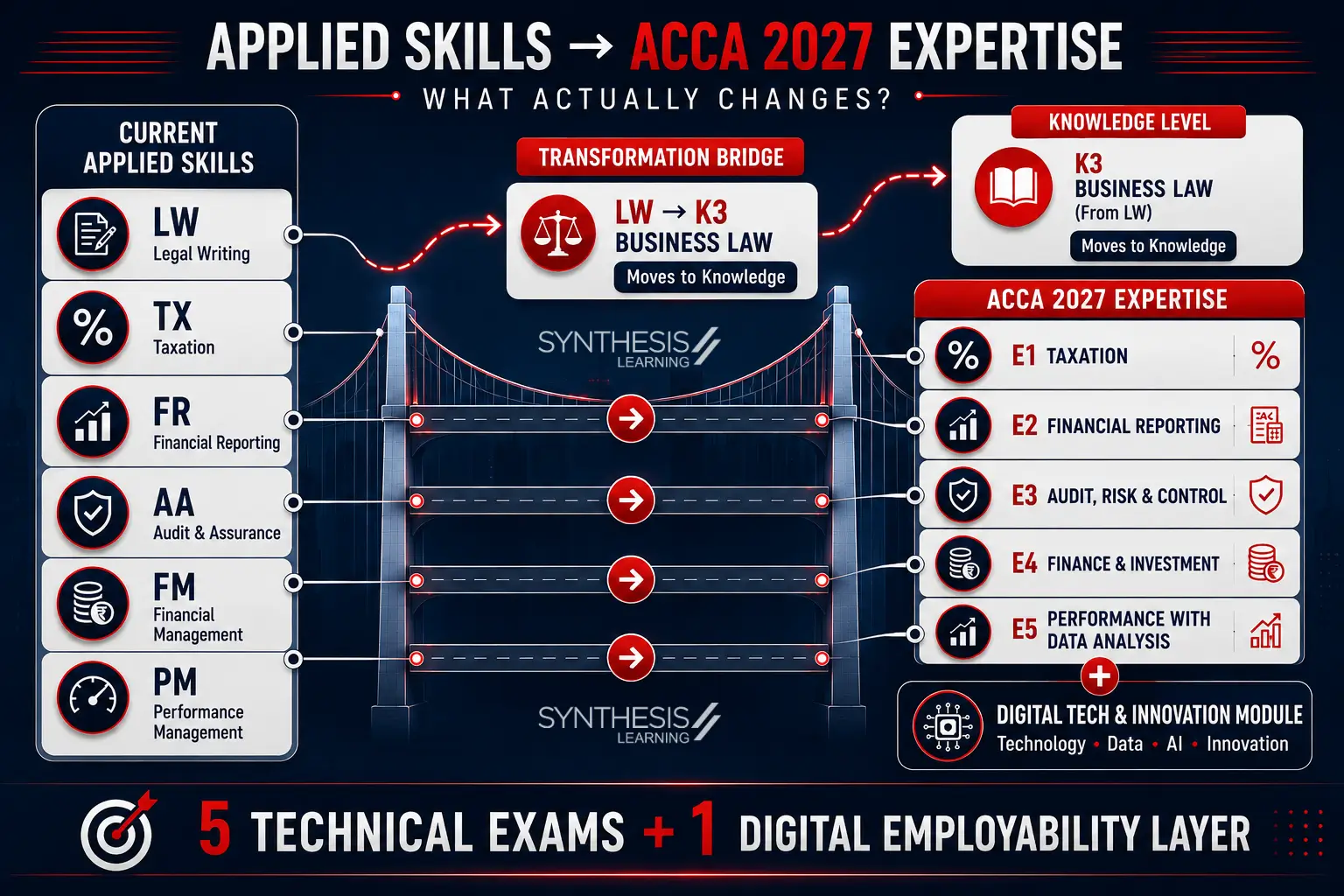
How Do Current Applied Skills Papers Map to ACCA Expertise?
Students already studying ACCA do not lose equivalent Applied Skills progress when the qualification changes.
The official transition mapping is:
| Current ACCA paper | ACCA 2027 equivalent |
| TX – Taxation | E1 Taxation |
| FR – Financial Reporting | E2 Financial Reporting |
| AA – Audit and Assurance | E3 Audit, Risk and Control |
| FM – Financial Management | E4 Finance and Investment |
| PM – Performance Management | E5 Performance with Data Analysis |
| LW – Corporate and Business Law | K3 Business Law at Knowledge Level |
ACCA confirms that equivalent completed elements receive transition credit.
So where did the sixth Applied Skills paper go?
It did not disappear.
Business Law moves earlier in the redesigned pathway, from Applied Skills to K3 Business Law at Knowledge.
Students who have not completed LW before transition will need to enter K3 before, or at the same time as, their Expertise exams.
Most aspirants miss this:
Applied Skills goes from six exams to five Expertise exams partly because Business Law moves to Knowledge.
What about the Digital Tech and Innovation credit?
Current students who complete all Applied Skills exams, including LW, before transition will not need to complete the future Digital Tech and Innovation module.
If Applied Skills is incomplete, equivalent passed papers still transfer, but the student will need Digital Tech and Innovation. ACCA currently expects that module to take approximately 100 hours for affected transition students.
For detailed individual cases, see ACCA 2027 Transition Rules Explained
Why Expertise Is More Than a Renamed Applied Skills Level
Applied Skills already develops strong, practical finance capability. The redesigned qualification builds on that rather than replacing something outdated.
What changes is how explicitly broader professional capability appears within the structure.
1. Applied Skills becomes applied expertise
ACCA describes Expertise students as being able to deal with varied contexts, identify internal and external business issues and provide value-adding advice.
2. Several subject areas become broader
Notice how the future paper names evolve:
AA → Audit, Risk and Control
FM → Finance and Investment
PM → Performance with Data Analysis
The technical foundation remains, but its connection with wider organisational decisions becomes more visible.
3. Data becomes explicit
Performance with Data Analysis combines performance-management capability with a clearer analytical layer.
Its published syllabus includes areas such as forecasting, regression, time series, performance analysis and evaluating how data can improve decisions.
4. Technology becomes structurally integrated
Every Expertise student must account for the Digital Tech and Innovation requirement, subject to transition credit.
5. Professional capability sits alongside technical knowledge
The redesigned level therefore develops:
finance knowledge + application + data + technology + judgement
What this actually means:
The shift is from simply learning finance subjects towards using finance expertise inside a modern business.
What Is the Digital Tech and Innovation Module?
Digital Tech and Innovation is the Essential Employability Module at Expertise Level.
Its published draft syllabus goes considerably beyond basic “technology awareness”.
Areas include:
- Digital transformation
- Programming applications for accountants
- Python and SQL
- Automated accounting workflows
- Data science and modelling
- AI and Large Language Models
- Governance, ethics and technology risk
- Data visualisation and storytelling
This does not turn ACCA into a coding qualification.
The objective is to develop finance professionals who can understand, use and question technology in increasingly digital business environments.
Quick insight:
ACCA is keeping finance at the centre while expanding the technology capability around it.
For a deeper explanation, see Does ACCA 2027 Include AI? and ACCA Employability Modules 2027 Explained
ACCA Applied Skills vs Expertise Level 2027
The redesign is best understood as an evolution—not “old finance” versus “modern finance”.
| Area | Current Applied Skills | ACCA 2027 Expertise |
| Tax | Taxation (TX) | E1 Taxation |
| Financial reporting | Financial Reporting (FR) | E2 Financial Reporting |
| Audit, assurance & risk | Audit and Assurance (AA) | E3 Audit, Risk and Control |
| Finance & investment decisions | Financial Management (FM) | E4 Finance and Investment |
| Performance & analytics | Performance Management (PM) | E5 Performance with Data Analysis |
| Business law | Corporate and Business Law (LW) | Moves earlier to K3 Business Law |
| Digital / employability layer | Technology and professional capability already feature across the current ACCA journey | Digital Tech and Innovation becomes a dedicated Expertise-level EEM |
| Technical exams at this stage | 6 | 5 |
| Overall emphasis | Broad applied technical and professional finance competence | Broad practical finance expertise with more explicit data, digital and advisory capability |
The current Applied Skills level already develops practical finance skills required of professional accountants.
The redesign makes data, risk, technology and wider business application more visible within the level architecture.
What Do You Receive After Completing ACCA Expertise?
Students who complete the five Expertise exams and the Digital Tech and Innovation requirement can earn the:
ACCA Advanced Diploma in Accounting and Business
ACCA benchmarks the Expertise Level at RQF Level 6, which is aligned academically with bachelor’s-degree level study.
Important distinction
RQF Level 6 does not mean completing the Expertise automatically gives you a bachelor’s degree.
It means the level is benchmarked at that academic level.
ACCA separately offers a route towards a BSc Professional Accountancy with the University of London while students continue progressing towards membership.
If exemptions apply, ACCA currently says students must still pass at least two Expertise exams to receive the Advanced Diploma.
What Career Relevance Does the Expertise Level Have?
Expertise does not train students for one narrow job.
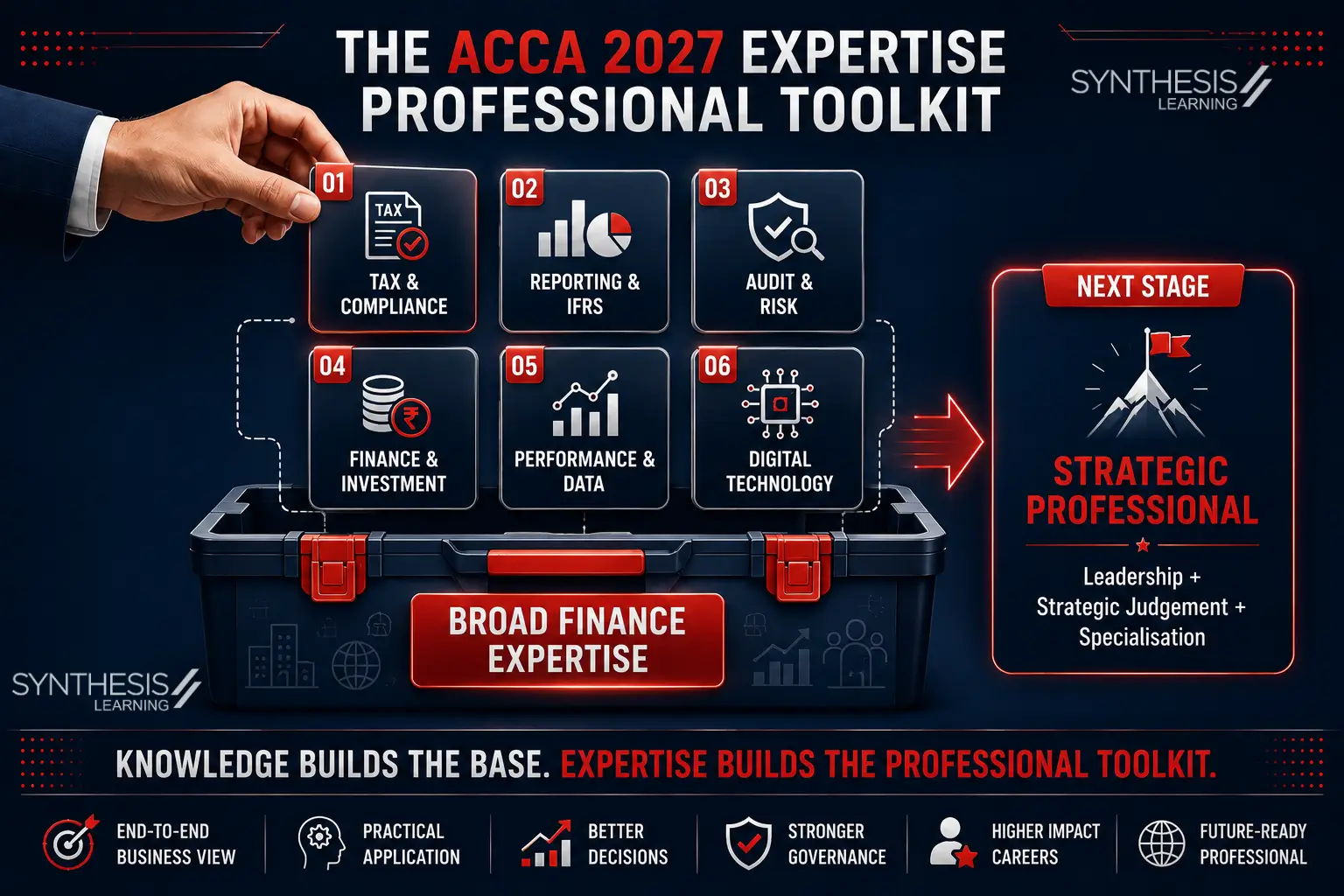
Its value comes from building a broad professional finance toolkit before students later specialise.
| Capability built across Expertise | Career relevance |
| Reporting & financial insight | Accounting, reporting, controllership and finance analysis |
| Risk, assurance & controls | External/internal audit, controls, assurance and risk |
| Commercial finance & investment thinking | Corporate finance, treasury and business-finance environments |
| Performance & data-led decision-making | FP&A, performance management and business partnering |
| Tax & regulatory understanding | Tax and finance roles where taxation affects business decisions |
| Digital business capability | Finance transformation and technology-enabled finance environments |
Career outcomes still depend on experience, skills, employer and role.
But the Expertise Level helps students build breadth across several finance disciplines before deciding where they eventually want deeper specialisation.
The value of Expertise is not that E1 leads to Job A and E5 leads to Job B. It is that the five areas together help build a more complete finance professional.
What Comes After ACCA Expertise?
After completing the Expertise requirements, students progress to Strategic Professional, the final exam level of the redesigned qualification.
The future structure requires:
2 compulsory exams + 1 optional exam + the relevant Essential Employability Module.
This stage moves from broad finance expertise towards strategic judgement, leadership and chosen professional specialisation.
Knowledge builds the foundation. Expertise builds breadth. Strategic Professional adds leadership and specialisation.
ACCA Strategic Professional Level 2027 — Complete Guide
From Technical Knowledge to Professional Expertise: The Synthesis Learning Approach
Expertise is the stage where students increasingly need to move beyond:
“Do I know this concept?”
towards:
“Can I apply it, analyse the situation and reach a professional conclusion?”
That shift also changes how preparation should work.
Synthesis Learning – a House of Global Courses with 25+ years of legacy in business and finance education and an ACCA Platinum Approved Learning Partner – supports students through:
- Concept-first learning
- Application-focused question practice
- 1-on-1 mentorship and paper planning
- Structured doubt-solving
- Tests and exam-focused mocks
- Future-finance and technology awareness
- Professional communication and career readiness
- Employer exposure through the wider Ascentium India ecosystem
The redesigned Expertise Level also fits naturally with a broader career-readiness approach: students need technical knowledge, but increasingly they also need to become confident working with data, technology, business context and professional judgement.
Expertise is where ACCA increasingly asks students to think less like exam candidates and more like finance professionals. Preparation should evolve in the same direction.
What Should You Take Away?
The ACCA Expertise Level 2027 replaces Applied Skills – but treating it as only a new name misses the bigger change.
Students still build strong capability across taxation, reporting, audit, finance and performance.
What evolves is the layer around those subjects:
risk + investment + data + technology + professional application
Business Law moves to Knowledge. Five technical exams remain at Expertise. Digital Tech and Innovation becomes part of the level’s progression.
The result is a stage designed to build broad, practical finance expertise before students move into leadership and specialisation at Strategic Professional.