The accounting profession is changing faster than most students realise.
AI is automating routine work. Data analytics is becoming part of finance decision-making. ESG reporting is moving from “extra knowledge” to a serious business requirement.
Employers now want finance professionals who can do more than prepare reports; they want people who can interpret information, advise decisions, and understand how business actually works.
From 2027 onwards, ACCA is moving towards a more future-ready structure with fewer exams, stronger employability modules, deeper digital exposure, and clearer links to modern finance careers.
This guide will help you understand:
- When the ACCA syllabus 2027 will be introduced
- What the new ACCA exam structure looks like
- What changes for Indian students
- How current ACCA students will transition
- Whether you should start ACCA before or after 2027
- How the new syllabus supports AI, ESG, data, and global finance careers
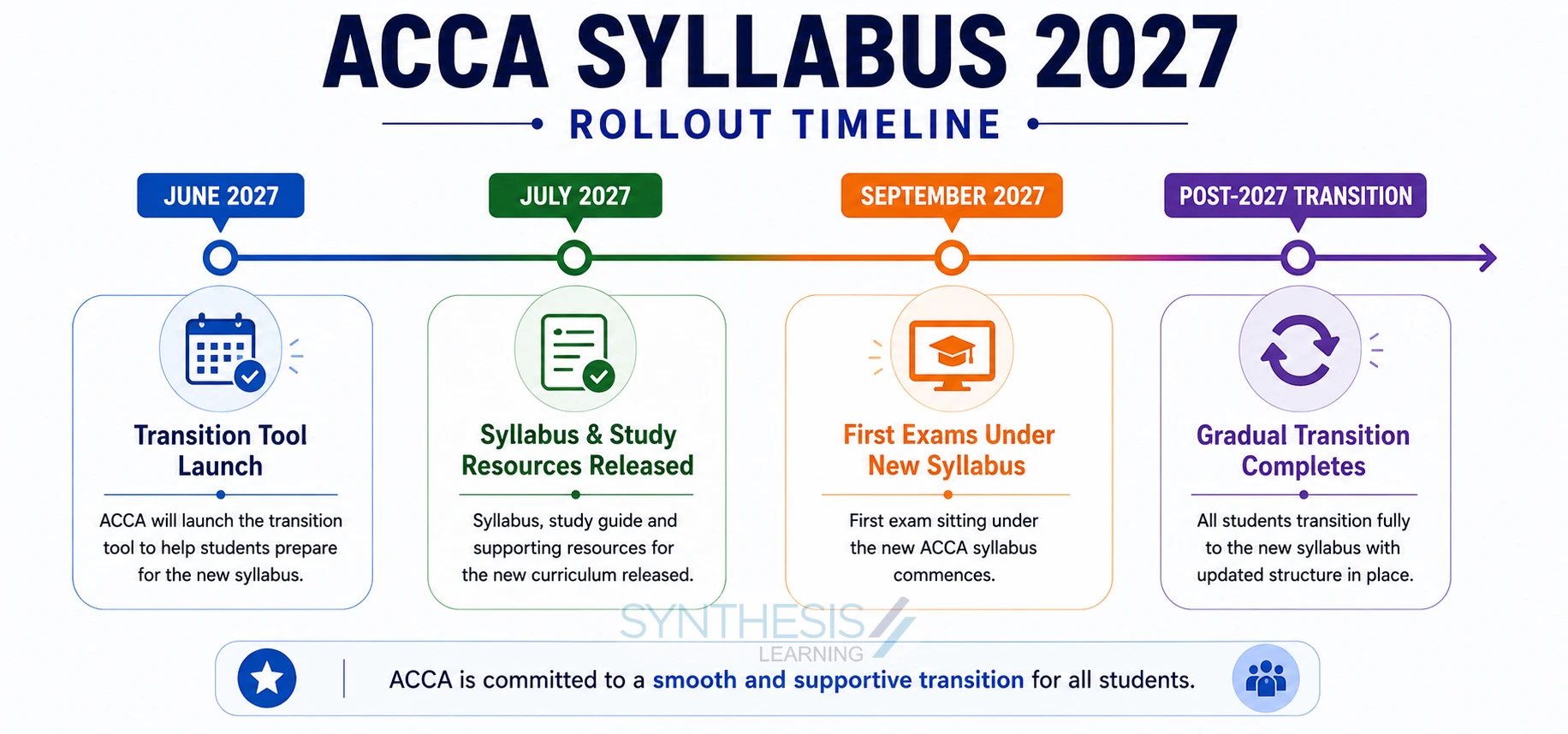
The ACCA syllabus 2027 will be rolled out in phases.
The new Foundations and Knowledge level exams are expected to begin from July 2027, while the new Expertise and Strategic Professional level exams begin from the September 2027 exam session.
For current ACCA students, this does not mean everything changes overnight. The existing qualification structure continues until the transition point, and ACCA has created transition tool support to help students move from the current structure to the new one.
ACCA Syllabus 2027 Timeline
| Timeline | What Happens | Who It Affects |
|---|---|---|
| Until June 2027 | Current ACCA structure continues. | Existing ACCA students. |
| July 2027 | Foundations and Knowledge level exams under the new structure begin. | Students entering these levels. |
| September 2027 | Expertise and Strategic Professional exams under the new structure begin. | New and transitioning students. |
| 2027 onwards | Essential Employability Modules become part of the qualification journey. | Students under the new structure. |
Quick insight
The ACCA syllabus 2027 is not a sudden reset.
It is a planned transition from the current qualification to a redesigned, future-focused structure.
ACCA Syllabus 2027 rollout timeline for students
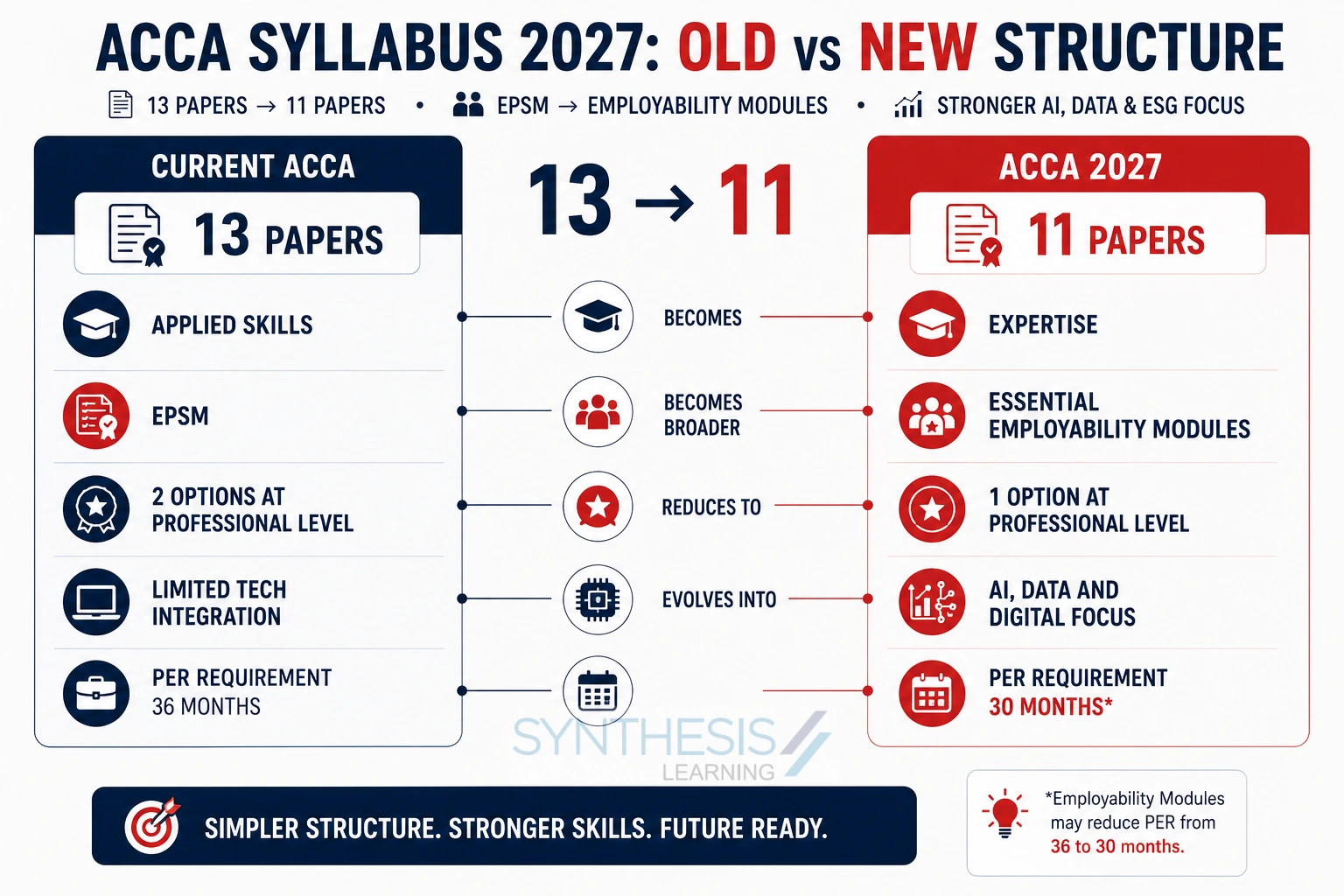
ACCA Syllabus from 2027: Old vs New Structure at a Glance
Before going level by level, it helps to see the complete shift in one place.
The biggest visible change is that ACCA is reducing the number of exams from 13 to 11. The new structure brings stronger employability modules, more data and technology integration, and greater focus on sustainability and strategic thinking.
ACCA Syllabus 2027: Old vs New Comparison
| Feature | Current ACCA Structure | New ACCA 2027 Structure |
|---|---|---|
| Total exams | 13 exams | 11 exams |
| Main levels | Applied Knowledge, Applied Skills, Strategic Professional | Knowledge, Expertise, Strategic Professional |
| Foundations route | Existing Foundations in Accountancy route | Simplified Foundations route for students who do not meet minimum entry requirements |
| Knowledge level | 3 papers | 3 papers |
| Skills / Expertise level | Applied Skills: 6 papers | Expertise: 5 papers |
| Strategic Professional level | 4 papers: 2 compulsory + 2 options | 3 papers: 2 compulsory + 1 option |
| Ethics/skills module | EPSM | Essential Employability Modules across stages |
| Data and technology focus | Present but limited | Stronger AI, data, digital, and analytics integration |
| Sustainability focus | Present in selected areas | More embedded across reporting, audit, leadership, and business decision-making |
| Practical Experience Requirement | 36 months | 36 months, with a possible 30-month route through certain optional employability modules |
What this actually means
The new ACCA structure is leaner, but not lighter in purpose.
It reduces some exam load, but increases focus on the skills students need in modern finance roles; especially digital awareness, ESG understanding, business communication, and applied decision-making.
ACCA Syllabus 2027 rollout timeline for students
Why Is ACCA Changing Its Syllabus From 2027?
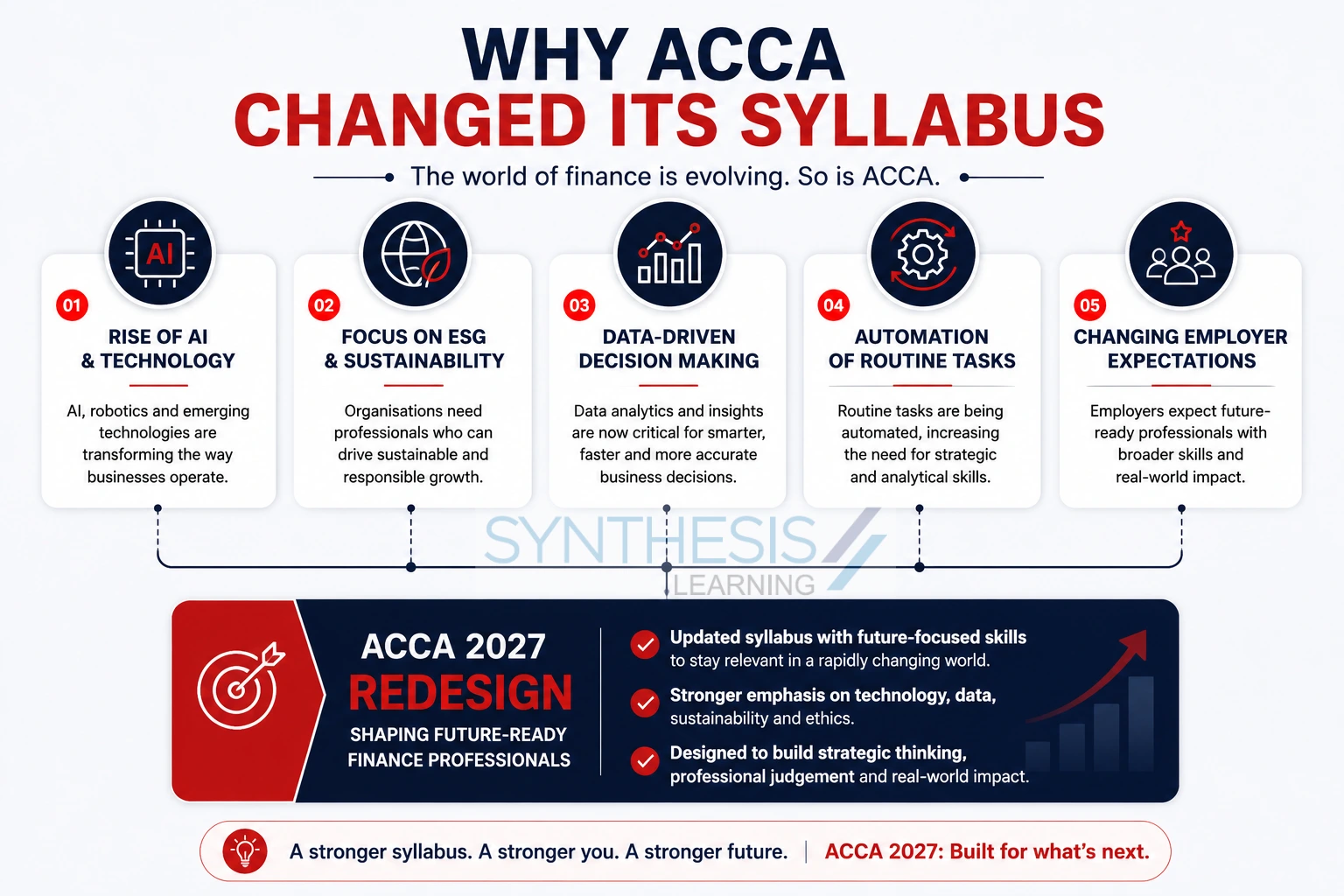
ACCA has decided to change its syllabus because the role of finance professionals is changing.
Earlier, accounting careers were heavily associated with bookkeeping, reporting, audit files and compliance deadlines. These areas still matter, but they are no longer enough on their own.
Employers now expect finance professionals to understand technology, interpret data, communicate insights, and support business decisions.
Major reasons behind the ACCA 2027 syllabus update
| Reason | Why It Matters |
|---|---|
| AI and automation | Routine accounting work is increasingly becoming automated. |
| Data analytics | Finance teams are expected to interpret and analyse data, not just prepare reports. |
| ESG and sustainability | Businesses increasingly need sustainability reporting and assurance capabilities. |
| Strategic finance roles | Employers want finance professionals who can advise and support decision-making, not just calculate. |
| Employability gap | Students need stronger communication, judgement, leadership, and digital skills. |
Quick insight
ACCA is not only updating what students study.
It is updating the kind of professional that the qualification will produce.
ACCA Syllabus 2027 rollout timeline for students
New ACCA Qualification Pathway Explained
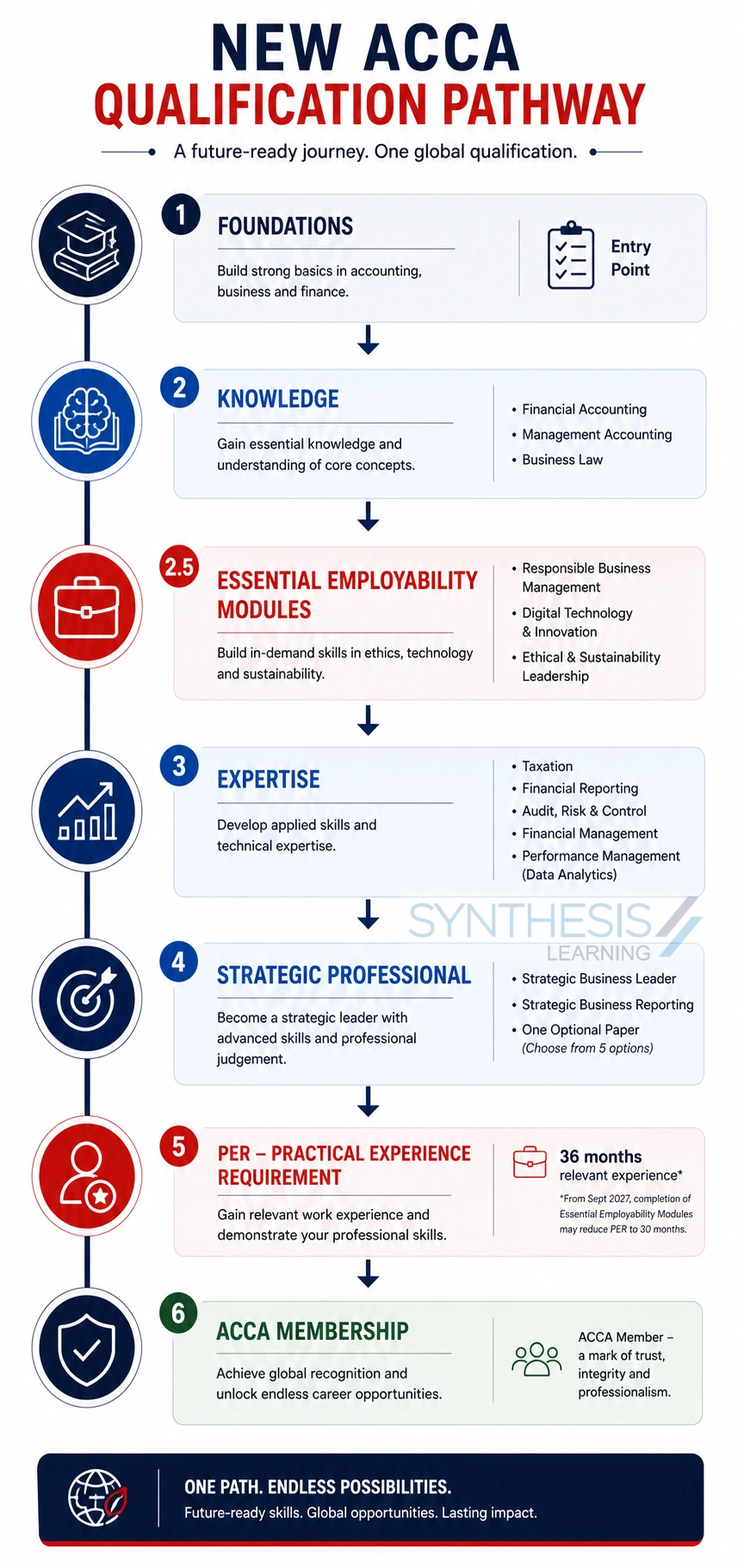
The future ACCA qualification includes:
- Foundations
- Knowledge
- Expertise
- Strategic Professional
- Essential Employability Modules
- Optional Employability Modules
- Practical Experience Requirement
- ACCA membership
However, every student does not necessarily begin at the Foundations level.
Students who meet ACCA’s minimum entry requirements usually begin at the Knowledge level.
The Foundations route is mainly for students who need an entry pathway before progressing into the ACCA Qualification.
Reality check
Do not confuse “passing ACCA exams” with “becoming an ACCA member.”
To become a member, students must complete the required exams, modules, and practical experience.
ACCA Syllabus 2027 rollout timeline for students
Foundations Level: Building Strong Accounting Basics
The Foundations level is designed for students who do not yet meet the minimum entry requirements for the main ACCA Qualification or need a stronger starting point.
It is also useful for learners who are new to accounting and need a step-by-step introduction before entering higher-level ACCA papers.
Foundations Level Papers
| Paper | Focus Area |
|---|---|
| F1 Accounts Preparation | Basic accounting and financial records |
| F2 Management Information and Costing | Costing and internal business information |
| F3 Decision Making with Data | Data-led decision support |
Students at this level also complete the Enterprise and Entrepreneurship Essential Employability Module.
Who is this level relevant for?
- Students who do not meet direct ACCA entry criteria
- Learners from non-commerce backgrounds
- Career changers who need accounting basics
- Students who need a smoother route into ACCA
What this actually means
For most Indian students who start ACCA after Class 12 and meet the required eligibility, the journey usually begins at the Knowledge level.
Foundations should be seen as an entry route, not as an extra level every student must complete.
Knowledge Level: Developing Core Accounting Skills
The Knowledge level builds the core base required for the rest of the ACCA Qualification.
It introduces students to financial accounting, management accounting and business law; three areas that help them understand how organisations record information, use information and operate within legal frameworks.
Knowledge Level Subjects
| Paper | Subject | What Students Learn |
|---|---|---|
| K1 | Financial Accounting | Accounting principles, financial records, and reporting basics |
| K2 | Management Accounting | Costing, budgeting, and internal decision support |
| K3 | Business Law | Legal principles relevant to business and finance |
The Knowledge level is also linked with the Responsible Business Management Essential Employability Module.
What makes this level different?
Compared to the current structure, one visible change is the inclusion of Business Law within the Knowledge level.
This helps students understand the legal and business environment earlier in their ACCA journey.
Quick insight
Knowledge level is not just about “basic papers.”
It builds the language students need before entering technical finance, reporting, audit and performance subjects.
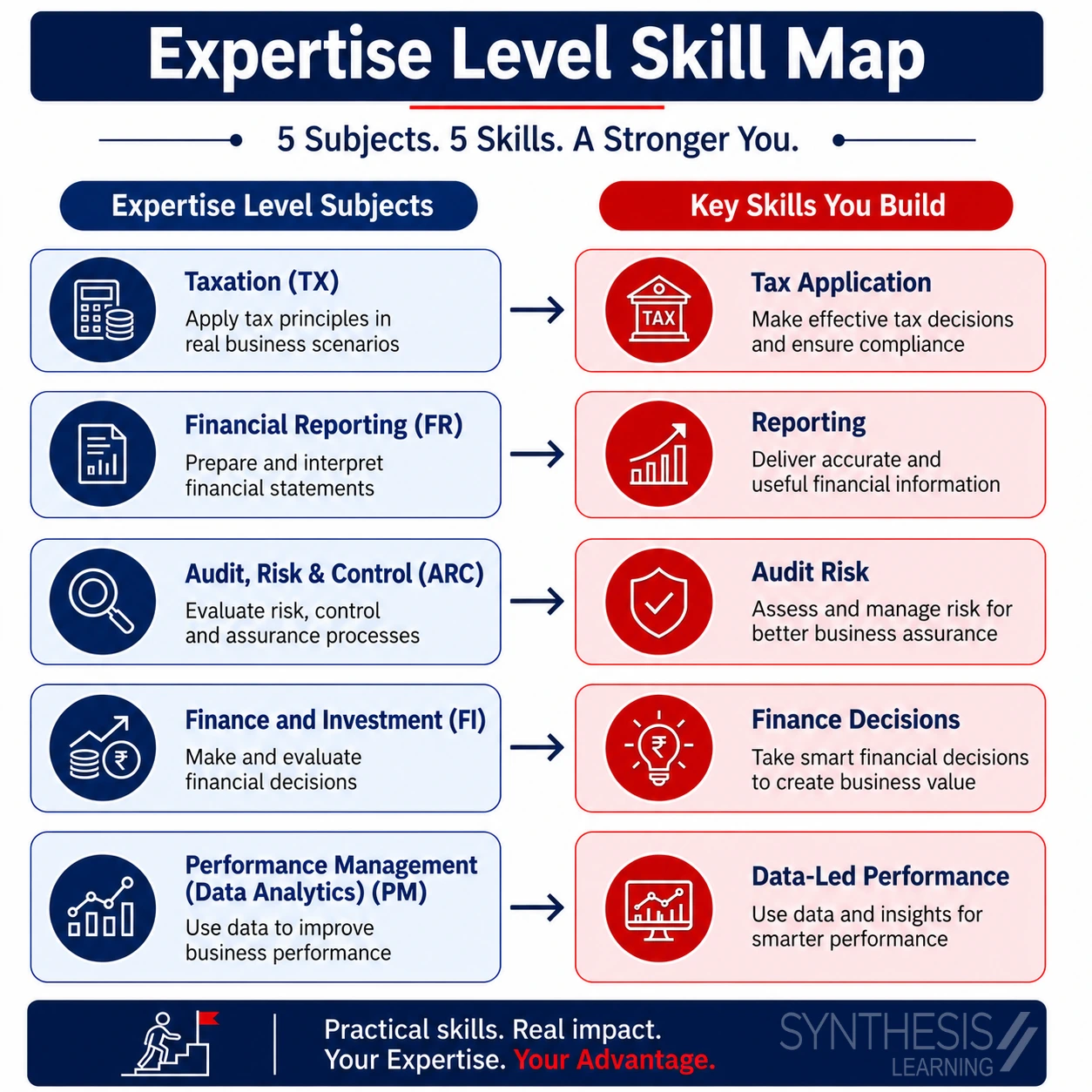
Expertise Level: Building Technical and Analytical Excellence
The Expertise level replaces the earlier Applied Skills level.
This is where students move from foundational understanding to applied technical competence. The level includes taxation, financial reporting, audit, finance, investment and performance; but with stronger data, risk and practical decision-making focus.
Expertise Level Subjects
| Paper | Subject | Key Focus |
|---|---|---|
| E1 | Taxation | Tax systems and application |
| E2 | Financial Reporting | IFRS, financial statements, groups, analysis, and sustainability concepts |
| E3 | Audit, Risk and Control | Audit process, risk assessment, internal controls, and evidence |
| E4 | Finance and Investment | Investment decisions, valuation, finance, and risk management |
| E5 | Performance with Data Analysis | Costing, budgeting, performance, and data interpretation |
Skills students develop at Expertise level
- Technical accounting application
- Financial analysis
- Audit and risk understanding
- Business decision-making
- Data interpretation
- Sustainability awareness
- Performance management
Most aspirants miss this
The name change from “Skills” to “Expertise” is not just cosmetic.
It signals that ACCA wants students to develop stronger applied capability before reaching Strategic Professional level.
ACCA Syllabus 2027 rollout timeline for students
Strategic Professional Level: Preparing Future Finance Leaders
The Strategic Professional level is designed for advanced decision-making, advisory thinking and leadership-oriented finance roles.
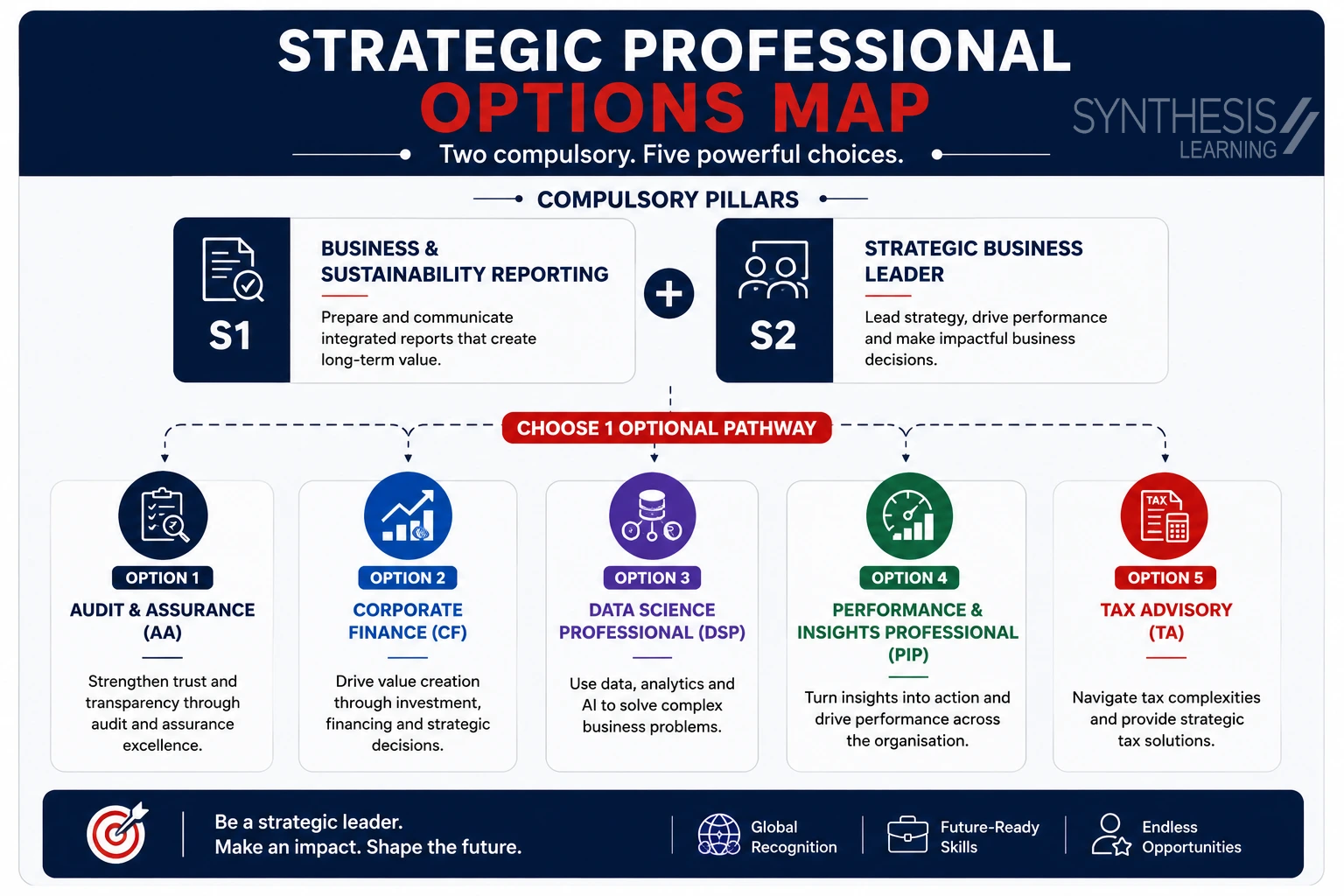
Under the ACCA syllabus 2027 structure, students complete:
- S1 Business and Sustainability Reporting
- S2 Strategic Business Leader
- One optional paper
This is a major change from the current structure where students complete two optional papers.
Strategic Professional Papers
| Type | Paper | Focus |
|---|---|---|
| Compulsory | S1 – Business and Sustainability Reporting | Advanced reporting + sustainability reporting |
| Compulsory | S2 – Strategic Business Leader | Strategy, leadership, governance, risk, technology and business decisions |
| Optional | One paper from the options list | Career-specific specialisation |
Strategic Professional Optional Papers
| Option | Best Suited For Students Interested In |
|---|---|
| Audit and Assurance Professional | Audit, assurance, risk and professional practice |
| Corporate Finance Professional | Valuation, investment decisions, mergers, finance strategy |
| Data Science Professional | Data analytics, AI-era finance, business intelligence |
| Performance and Insights Professional | Performance strategy, insights and management decision-making |
| Taxation Advisory Professional | Advanced tax planning and advisory roles |
Quick insight
The addition of Data Science Professional is one of the clearest signals of ACCA’s future direction.
It shows that data, analytics and technology are becoming central to the finance profession, not separate from it.
ACCA Syllabus 2027 rollout timeline for students
Fewer Exams, Greater Career Focus
The reduction from 13 exams to 11 exams is one of the most discussed changes happening in the ACCA qualification in 2027.
But students should be careful not to interpret this as “ACCA is becoming easy.”
A better way to understand the change is this:
ACCA is reducing repetition and increasing career relevance.
What fewer exams may indicate
| Change | Meaning |
|---|---|
| 13 exams reduced to 11 | Leaner qualification structure |
| Strategic options reduced from 2 to 1 | More focused specialisation |
| Employability modules added | Skills built beyond exam papers |
| Data and ESG embedded | Stronger workplace relevance |
Reality check
Fewer exams may reduce structural burden, but the qualification still expects students to apply concepts, analyse scenarios and think professionally.
The new ACCA syllabus rewards clarity, application and judgement, not shortcuts.
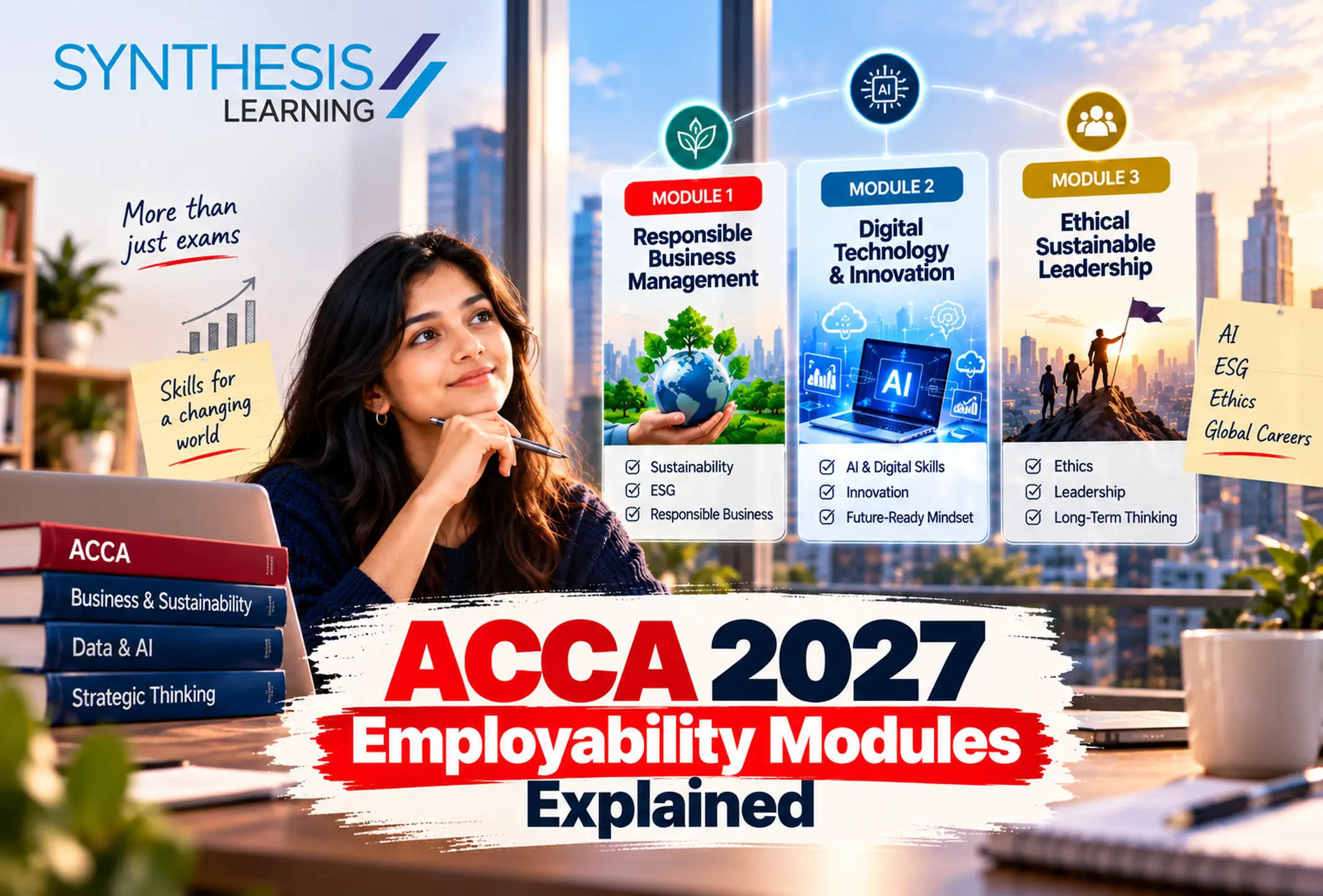
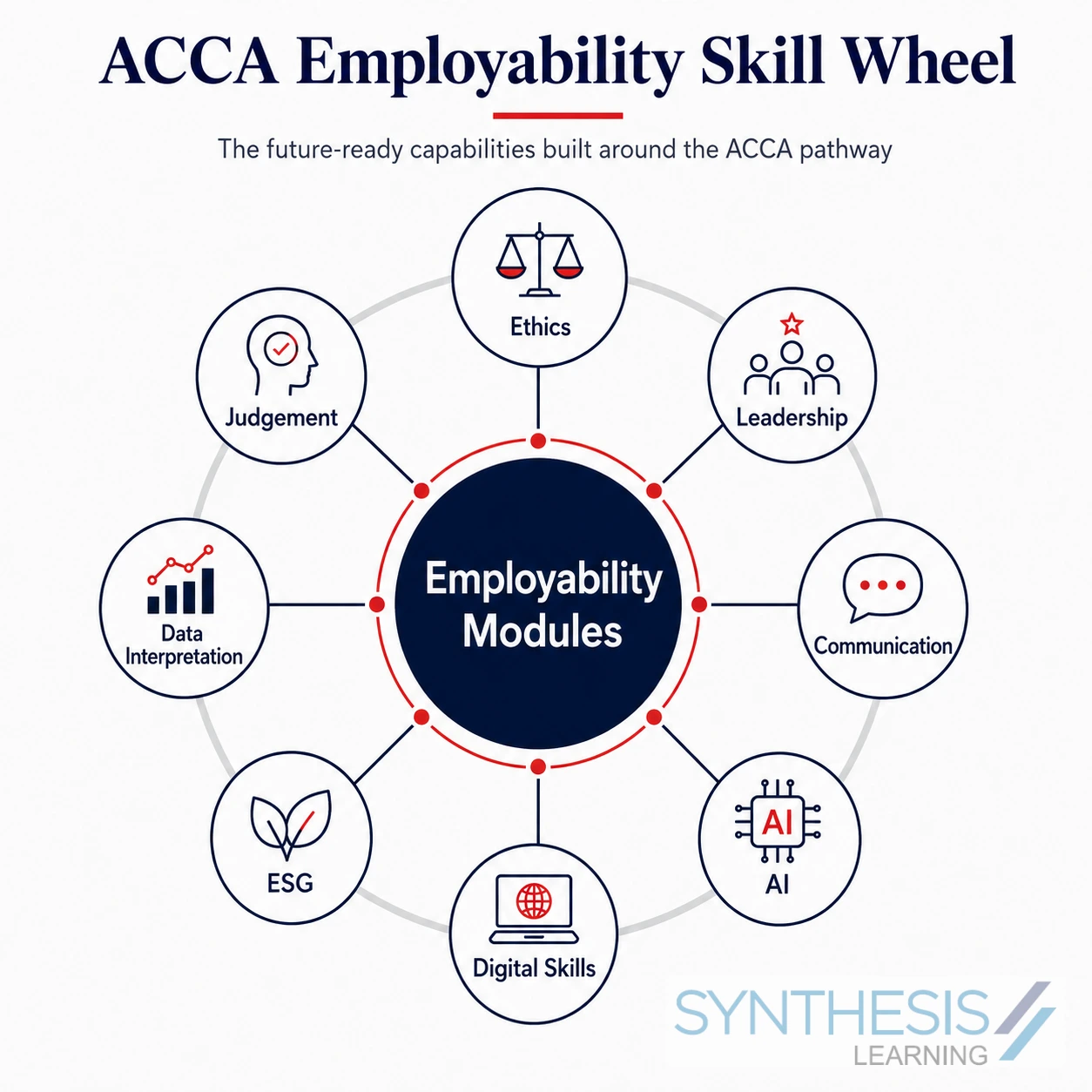
ACCA Employability Modules Explained
One of the most important changes in the ACCA syllabus 2027 is the introduction of Essential Employability Modules.
These modules are designed to build workplace skills throughout the qualification, rather than keeping professional skills as a separate end-stage requirement.
Essential Employability Modules
| Stage | Module | Broad Focus |
|---|---|---|
| Foundations | Enterprise and Entrepreneurship | Business basics and enterprise thinking |
| Knowledge | Responsible Business Management | Business activity, ethics, sustainability and operations |
| Expertise | Digital Tech and Innovation | Technology, AI, data science, innovation and digital business |
| Strategic Professional | Ethical, Sustainable Leadership | Leadership, ethics, sustainability and professional judgement |
Essential vs Optional Employability Modules
| Type | Meaning |
|---|---|
| Essential Employability Modules | Compulsory modules linked to qualification progression |
| Optional Employability Modules | Additional modules designed to build specific workplace skills and may support employability outcomes |
What this actually means
ACCA is moving beyond the idea that students should only study papers and later figure out workplace skills on their own.
The new structure builds employability into the qualification journey.
ACCA Syllabus 2027 rollout timeline for students
Practical Experience Requirement: What’s Changing?
The Practical Experience Requirement, commonly called PER, remains a key part of becoming an ACCA member.
Students are still expected to complete workplace experience and performance objectives. This is because ACCA membership is not based only on exams, it also requires practical professional development.
PER under the ACCA 2027 structure
| Area | Requirement |
|---|---|
| Standard PER | 36 months of relevant workplace experience |
| Performance objectives | Required as part of professional development |
| Optional employability route | Certain optional modules may allow up to 6 months of PER credit |
| Possible reduced experience route | 30 months, if eligible conditions are met |
Reality check
PER is often misunderstood.
Passing ACCA exams makes a student an ACCA Affiliate. Completing PER and other membership requirements moves the student towards ACCA membership.
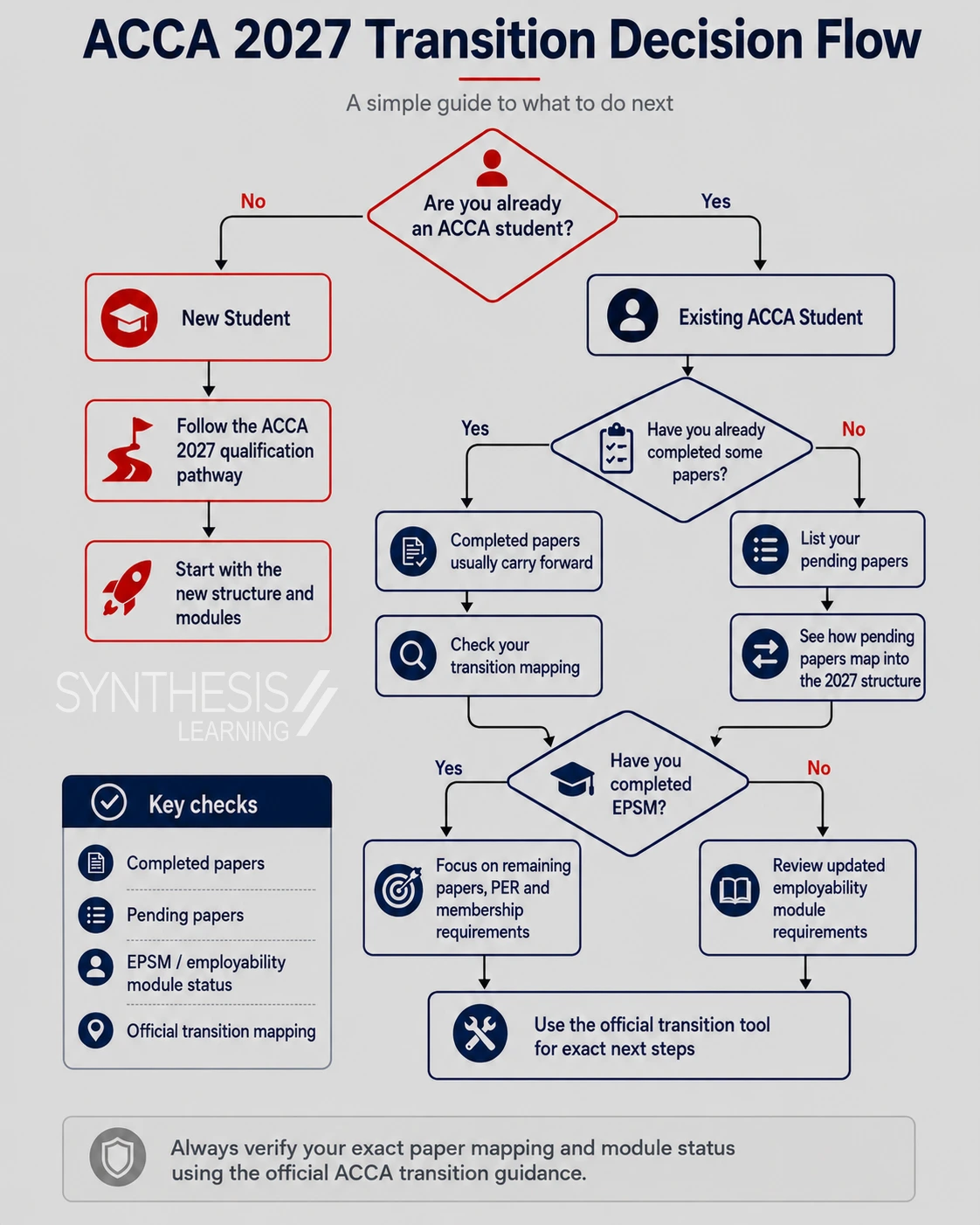
Transition Rules for Existing ACCA Students
Existing ACCA students do not need to panic.
ACCA has designed arrangements and created a transition tool, so students can move from the current structure to the new structure without losing valid exam progress.
What current ACCA students should know
| Student Situation | Likely Impact |
|---|---|
| Completed exams before transition | Completed exams remain recognised under transition rules |
| Some papers pending after June 2027 | Student moves into the mapped new structure |
| EPSM completed | Relevant credit may apply under transition mapping |
| Starting ACCA in 2026 | Student may experience transition depending on exam progress |
| Starting in 2027 or later | Student may directly follow the new structure depending on registration timing |
What students should do
- Track completed papers
- Check ACCA’s official transition tool
- Avoid making assumptions based on rumours
- Plan attempts based on preparation, not fear
- Speak to an ACCA mentor if unsure
Quick insight
The transition is designed to protect progress.
Students should focus on planning intelligently rather than rushing blindly.
ACCA Syllabus 2027 rollout timeline for students
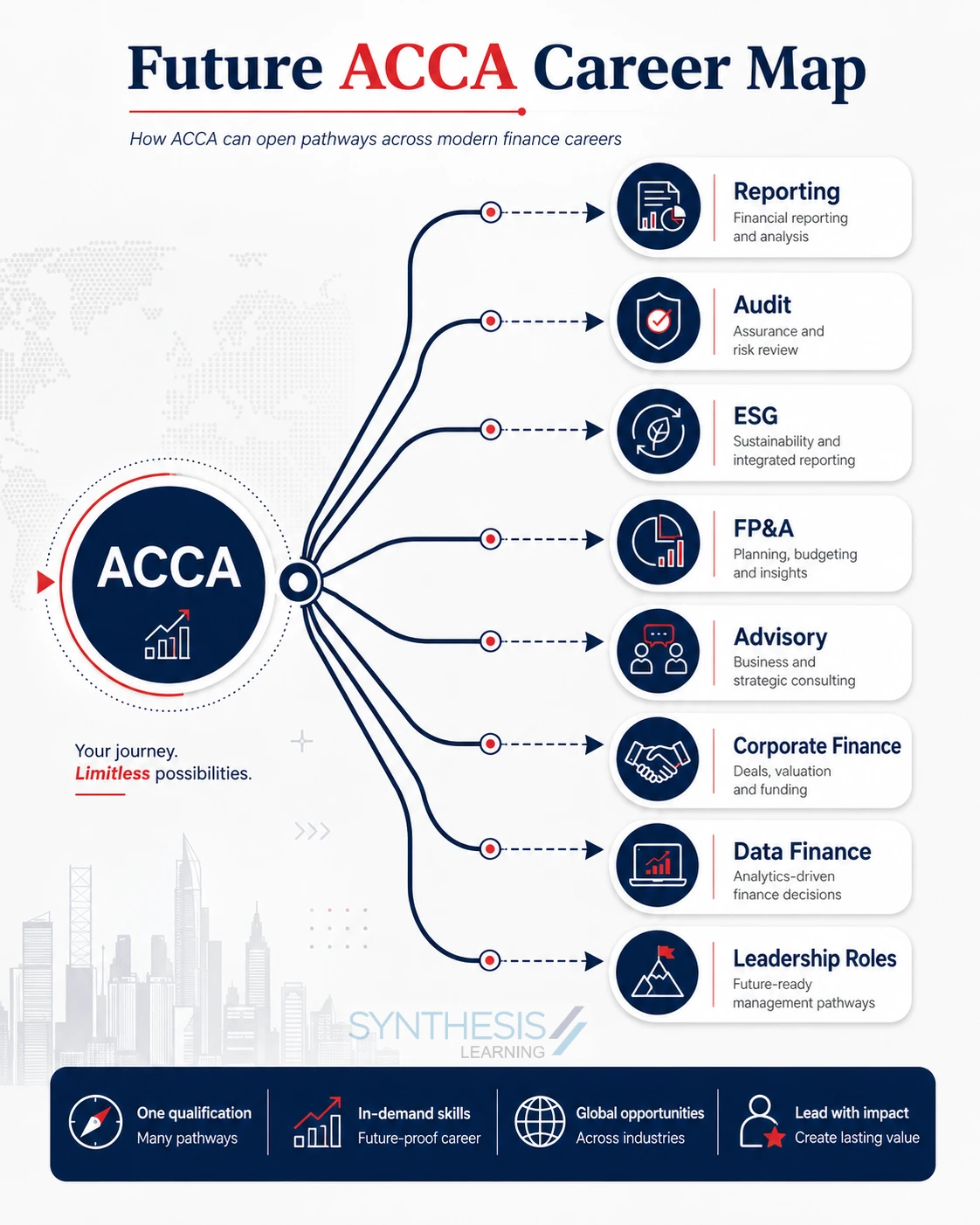
How the New ACCA 2027 Syllabus Supports Future Careers
The new ACCA syllabus is designed to align more closely with how finance careers are evolving.
Students are no longer preparing only for traditional accounting roles. They are preparing for roles that combine finance knowledge with data, sustainability, advisory thinking and business communication.
Career areas supported by the ACCA 2027 syllabus
| Career Area | How the New Syllabus Helps |
|---|---|
| AI-ready finance roles | Exposure to digital tools, AI awareness and data-led thinking |
| ESG reporting | Sustainability reporting and ethical leadership focus |
| Global compliance | International reporting, audit and governance knowledge |
| Business advisory | Strategy, leadership and decision-making emphasis |
| Digital finance | Technology, data and innovation modules |
| FP&A and performance roles | Performance with Data Analysis and finance decision-making |
| Audit and assurance | Risk, control, sustainability assurance and professional scepticism |
Most aspirants miss this
The future of finance is not only “accounting vs technology.”
It is accounting plus technology, reporting plus ESG, and analysis plus communication.
That is exactly the direction ACCA is moving towards.
ACCA Syllabus 2027 rollout timeline for students
ACCA 2027 vs Other Professional Qualifications
Students often compare ACCA with CA, CFA, US CMA and CPA.
The right question is not “Which qualification is best overall?”
The better question is: “Which qualification fits the career direction I want?”
ACCA 2027 vs CA vs CFA vs US CMA vs CPA
| Qualification | Best Fit For | Main Focus |
|---|---|---|
| ACCA 2027 | Global accounting, audit, reporting, finance and advisory roles | Accounting + reporting + ESG + employability + digital finance |
| CA | Indian accounting, audit, taxation and statutory practice | Indian compliance, taxation, audit and practice depth |
| CFA | Investment research, portfolio management and markets | Valuation, investments, capital markets and portfolio management |
| US CMA | Management accounting and corporate finance roles | Costing, budgeting, planning and performance |
| CPA | US accounting and reporting careers | US GAAP, audit, regulation and taxation |
Where ACCA fits in the evolving finance landscape
ACCA is positioned strongly for students who want a global accounting and finance qualification with exposure to reporting, audit, governance, sustainability, digital finance and employability skills.
It is not limited to one geography or one narrow career track.
Reality check
A qualification is not “better” in isolation.
It becomes better when it matches your career goals, learning style, timeline and target market.
Should You Start ACCA Before or After 2027?
This is one of the most common questions students are asking right now.
The answer depends on your current stage, not just the calendar.
Decision framework for students
| Student Profile | Suggested Thinking |
|---|---|
| Starting in 2026 | Start if you are ready; transition mapping exists |
| Starting in 2027 or later | You may directly follow the new structure |
| Existing ACCA student | Continue planning attempts and use ACCA’s transition tool |
| Class 12 or college student | Starting early can help build momentum |
| Waiting only because of 2027 changes | Waiting may not give a real advantage |
| Working professional | Decide based on time availability and study consistency |
Should you wait for 2027 to start your ACCA?
Waiting only makes sense if your personal timeline genuinely points to 2027 or later.
If you are academically ready before that, delaying only because of the new syllabus may not be necessary.
Quick insight
ACCA 2027 is not a reset button.
It is an upgrade of the same global qualification
How to Prepare for the New ACCA Syllabus
The new ACCA syllabus rewards students who prepare with career clarity, not just exam pressure.
Students should understand the structure, build strong basics, and gradually develop digital, communication and analytical skills alongside technical preparation.
Preparation checklist
| Area | What Students Should Do |
|---|---|
| Structure clarity | Understand Knowledge, Expertise and Strategic Professional levels |
| Paper planning | Know the order and difficulty of papers |
| Elective choice | Choose optional papers based on career goals |
| Digital skills | Build comfort with data, dashboards and AI awareness |
| Communication | Practise explaining answers clearly |
| Sustainability | Understand ESG and sustainability reporting basics |
| PER planning | Track relevant work experience early |
| Mentorship | Seek guidance before making transition decisions |
Most aspirants miss this
The new ACCA syllabus is not only about what to study.
It is also about how to think, like a professional who can analyse, advise and communicate.
How Synthesis Learning Helps Students Prepare for ACCA 2027
ACCA builds global accounting and finance capability.
But students often need structure to navigate the journey correctly, especially when a major qualification update is introduced.
At Synthesis Learning, students are supported through structured ACCA preparation, paper planning, mentorship and career readiness.
Why students choose Synthesis Learning
- Platinum Approved Learning Partner with the ACCA
- 25+ years of legacy in finance education
- ACCA affiliated tutors who have coached global rank holders, including World Rank 1
- 1-on-1 mentorship, paper planning and doubt solving
- Campus-to-Corporate placement pathway
- In-house ACCA Approved Employer: Ascentium India
- Global alumni and mentor network
- Indian Tax & Compliance module offered alongside ACCA preparation for better employment opportunities
Quick insight
Qualification builds capability.
Contextual readiness builds confidence.
ACCA from 2027 is not something to wait for.
It is something to understand and move forward with the right preparation.
Final Thoughts
The ACCA syllabus 2027 update is one of the most important qualification changes students should understand clearly.
The number of exams is reducing from 13 to 11, but the qualification is not simply becoming shorter. It is becoming more focused on employability, technology, sustainability, data and strategic decision-making.
For students in India, this matters because finance careers are also changing.
Employers increasingly value professionals who can combine accounting knowledge with practical judgement, digital awareness and business understanding.
The best next step is not panic or delay.
It is clarity.
Understand the new structure, know where you currently stand, and plan your ACCA journey with the right guidance.