ACCA is being redesigned from 2027, and the change goes much further than simply reducing the number of exams.
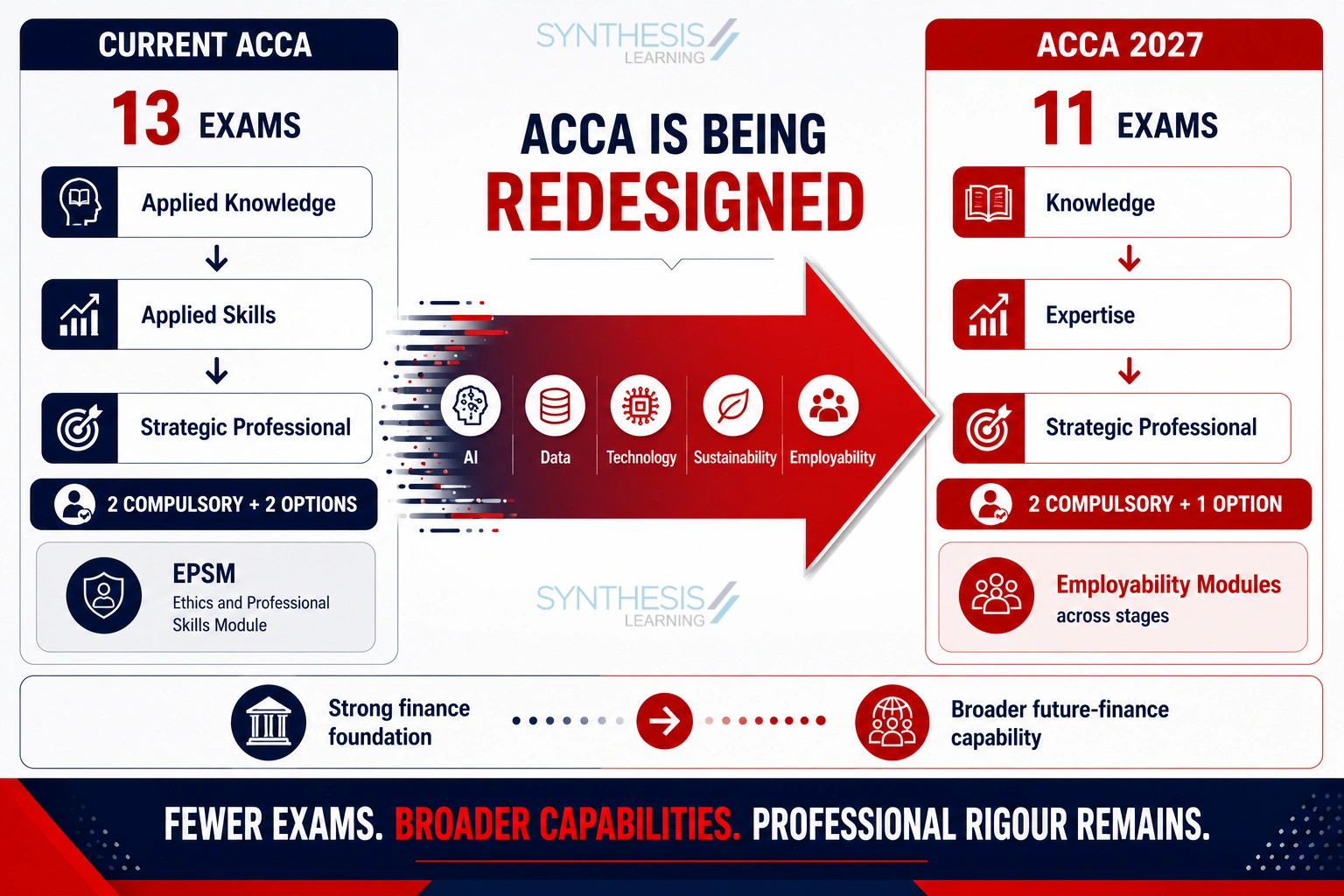
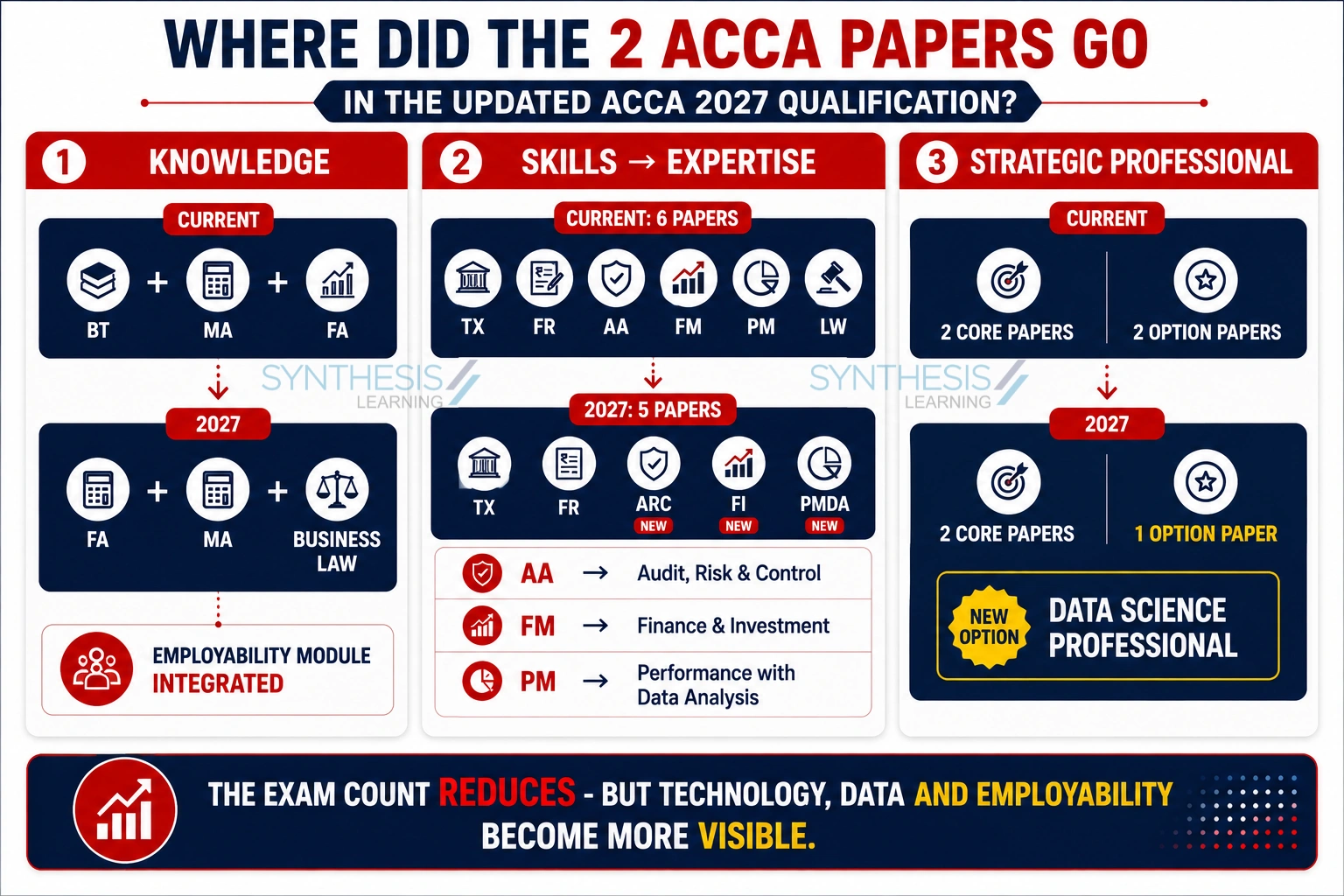
The current qualification has 13 exams across Applied Knowledge, Applied Skills and Strategic Professional. The redesigned route moves to 11 exams across Knowledge, Expertise and Strategic Professional, with employability skills more deeply integrated throughout the journey.
Why the change? Because the finance profession itself is changing.
AI, data, sustainability, digital technology and strategic decision-making are becoming increasingly important alongside strong accounting knowledge.
Here is what is actually changing, and what it means for students.
Why Is ACCA Being Redesigned in 2027?
ACCA already develops technical, ethical, business and professional skills. The 2027 redesign builds on that foundation rather than replacing it.
The bigger shift is towards the kind of finance professional businesses increasingly need: someone who can understand the numbers, work with technology, interpret data and help organisations make better decisions.
ACCA describes the changing profession around four major themes: sustainability and social impact, ethics and trust, pioneering AI and technology, and new or expanding career roles.
Quick insight:
ACCA is not moving away from accounting. It is expanding what an accountant is expected to do.
Current ACCA Syllabus at a Glance
The current ACCA Qualification progresses through three exam levels, alongside EPSM and practical experience.
| Level | Current Papers |
|---|---|
| Applied Knowledge | Business and Technology (BT), Management Accounting (MA), Financial Accounting (FA) |
| Applied Skills | Corporate and Business Law (LW), Performance Management (PM), Taxation (TX), Financial Reporting (FR), Audit and Assurance (AA), Financial Management (FM) |
| Strategic Professional – Essentials | Strategic Business Leader (SBL), Strategic Business Reporting (SBR) |
| Strategic Professional Options – Choose 2 | Advanced Financial Management (AFM), Advanced Performance Management (APM), Advanced Taxation (ATX), Advanced Audit and Assurance (AAA) |
This gives the current main qualification a total of 13 exams.
ACCA New Syllabus 2027 Structure at a Glance
The redesigned qualification keeps three main levels, but changes the middle stage, paper mix and specialisation structure.
| Level | ACCA 2027 Papers |
|---|---|
| Knowledge | K1 Financial Accounting, K2 Management Accounting, K3 Business Law |
| Expertise | E1 Taxation, E2 Financial Reporting, E3 Audit, Risk and Control, E4 Finance and Investment, E5 Performance with Data Analysis |
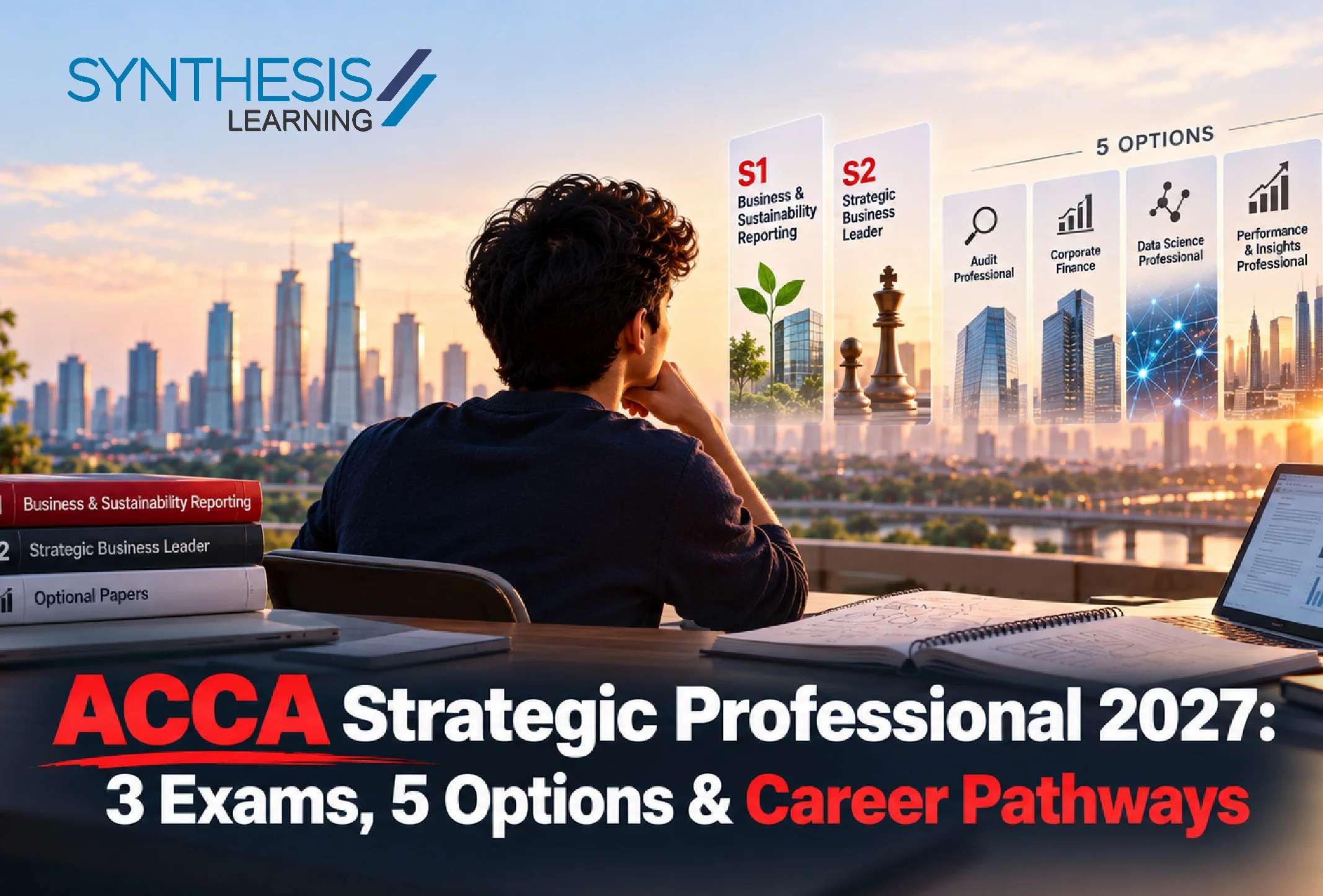
| Strategic Professional – Core | S1 Business and Sustainability Reporting, S2 Strategic Business Leader |
| Strategic Professional – Choose 1 | Audit and Assurance Professional, Corporate Finance Professional, Data Science Professional, Performance and Insights Professional, Taxation Advisory Professional |
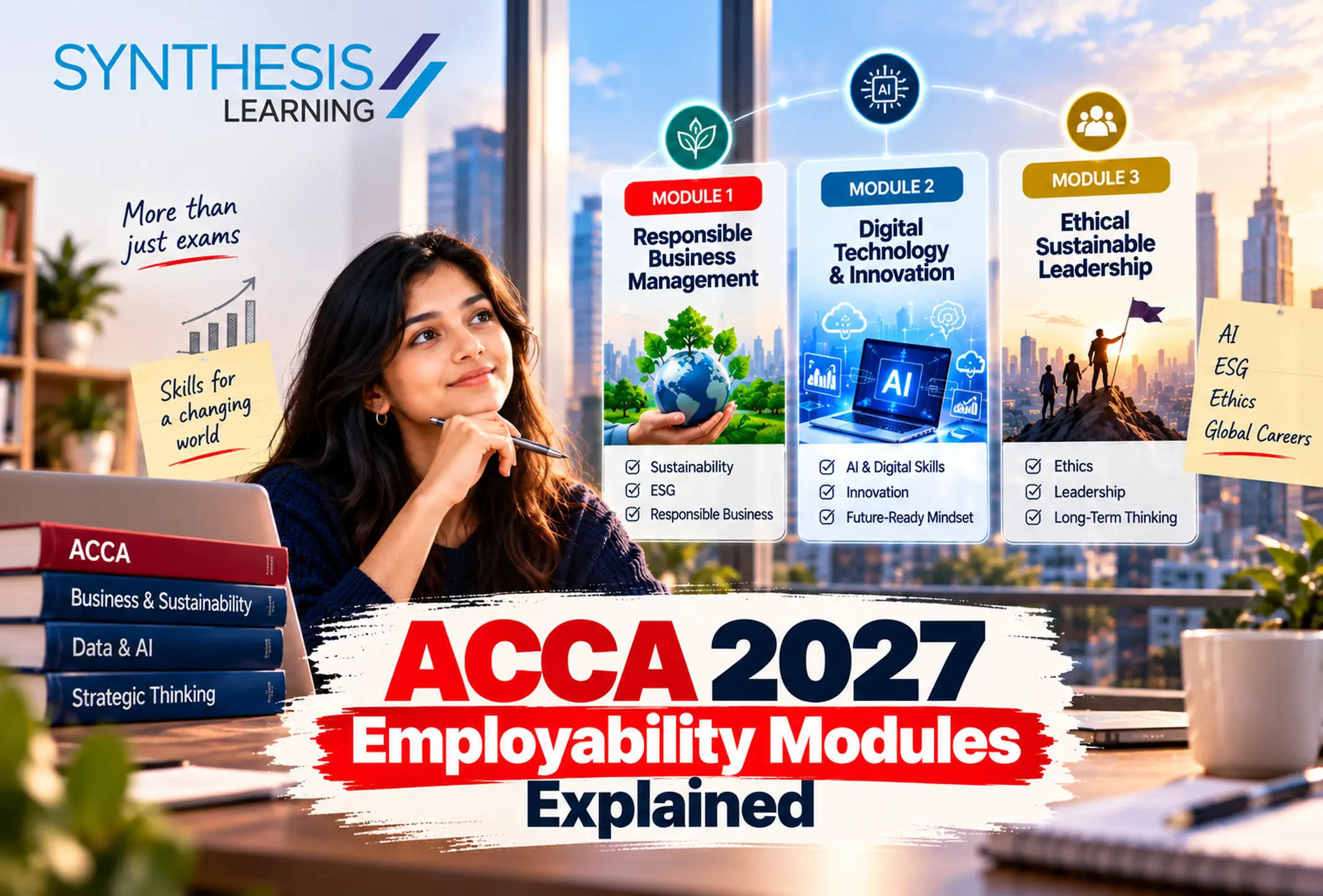
Each level is also supported by an Essential Employability Module, bringing professional and workplace capability more directly into qualification progression.
ACCA Old vs New Syllabus 2027: Side-by-Side Comparison
| Area | Current ACCA | ACCA 2027 |
|---|---|---|
| Main exams | 13 | 11 |
| Levels | Applied Knowledge → Applied Skills → Strategic Professional | Knowledge → Expertise → Strategic Professional |
| Middle level | 6 Applied Skills exams | 5 Expertise exams |
| Strategic Professional | 2 compulsory + 2 options | 2 compulsory + 1 option |
| Professional development | EPSM | Essential Employability Modules integrated by stage |
| Technology & data | Already present within the qualification | More explicitly embedded across learning |
| Sustainability | Included within current learning | More visibly integrated into reporting, leadership and decision-making |
| Specialisation | 4 options | 5 options, including the new Data Science Professional |
| Overall direction | Technical + ethical + strategic capability | Technical + digital + data + sustainability + employability + strategic capability |
What this actually means:
The redesigned ACCA is not replacing technical finance knowledge with technology. It is adding a wider future-ready skill layer around that technical foundation.
What Is Actually Changing in ACCA 2027?
1. 13 Exams Become 11 – Without Reducing the Standard
Two visible structural changes reduce the exam count:
- Applied Skills moves from six papers to five Expertise exams.
- Strategic Professional moves from two optional papers to one.
But fewer exams should not be confused with a diluted qualification.
The new structure places greater emphasis on integrated skills, employability and application alongside technical knowledge.
Reality check:
11 exams does not mean “easier ACCA.” It means a redesigned route to professional capability.
2. Applied Skills Becomes Expertise
This is more than a new label.
The future Expertise level is designed around strong practical finance capability and the ability to identify business issues and provide useful advice.
Even the paper names show the shift:
AA → Audit, Risk and Control
FM → Finance and Investment
PM → Performance with Data Analysis
The direction is clear:
Know the concept, apply it, interpret it and connect it to business.
3. AI, Data Analysis and Technology Become More Visible
This is one of the most important changes.
The future qualification includes:
- Performance with Data Analysis
- A dedicated Data Science Professional option
- Stronger digital and innovation learning
- Wider emphasis on AI, technology and data-led finance.
This does not mean every ACCA student becomes a programmer or data scientist.
It means future finance professionals are expected to understand technology well enough to work with it, question its outputs and use information intelligently.
4. Sustainability Moves Further Into Core Finance
The new compulsory Business and Sustainability Reporting paper makes sustainability more visible at Strategic Professional level.
ACCA also places sustainability within its broader vision of how accountants contribute to reporting, ethical decision-making and long-term organisational value.
5. Strategic Professional Becomes More Focused
Current students choose two of four option papers.
From September 2027, students will choose one of five, allowing more focused specialisation.
The addition of Data Science Professional is particularly significant because it creates a direct specialisation pathway around data and analytics within ACCA.
From EPSM to Employability Skills Across the Journey
Under the current structure, students complete the Ethics and Professional Skills Module.
The future qualification takes a different approach: Essential Employability Modules sit alongside each qualification level and are mandatory parts of progression. ACCA says they will develop technical and business skills and include assessed learning.
This makes employability less of a separate milestone and more of a continuous part of the ACCA journey
Most aspirants miss this:
The ACCA redesign is not simply “13 papers becoming 11.” The overall learning journey is changing too.
Does ACCA 2027 Become More Future-Ready?
Yes, this is arguably the bigger story behind the redesign.
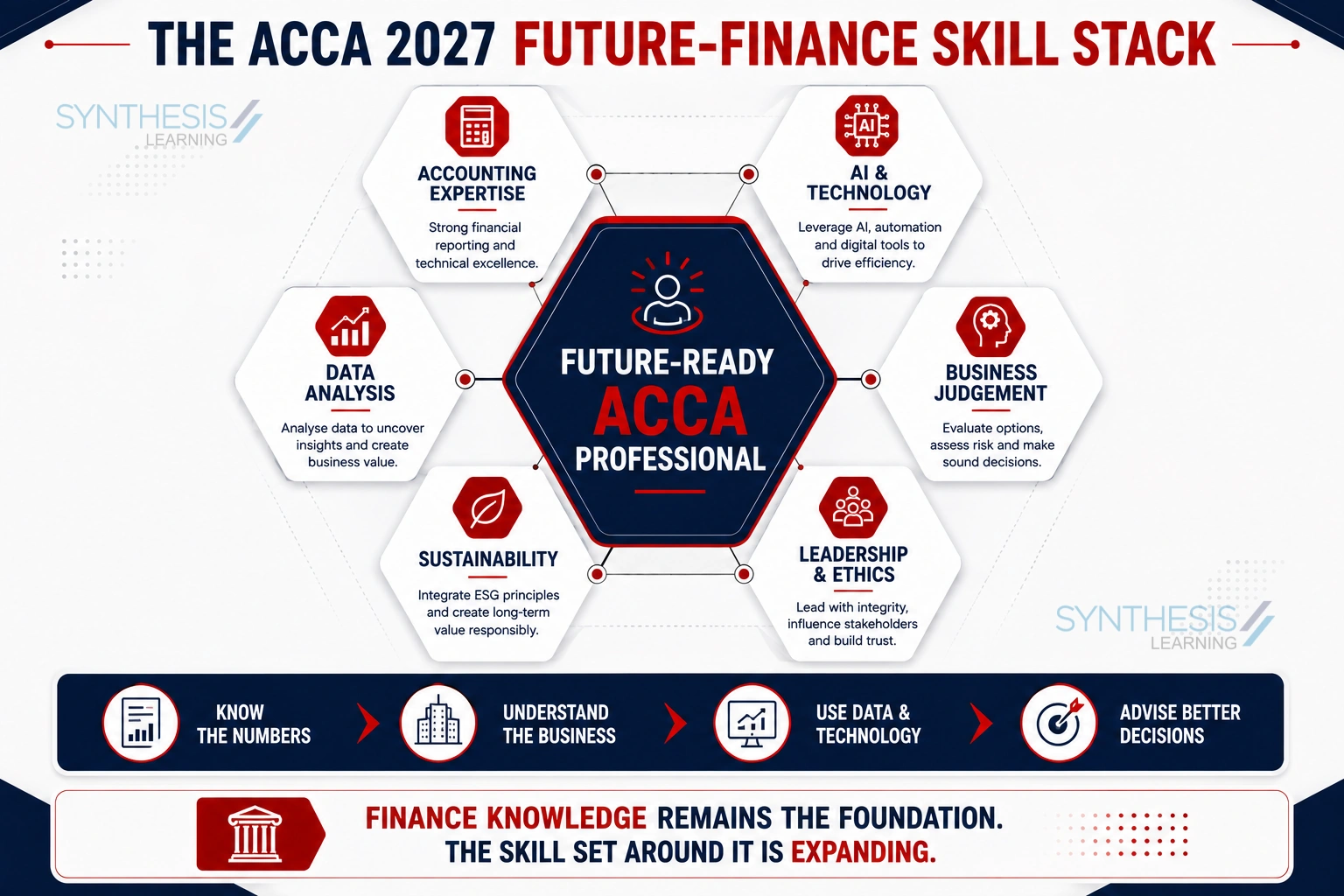
The future ACCA professional is being prepared to combine:
| Capability | Why It Matters |
|---|---|
| Accounting expertise | Understands reporting, audit, tax, finance and performance |
| Business judgement | Connects finance with organisational decisions |
| Data capability | Interprets information rather than only producing it |
| Technology awareness | Works effectively alongside AI and digital tools |
| Sustainability thinking | Considers wider business and reporting impact |
| Ethics & leadership | Exercises judgement when technology alone cannot make the decision |
ACCA itself frames the profession’s future around AI and technology, sustainability, ethics and expanding career roles.
Does the New Syllabus Mean You Should Wait Until 2027?
Usually, the syllabus change alone is not a good reason to delay starting ACCA.
Already studying ACCA?
Continue based on your academic readiness and current progress. ACCA’s transition rules recognise equivalent completed elements, and its Transition Tool shows how expected progress maps into the redesigned qualification.
Planning to start ACCA?
Consider:
- Your eligibility
- Graduation timeline
- Current accounting foundation
- Available preparation time
- When you realistically want to begin exams
Do not compare only 13 exams vs 11 exams.
Quick insight:
Choose your starting point based on readiness, not the smaller number on a syllabus chart.
How Should Students Prepare for ACCA 2027?
You do not need to wait until 2027 to start building the skills the future qualification values.
| Build Now | Why |
|---|---|
| Strong accounting fundamentals | Technology cannot compensate for weak finance basics |
| Analytical thinking | Modern finance requires interpretation, not only calculation |
| Data confidence | Performance and decision-making are becoming increasingly data-led |
| Business communication | Finance professionals must explain insights clearly |
| Technology awareness | AI and digital tools will increasingly sit alongside finance work |
The goal is not to become a coder before beginning ACCA.
It is to become a finance professional who is comfortable learning, questioning and working with technology.
Preparing for ACCA Today, and for What Comes Next
A syllabus can change. Strong preparation principles do not.
Students still need concept clarity, sensible paper planning, consistent question practice, feedback and an understanding of how ACCA connects to actual finance careers.
As an ACCA Platinum Approved Learning Partner, Synthesis Learning supports students through:
- 1-on-1 mentorship and paper planning
- Structured doubt-solving
- Exam-focused tests and mocks
- Classroom, live-online and self-paced learning options
- Tutors who have coached Global Rank holders, including World Rank 1
- Campus-to-Corporate career readiness
- Exposure to an in-house ACCA Approved Employer ecosystem through Ascentium India
- Practical India-relevant finance and compliance awareness
The qualification is evolving towards a broader, more technology-aware finance professional.
Preparation should evolve with it.
What Should You Take Away?
The ACCA 2027 redesign is bigger than a reduction from 13 exams to 11.
It introduces a more focused structure while making AI, data, technology, sustainability, employability and strategic judgement more visible across the qualification.
The technical finance foundation remains critical. What changes is the professional capability being built around it.
For students, the smartest approach is simple:
Understand the new structure, build strong fundamentals and plan your journey based on readiness, not rumours about whether old or new ACCA is easier.