A BCom gives you a broad foundation in accounting, commerce and business. ACCA can take that foundation into a more specialised professional direction.
From 2027, that pathway becomes even more future-focused.
The redesigned ACCA Qualification combines professional finance knowledge with a stronger emphasis on data, technology, AI-era skills, sustainability, employability and strategic judgement.
ACCA describes the redesign as preparing future-ready professionals for changing employer needs.
But if you already have a BCom, the first question is simpler:
“How much of ACCA will I actually need to complete?”
That depends on your official exemption result – not the degree title alone.
Can You Do ACCA After BCom in 2027?
Yes. Students who meet ACCA’s minimum entry requirements can enter the redesigned qualification, while those who do not use the Foundations route.
For a BCom graduate, the bigger question is usually not eligibility but exemptions.
Relevant previous learning may reduce the number of ACCA exams you need to attempt. But the exact result depends on the qualification ACCA recognises for your institution and programme.
ACCA therefore directs students to its official Exemptions Calculator rather than giving one blanket exemption number.
How Many ACCA Exemptions Can You Get After BCom?
There is no single correct number for every BCom graduate.
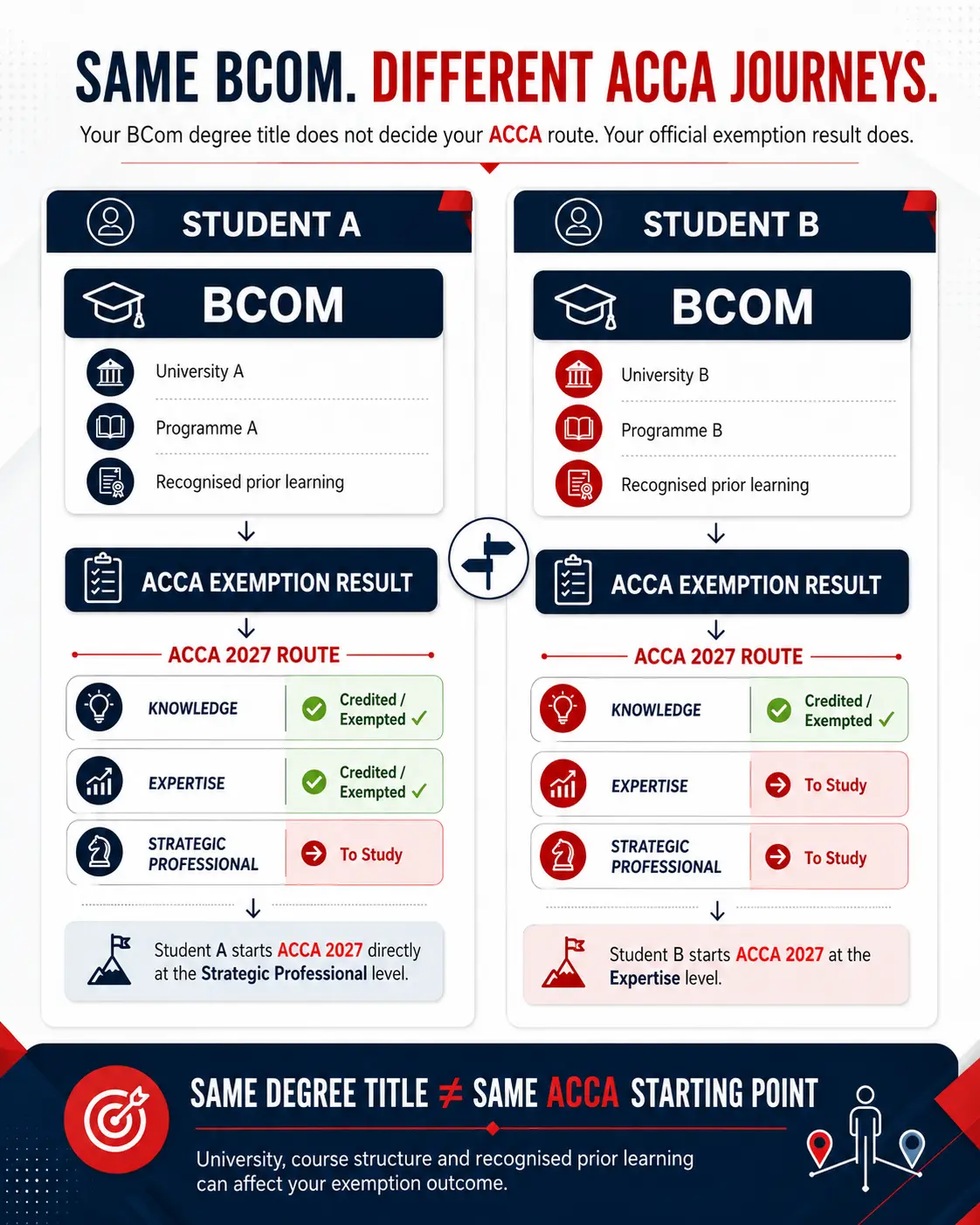
Two students can both hold a BCom and still have different ACCA pathways depending on the prior learning recognised by ACCA.
The correct process is:
BCom → Institution & programme → ACCA exemption assessment → Your actual remaining route
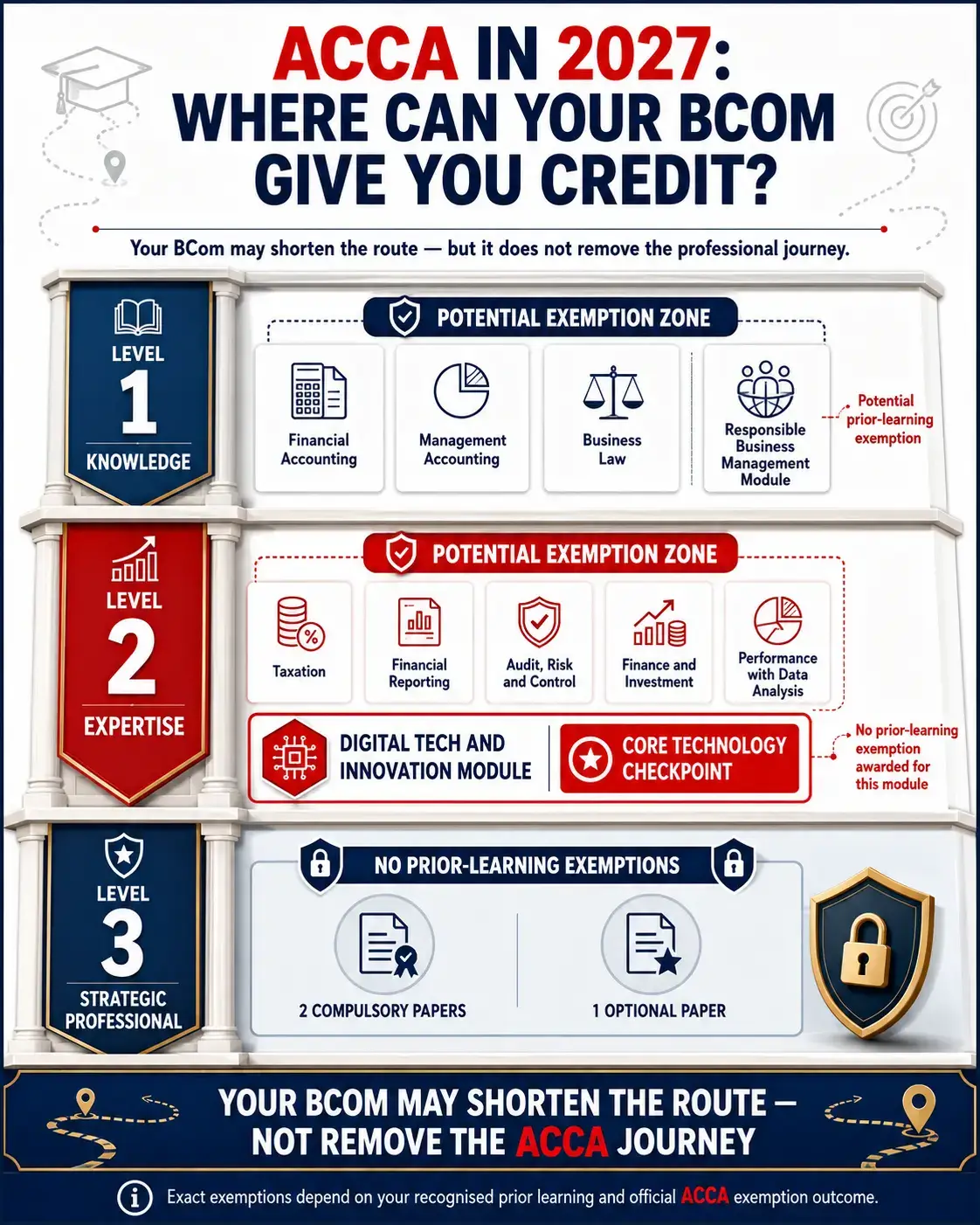
Under the redesigned qualification, relevant prior learning may potentially provide exemptions from:
- Knowledge exams
- Expertise exams
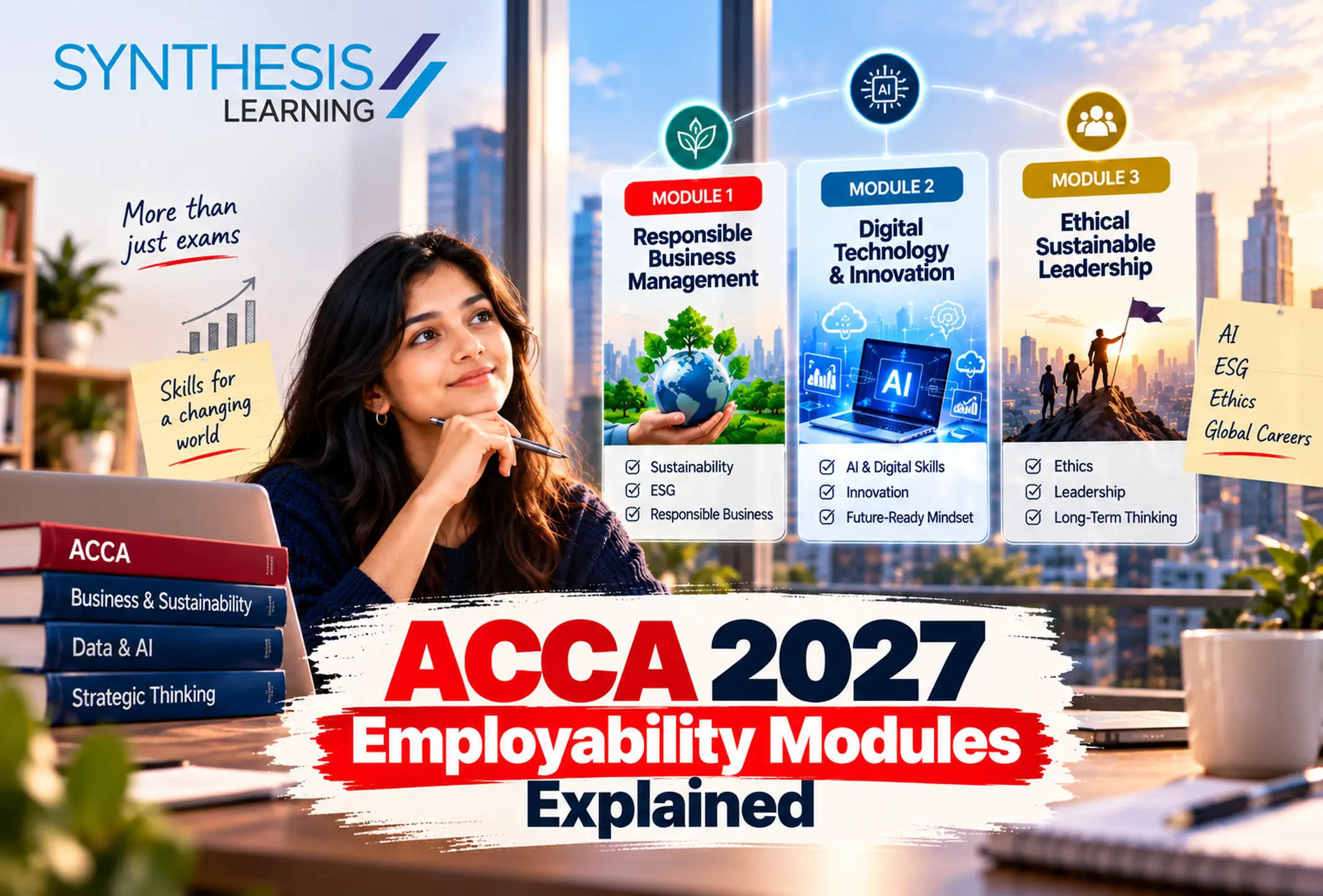
- the Knowledge-level Responsible Business Management module
But the exact exemptions awarded remain individual.
Most aspirants miss this:
Your degree says BCom. Your ACCA exemption result tells you where your ACCA journey actually starts.
What Could Your ACCA 2027 Route After BCom Look Like?
The redesigned ACCA Qualification has three main progression levels:
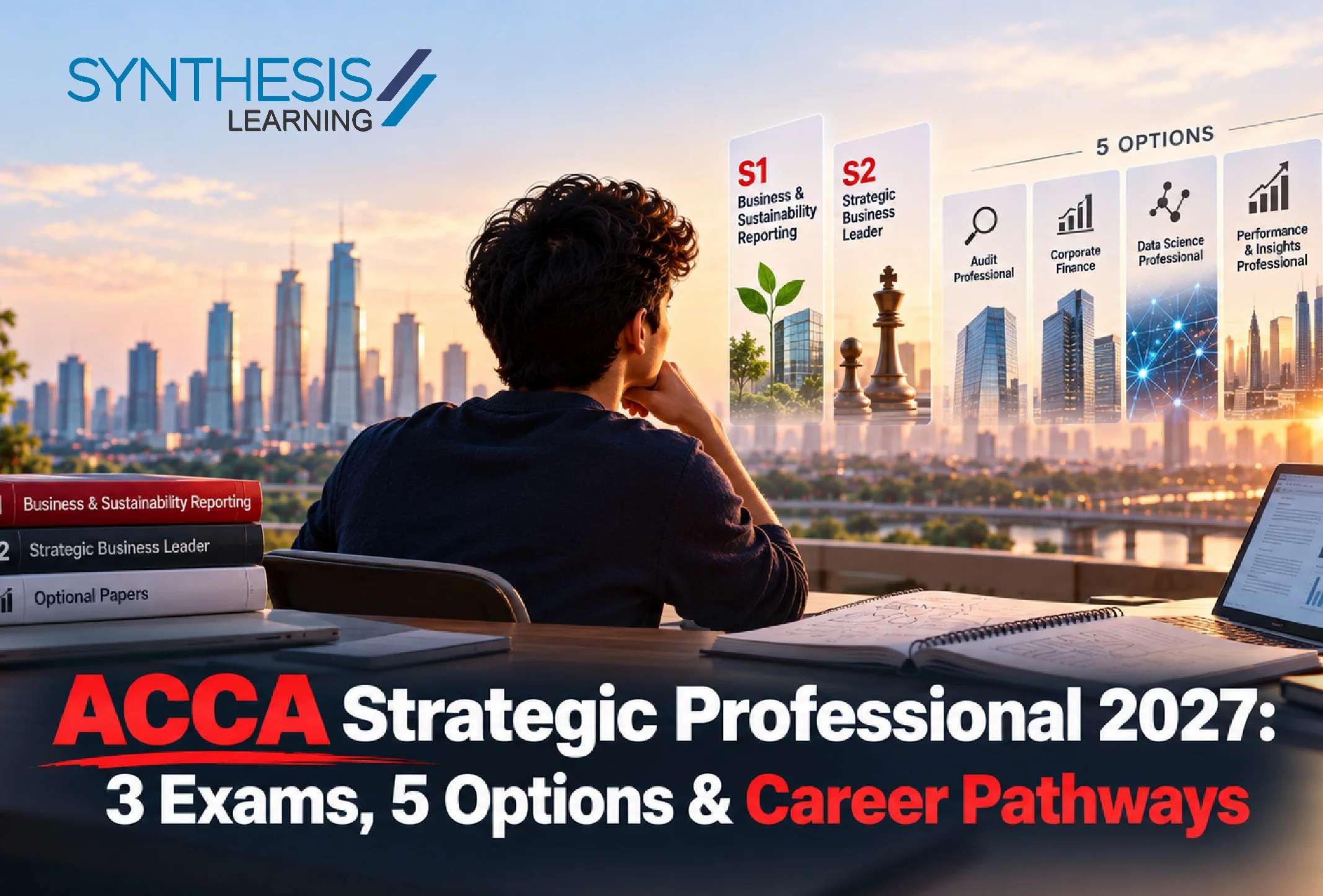
Knowledge → Expertise → Strategic Professional.
Your BCom exemptions determine how much of the earlier journey remains.
| Your exemption outcome | What your route may look like |
| Few or no exemptions | Complete remaining Knowledge requirements |
| Some Knowledge exemptions | Attempt only the Knowledge elements still pending |
| Knowledge largely covered | Progress towards Expertise |
| Some Expertise exemptions | Complete remaining Expertise exams and required module |
| Extensive Knowledge/Expertise exemptions | Reach Strategic Professional sooner |
| Strategic Professional | Must still be completed, no exemptions are available at this level |
This is why asking “How many ACCA papers are there after BCom?” without checking exemptions first can be misleading.
What Can – and Cannot – Be Exempted in ACCA in 2027?
The redesigned exemption policy makes one distinction particularly important.
| ACCA 2027 requirement | Prior-learning exemption possible? |
| Knowledge exams | Yes |
| Responsible Business Management module | Yes |
| Expertise exams | Yes |
| Expertise-level Digital Tech and Innovation module* | No |
| Strategic Professional exams | No |
| Strategic Professional employability module | No |
ACCA says exemptions are unavailable for its Expertise-level technology module because this is a new and emerging area that it considers important for every student’s core journey.
*ACCA’s current published materials use Digital Tech and Innovation for this module in the qualification and exemption guidance.
Quick insight:
Your BCom may shorten the exam route. ACCA still wants you to develop modern digital capability as part of becoming a future finance professional.
ACCA 2027 Exemptions vs Transition Credits
These terms sound similar but mean different things.
| Term | When it applies |
| Exemption | Your BCom or another prior qualification gives you credit for relevant ACCA learning |
| Transition credit | You have already completed an ACCA exam/module before the redesign and it maps into ACCA 2027 |
Existing ACCA students receive credit for equivalent completed elements when they transition to the redesigned qualification.
For a detailed existing-student pathway, see ACCA 2027 Transition Rules Explained
ACCA After BCom: Before 2027 vs After 2027
Students starting now and students entering after the redesign ultimately progress towards the same ACCA membership, but the structure around them differs.
| If you begin under the current route | If you enter the ACCA 2027 route |
| Current exemption system applies | Redesigned exemption system applies |
| Applied Knowledge + Applied Skills structure | Knowledge + Expertise structure |
| Current papers transition later if still incomplete | You begin directly within the redesigned pathway |
| EPSM forms part of the current journey | Employability Modules are integrated by level |
| Existing progress receives transition credit | No transition required for a new entrant |
All redesigned qualification exemptions will become visible on ACCA’s Exemptions Calculator from July 2027.
Existing current-qualification exemptions are also due to transition into the redesigned structure under ACCA’s published rules.
Reality check:
Do not compare the two routes only by counting papers.
Should BCom Students Start ACCA Before or After 2027?
There is no universal advantage to waiting.
Starting earlier may make sense if:
- You are academically ready
- You have already decided that ACCA fits your career direction
- You can realistically begin preparing now
- Delaying would simply leave productive study time unused
Waiting may make sense if:
- Graduation commitments currently make ACCA preparation unrealistic
- You are still evaluating your career direction
- You genuinely are not ready to begin professional exams
The redesigned ACCA has fewer main exams, but it also integrates Essential Employability Modules and expands its future-finance focus.
Quick insight:
Do not wait for 11 papers simply because 11 sounds better than 13.
Is ACCA in 2027 Worth It After BCom?
For the right career direction, the combination can be powerful because the two qualifications do different jobs.
A BCom gives you an academic commerce foundation.
The redesigned ACCA 2027 pathway can add:
- Deeper professional accounting and finance expertise
- International business and reporting perspective
- Strategic decision-making
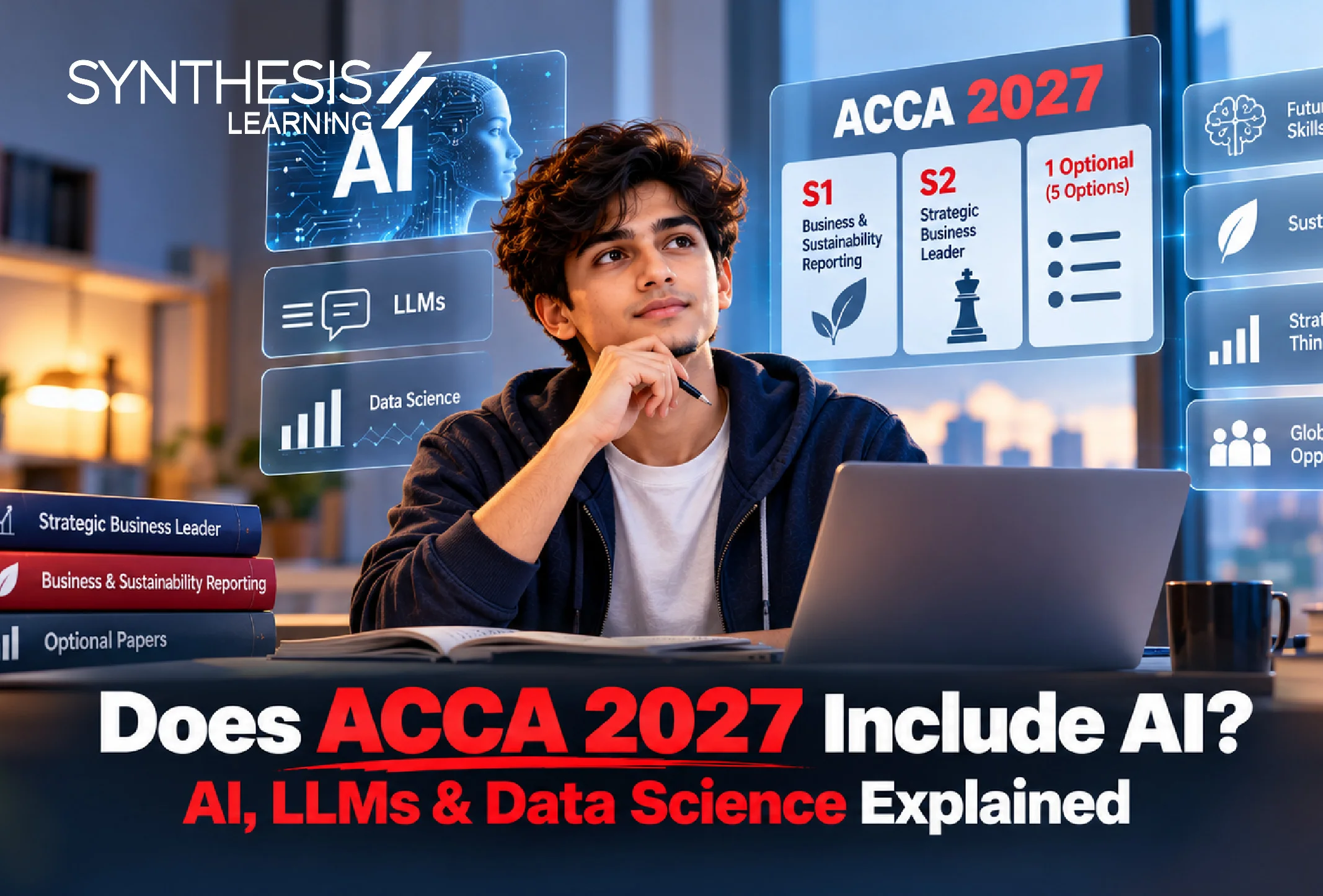
- AI and technology awareness
- Data-led finance capability
- Sustainability and ethical judgement
- Professional and workplace-ready skills
At Expertise level alone, ACCA introduces Finance and Investment, Performance with Data Analysis and a technology-focused Employability Module.
At the Strategic Professional level, students can even specialise through Data Science Professional.
So the value proposition is broader than:
BCom + another accounting qualification
It is closer to:
Commerce foundation + global professional finance + technology + data + business judgement
That can support a BCom graduate in moving towards more specialised and increasingly technology-enabled finance roles.
Quick insight:
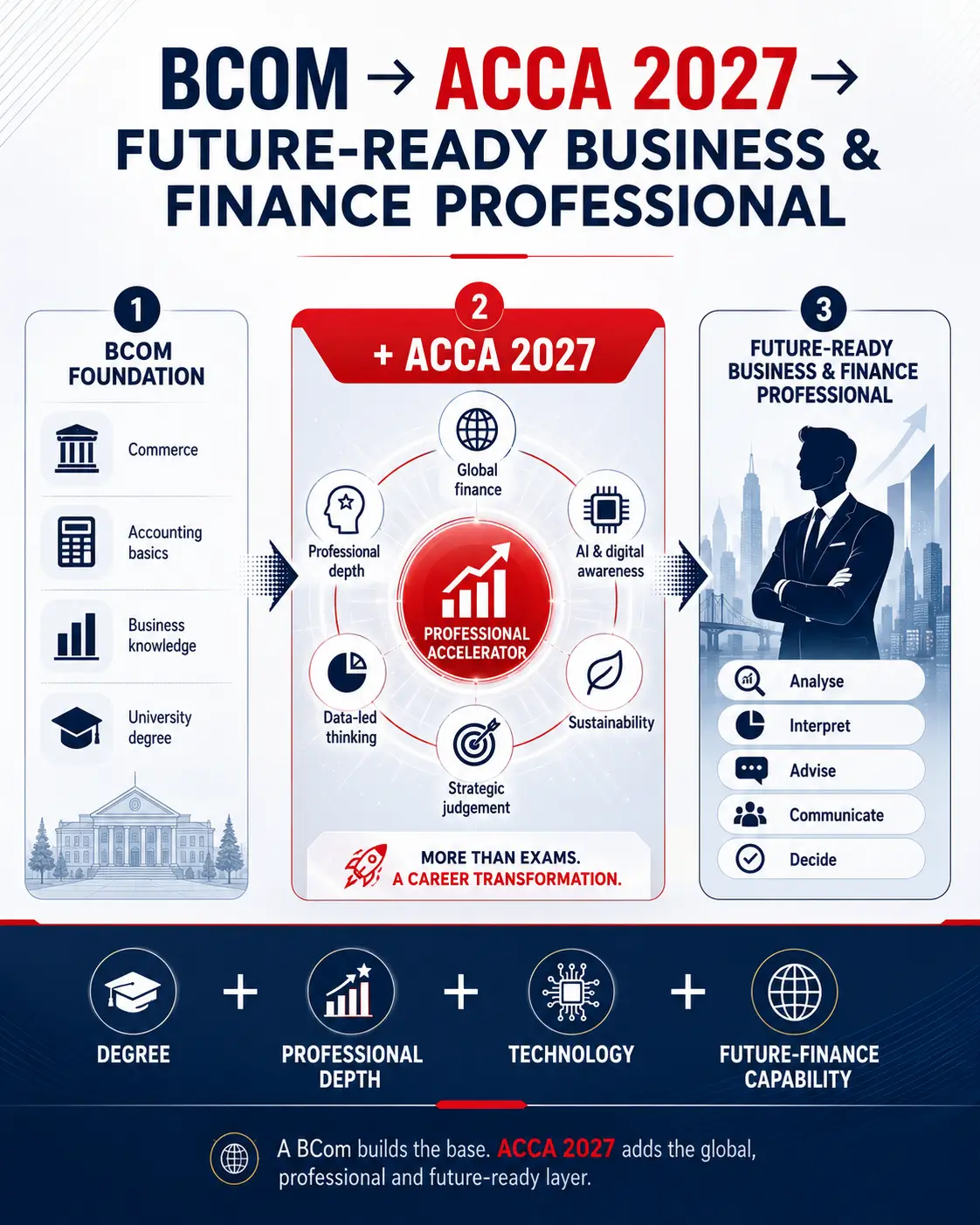
BCom builds the base. ACCA 2027 can add the global, professional and future-finance layer.
Career Options After BCom + ACCA
Career outcomes still depend on skills, experience, employer and market conditions. But the combined pathway can support several directions.
| Career direction | What ACCA 2027 can add beyond a general BCom |
| Financial reporting | International reporting depth + sustainability awareness |
| Audit & controls | Assurance, risk, controls and technology awareness |
| FP&A | Performance analysis + data-led business insight |
| Tax | Professional tax application and advisory capability |
| Business finance | Commercial thinking + strategic decision support |
| Finance transformation | Finance knowledge + digital process awareness |
| Data-led finance | Analytics awareness + interpretation and judgement |
ACCA says the redesigned qualification is intended to develop broad, practical finance capability alongside digital innovation, workplace skills and advanced options such as Data Science Professional.
From BCom Exemptions to ACCA Readiness: How Synthesis Learning Helps
Receiving an exemption removes an exam requirement.
It does not automatically mean the underlying knowledge is strong enough for the paper that comes next.
That is why ACCA planning after BCom should begin with more than counting exemptions.
Synthesis Learning – a House of Global Courses with 25+ years of legacy in business and finance education – helps students think through:
- Their exemption position
- Knowledge gaps that may need reinforcement
- Sensible paper sequencing
- Concept-focused exam preparation
- One-on-one mentorship and doubt-solving
- Tests, mocks and exam readiness
- Career preparation alongside the qualification
As the redesigned ACCA becomes more technology-aware and data-led, Synthesis Learning also integrates a wider future-career layer around the qualification – helping students build practical digital confidence, business communication, workplace judgement and employer readiness without treating these as separate from their finance journey.
The objective is not:
“How can I claim the maximum exemptions?”
It is:
“How can I use my BCom intelligently to build the strongest ACCA and career pathway?”
What Should You Take Away?
ACCA after BCom can be a strong professional pathway – but your BCom does not automatically determine one fixed exemption number.
Start by checking your recognised exemptions.
Then evaluate what remains, whether your fundamentals are strong enough, and how the redesigned ACCA 2027 pathway fits the work you eventually want to do.
With stronger integration of finance, data, technology, AI-era skills, sustainability and employability, ACCA 2027 can take a broad commerce foundation into a much more future-ready professional direction.