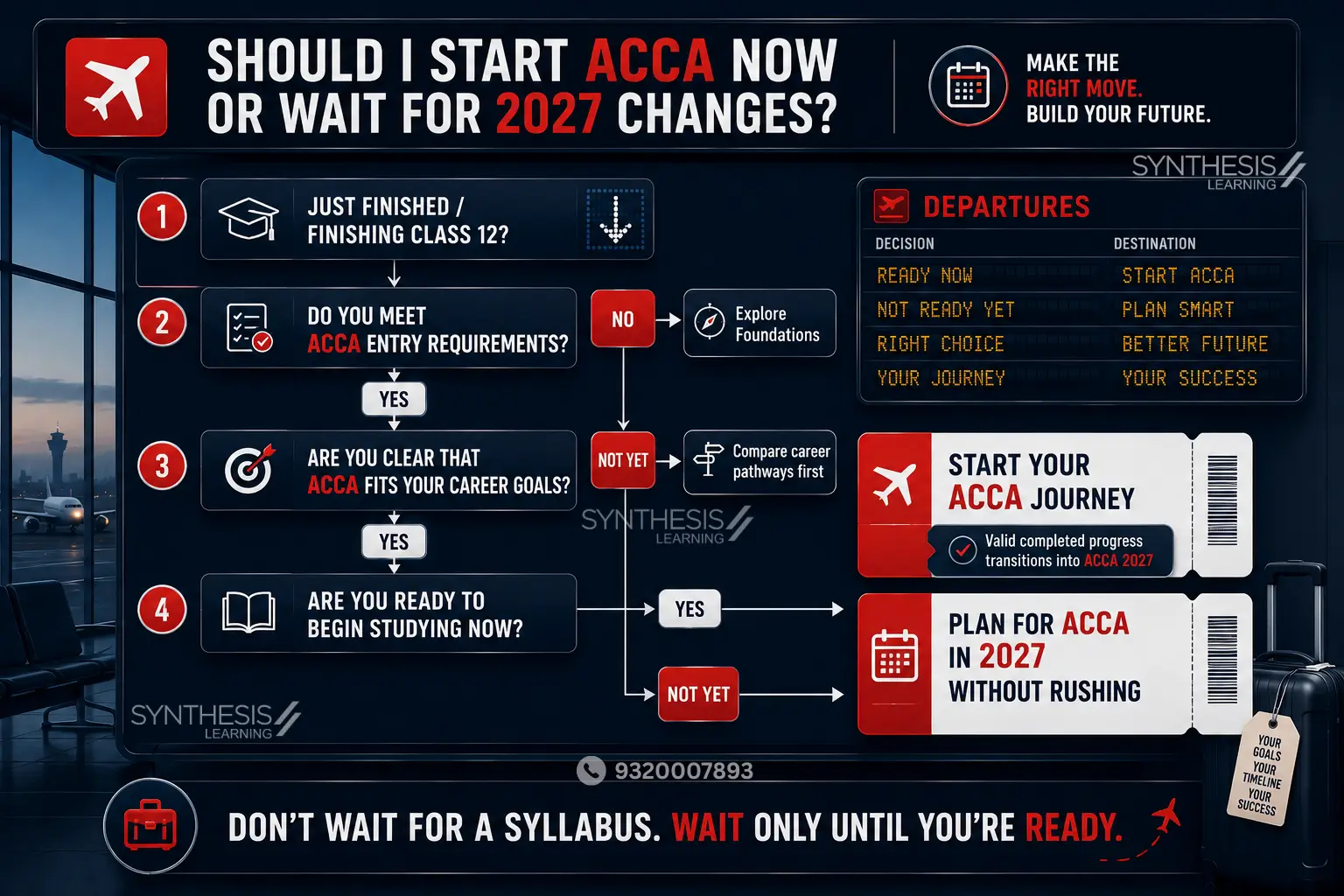
If you have just completed Class 12 and are considering ACCA, the 2027 redesign creates an obvious question:
Should I start ACCA now – or wait for the new 11- exam structure?
For most students who are eligible, clear about choosing ACCA and academically ready, there is usually little reason to delay solely because the syllabus is changing.
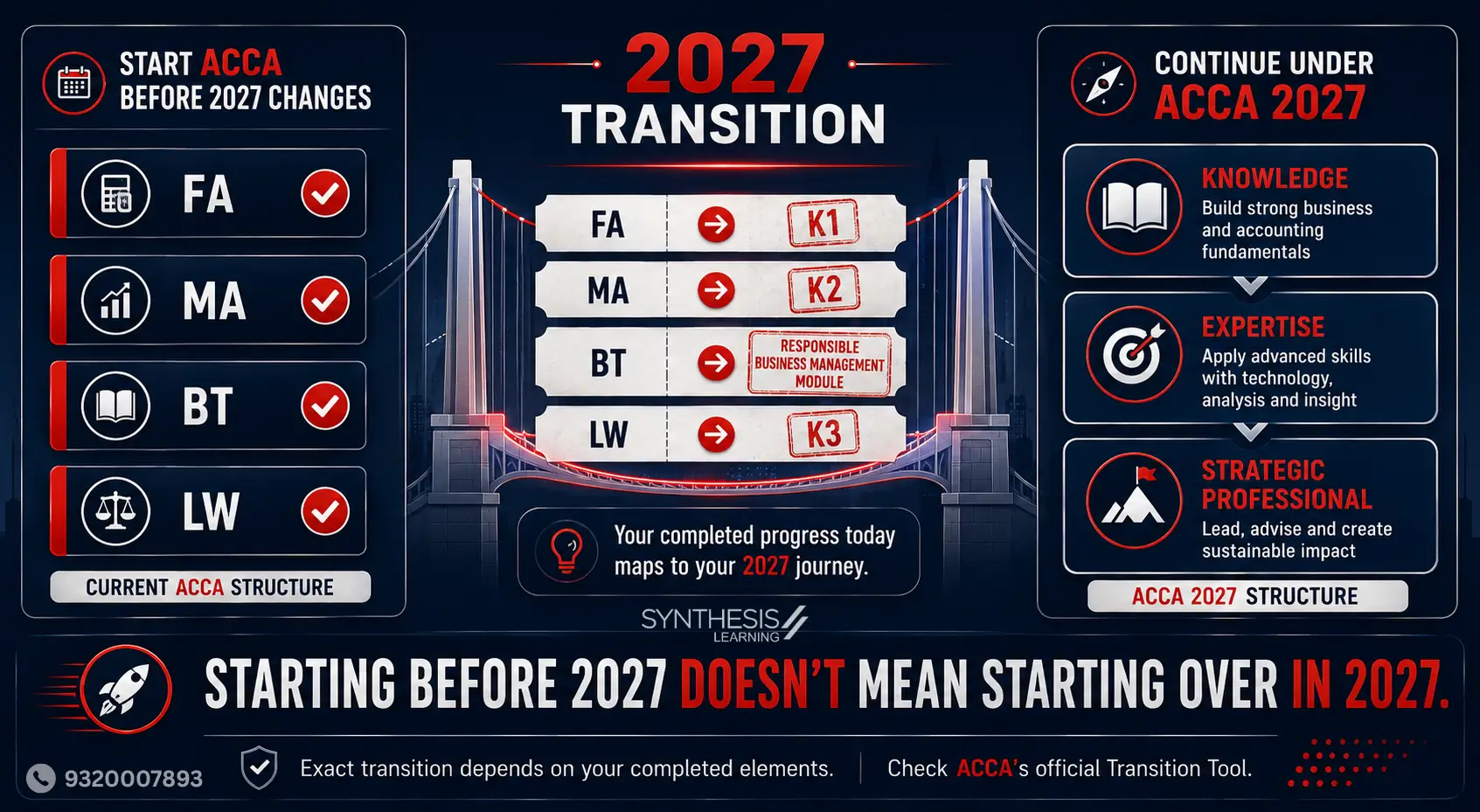
Starting before 2027 does not mean your progress disappears. ACCA has published transition rules so equivalent completed elements move into the redesigned qualification.
And the future ACCA itself becomes more aligned with where finance is heading – data, technology, AI, sustainability, employability and strategic business decision-making.
The smarter question, therefore, is not old ACCA or new ACCA?
It is:
When am I genuinely ready to begin building my finance career?
Can You Start ACCA Directly After Class 12 in India?
Yes – if your Class 12 qualification meets ACCA’s minimum entry requirements.
For recognised Indian 10+2 qualifications, ACCA currently requires passes in five subjects, including English and Mathematics or Accounts, with 65% in at least two subjects and over 50% in the others. Exact requirements can vary by qualification, so students should verify their certificate through ACCA’s official minimum entrance requirements database.
| Your situation | Likely ACCA route |
| Meet ACCA’s direct entry criteria | Enter the main ACCA Qualification |
| Do not meet the entry criteria | Start through the Foundations route |
| Have additional recognised qualifications | Check whether exemptions apply |
ACCA’s Foundations level has no standard minimum entry requirement and provides a route into the main qualification for students who do not yet meet direct entry criteria.
Quick insight:
Your stream alone does not decide ACCA eligibility. Your recognised qualification, subjects and marks do.
What Does “Starting ACCA Now” Actually Mean?
Starting ACCA early does not mean rushing through papers before 2027.
For a student coming directly from school, starting well can mean:
- Understanding whether ACCA fits your career goals
- Checking eligibility correctly
- Building strong Financial Accounting and Management Accounting fundamentals
- Planning ACCA alongside graduation
- Developing professional study habits
- Attempting papers when you are genuinely prepared
That distinction matters.
Starting early can be useful. Rushing exams is not the same as starting early.
For many Class 12 students, the strongest plan is not the fastest possible ACCA timeline. It is a sustainable professional pathway that works alongside college, skills and career exposure.
What Changes for Class 12 Students Under ACCA 2027?
The redesigned main ACCA 2027 Qualification continues through three levels:
Knowledge
- K1 Financial Accounting
- K2 Management Accounting
- K3 Business Law
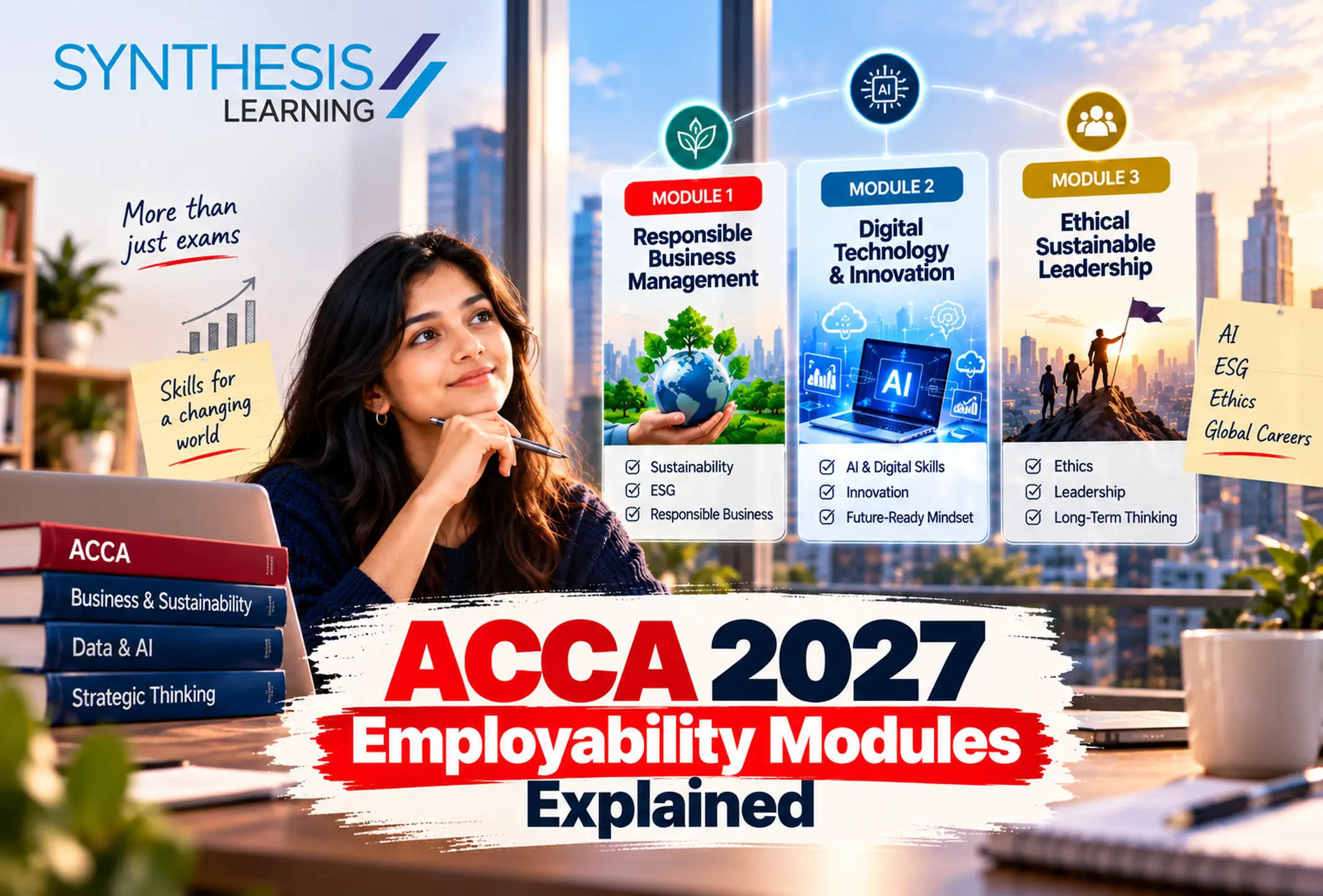
- Responsible Business Management Essential Employability Module
Expertise
Five exams covering:
- Taxation,
- Financial Reporting,
- Audit, Risk and Control,
- Finance and Investment, and
- Performance with Data Analysis,
alongside an Expertise-level Essential Employability Module.
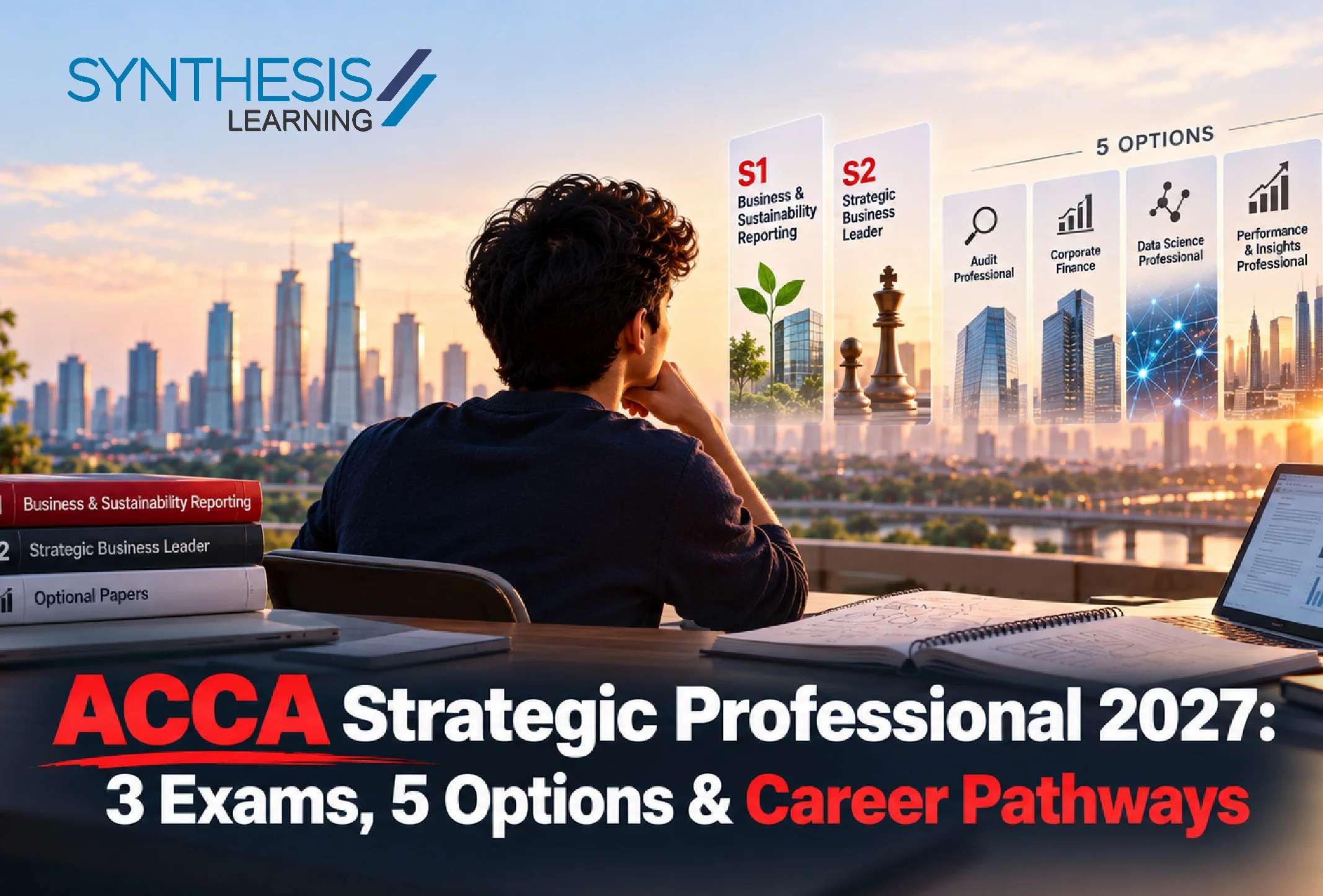
Strategic Professional
Two compulsory exams plus one optional exam, with future options including areas such as:
- Audit and Assurance,
- Corporate Finance,
- Taxation,
- Performance and Insights, and
- Data Science Professional.
Students who do not meet direct entry requirements can enter through the redesigned Foundations level first.
The important change for a student starting young is not simply:
13 exams → 11 exams
It is that the qualification becomes more deliberately connected to:
AI + Data + Technology + Sustainability + Employability + Strategic Judgement
Should You Start ACCA Now or Wait Until 2027?
There is no one answer for every Class 12 student.
But the decision becomes much easier when you remove the syllabus hype.
| Your situation | How to think about it |
| Finished Class 12, eligible and ready | There is usually little reason to delay only because ACCA is changing |
| Interested in ACCA but still unsure about the career | Understand the profession and compare pathways before committing |
| Currently preparing for Class 12 boards | Prioritise school performance and plan ACCA calmly |
| Do not meet direct entry requirements | Explore the Foundations route |
| Starting college and worried about workload | Plan your graduation + ACCA combination before deciding exam pace |
| Waiting only because ACCA 2027 has 11 exams | Paper count alone is not a strong reason to wait |
ACCA itself encourages students to continue progressing rather than create unnecessary delays purely because the qualification is being redesigned.
The better starting date is not automatically 2026 or 2027. It is the point at which your career direction and preparation are ready.
What Happens If You Start ACCA Before the 2027 Change?
This is where many students worry unnecessarily.
You do not start again in 2027.
ACCA says current students receive credit for completed elements where an equivalent remains in the redesigned qualification.
At the early stages, some important mappings include:
| Complete under the current structure | ACCA 2027 outcome |
| FA – Financial Accounting | K1 Financial Accounting credit |
| MA – Management Accounting | K2 Management Accounting credit |
| BT – Business and Technology | Responsible Business Management module credit |
| LW – Corporate and Business Law | K3 Business Law credit |
Students who move further into Applied Skills before transition also receive credit for equivalent Expertise exams already completed.
So if your ACCA journey crosses 2027, the process is:
Current progress → official transition mapping → continue from your new position
not:
Current progress → deleted → start again
Quick insight:
Starting before 2027 does not trap you in the current syllabus. Your valid progress moves with you.
For detailed individual scenarios, see ACCA 2027 Transition Rules Explained.
ACCA After Class 12: Starting Before vs After 2027
Here is the practical difference from a school-leaver’s perspective:
| Start before the redesign | Start directly under ACCA 2027 |
| Enter the current ACCA structure | Enter redesigned Knowledge if eligible |
| Begin with current Applied Knowledge requirements | Begin with K1, K2 and K3 |
| Completed requirements later receive transition credit | No transition required |
| Current modules apply while relevant | Employability Modules are integrated by stage |
| Part of your journey may cross the transition | Entire journey follows the redesigned structure |
| You still progress towards ACCA membership | You still progress towards ACCA membership |
Neither route creates a “better” ACCA qualification.
The main question is whether delaying your professional development gives you any genuine benefit.
For a detailed syllabus comparison, see ACCA New Syllabus 2027 vs Current Syllabus.
Should You Pursue ACCA Alongside BCom or Another Degree?
You do not need to complete graduation before beginning ACCA if you already meet ACCA’s entry requirements.
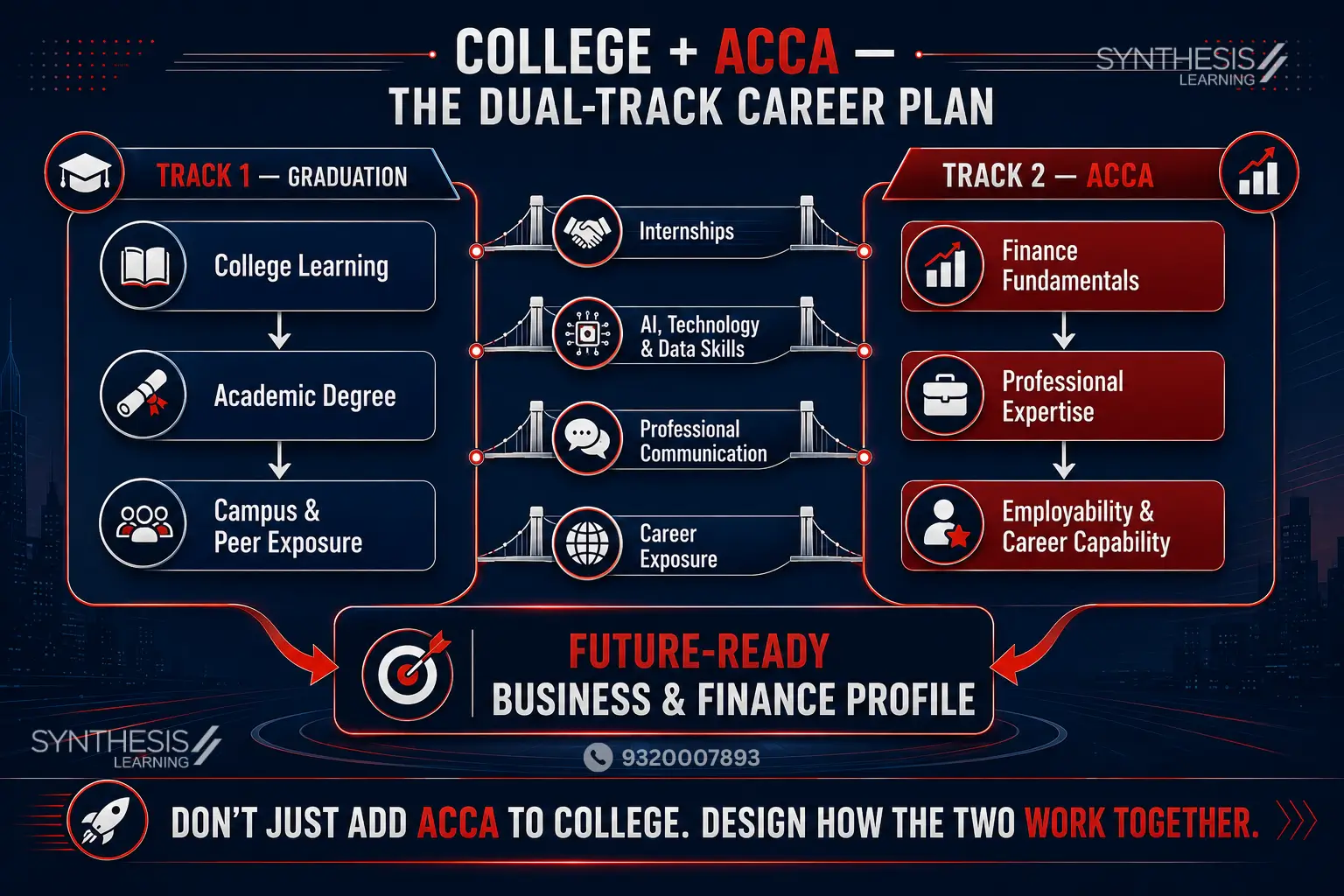
For many Indian students, however, pursuing ACCA alongside a suitable graduation degree can create a sensible dual pathway:
College provides academic breadth and campus exposure.
ACCA develops professional depth in accounting, business, and finance.
This can also give students time to build internships, professional skills and workplace exposure while progressing through the qualification.
But the combination needs to be planned realistically.
Consider:
- College workload
- University quality
- Commuting and class schedules
- Your ACCA exam pace
- Actual exemptions available
- Strength of your accounting fundamentals
And do not choose a college or integrated programme only because it advertises a large exemption number. {present info in a different manner}
An exemption can remove an exam requirement. It does not automatically build the knowledge you may need later.
What this actually means:
Plan your degree + ACCA journey as one career pathway, not as two unrelated qualifications.
What Kind of Professional Is ACCA 2027 Trying to Build?
A student beginning after Class 12 today may still be working in finance decades from now.
That is why future relevance matters.
| Capability | Career relevance |
| Accounting & reporting | Financial reporting and professional accounting roles |
| Audit, risk & controls | Assurance, controls, governance and risk |
| Finance & performance | FP&A, business finance and decision support |
| Tax & advisory | Tax and broader advisory pathways |
| Data capability | More analytical and insight-led finance work |
| Technology awareness | Finance transformation and digitally enabled business |
| Strategic judgement | Business partnering and senior decision-support roles |
The redesigned qualification includes areas such as Performance with Data Analysis, Finance and Investment, Business and Sustainability Reporting and Data Science Professional, alongside Essential Employability Modules.
So ACCA’s future direction extends beyond traditional bookkeeping or accounting processing.
It increasingly represents a global business and finance qualification built for a more AI-enabled, technology-driven profession.
From Class 12 to ACCA Membership: Exams Are Only Part of the Journey
A common mistake after Class 12 is to think:
“I just need to clear the papers.”
Professional qualification works differently.
The broader journey looks like:
CLASS 12
↓
ACCA EXAMS + EMPLOYABILITY MODULES
↓
RELEVANT WORK EXPERIENCE
↓
36-MONTH PER + PERFORMANCE OBJECTIVES
↓
ACCA MEMBERSHIP
Under the redesigned qualification, students still need a minimum 36 months of supervised relevant practical experience and Performance Objectives for membership.
Relevant experience does not necessarily need to wait until all exams are over. ACCA encourages students to start recording PER once they enter a relevant role.
That means college internships and early finance exposure can become part of a much bigger professional-development mindset.
A Smarter ACCA Plan After Class 12
Instead of asking:
“How fast can I finish ACCA?”
think in phases.
Phase 1 – Build the Base
Focus on:
Graduation + accounting fundamentals + ACCA study discipline
Understand FA and MA properly, learn how professional exams work and establish a sustainable college-study routine.
Phase 2 – Build Professional Depth
As you progress:
Technical ACCA learning + application + data/technology awareness
This is where students increasingly move from understanding concepts to using them in business contexts.
Phase 3 – Build Employability
Gradually add:
Internships + professional communication + workplace confidence + career preparation
The objective is to become stronger on both sides:
Exam-ready AND work-ready.
This is a planning model – not a promised three-year ACCA completion timeline. Individual pace depends on college workload, exemptions, preparation and exam progression.
From Class 12 to a Global Finance Career: How Synthesis Learning Supports the Journey
For a Class 12 student, good ACCA guidance should answer more than:
“Which paper do I study first?”
It should help plan the next few years.
Synthesis Learning – a House of Global Courses with 25+ years of legacy in business and finance education and an ACCA Platinum Approved Learning Partner – supports school-leavers across that wider journey.
The approach includes:
- Understanding whether ACCA fits the student’s career direction
- Evaluating how ACCA can work alongside graduation
- Strengthening FA and MA fundamentals through Bridge Course support
- Realistic paper planning through 1-on-1 mentorship
- Structured doubts, tests and mocks
- Classroom, live-online and self-paced learning options
- Practical future-finance and digital capability
- Campus-to-Corporate career readiness
- Early employer perspective through the wider Ascentium India ecosystem
The emphasis is not simply on attempting ACCA early.
It is on starting correctly.
For a Class 12 student, the right ACCA plan should prepare you for the next few years – not just the next exam.
Final Verdict: Should You Start ACCA Now or Wait for 2027?
If you have completed Class 12, meet ACCA’s eligibility criteria, understand the career direction and are ready to begin, the 2027 redesign alone is generally not a reason to wait.
Your valid completed progress can transition into the redesigned qualification.
If you are not yet ready, there is also no reason to rush simply to enter before the changes.
Use this rule:
Career clear + eligible + ready?
Start planning your ACCA journey.
Still unsure or academically overloaded?
Build clarity first.
The future qualification may have fewer exams, but its bigger story is not the number 11.
It is an ACCA pathway becoming increasingly connected to AI, data, technology, sustainability, employability and the future of global finance.
Don’t choose your ACCA starting date based on which syllabus looks shorter. Choose it based on when you are ready to build the career behind it.