What Is The ACCA Syllabus? How Many Papers To Be Attempted In ACCA?
Table of Content
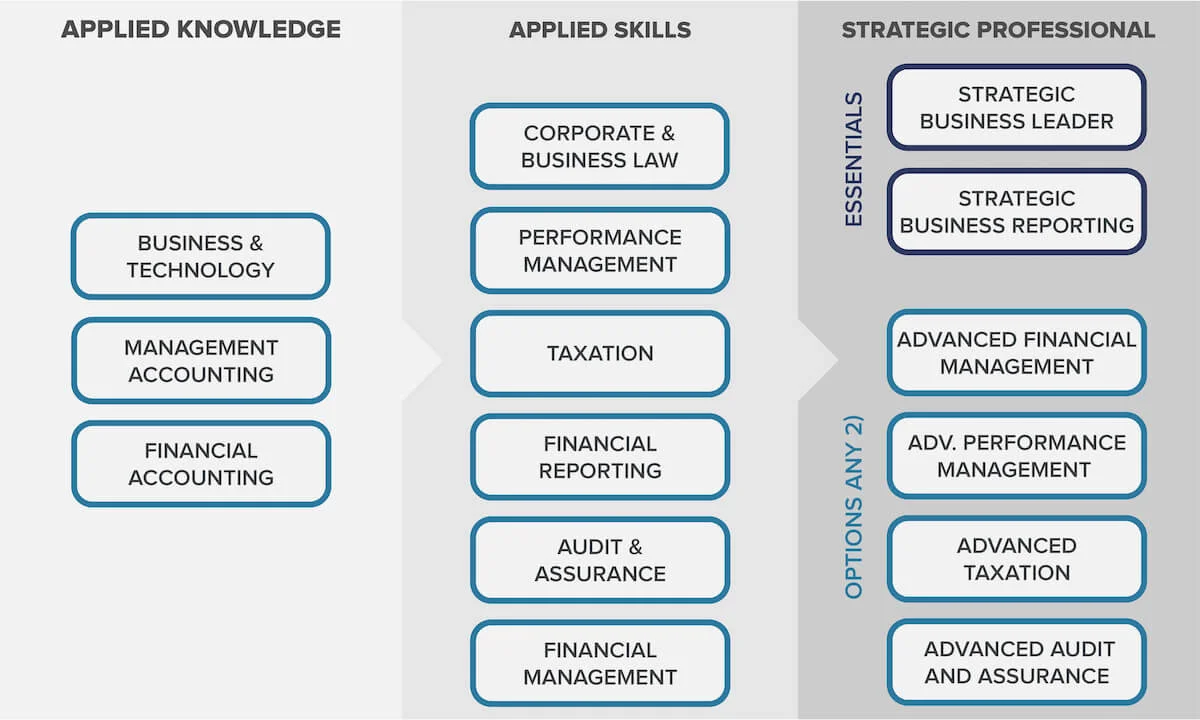
ACCA is the Association of Chartered Certified Accountants, the world’s most forward-thinking professional accountancy body based in the UK with 115+ years of experience. It is a globally accepted qualification for successful careers in finance, accounting, banking, consulting, and management. The ACCA qualification provides excellent career opportunities to commerce students and professionals in India and abroad; creating strategic-thinking business managers globally. This wouldn’t have been possible with a comprehensive syllabus consisting of 13 papers or exam modules & an Ethics and Professional Skills module. These 13 exam modules are further subdivided into two categories, namely the Fundamental Level and the Professional Level. Let us learn about each of them in detail below-
Fundamental Level Courses
The Fundamental Level comprises of 2 sections with a total of 9 exam modules – the Knowledge Level & the Skills Level. Undergraduate students who do not have any graduate degree yet (or any other relevant professional qualification like Chartered Accountant) need to attempt all the papers at this level in order to be eligible for the Professional Level. Graduates have an option to claim exemptions and skip attempting some of the papers in this level depending upon their course.
Knowledge Level or Applied Knowledge Papers
The Applied Knowledge Level exams provide students with a broad introduction to finance and accounting. The exam modules are designed to develop your essential understanding of practices and techniques in accounting. Strengthening your fundamental knowledge about several topics at this level will prepare you for the more advanced subjects in the next level. The Applied Knowledge Level examinations contain 100% compulsory questions to encourage candidates to study across the breadth of each syllabus. The three examinations under this level are as follows-
Students shall be awarded the ACCA Diploma in Accounting and Business (RQF Level 4) when they have successfully completed (either passed or exempt) the Applied Knowledge Level.
Skills Level or Applied Skills Papers
The Applied Skills Level exam modules or papers build on your existing knowledge acquired during the previous level itself. It creates an understanding of applications and develops strong practical finance understanding and skills required to function as a professional accountant across sectors or industries globally. The six examinations under this level are as follows –
Students shall be awarded the Advanced Diploma in Accounting and Business when they have successfully completed (either passed or exempt) the Applied Skills exams.
Professional Level or Strategic Professional Level
While the Foundation Level modules provide the preliminary knowledge and understanding of the domain, an accountant needs to develop broader strategic and leadership skills to flourish in real-life leadership positions. The Strategic Professional or Professional Level exams prepare students for these future leadership positions through a practically-developed curriculum. Students get an opportunity to hone their technical, ethical, and professional skills which helps them to approach problems from varied business perspectives. The Strategic Professional Level comprises six papers, of which two are compulsory and four optional. Every student needs to choose two specializations from FM, PM, TX, and AA that best suit their career ambitions. The six examinations under this level are as follows –
Students shall be awarded a Strategic Professional Certificate when they have successfully completed all the Strategic Professional exams of the ACCA Qualification.
Ethics and Professional Skills Module (EPSM)
In addition to clearing the above modules across both levels, students are also required to complete 20 hours of the Ethics and Professional Skills Module or EPSM which develops a range of skills to facilitate the employability of ACCA candidates. By providing case studies and introducing students to real-world business situations, this module aims to boost the trustworthiness and credibility of ACCA candidates.
The exam modules and the Ethics and Professional Skills Module can be attempted in modular order. Every student needs to attempt the Applied Knowledge modules, followed by the Applied Skills modules, which in turn is followed by the Strategic Professional modules. The Ethics and Professional Skills Module can be taken at any point after completion of the Applied Knowledge exams. The following table highlights the exam duration, passing marks, mode of examinations, and all attempts that can be given-
Paper
Exam Duration
Passing Marks
Exam Mode
All Attempts
ACCA BT – LW
2 hours
50/100
Online
On-Demand
ACCA PM – FM
3 hours
50/100
Online
Mar/Jun/Sep/Dec
ACCA SBL
4 hours
50/100
Online
Mar/Jun/Sep/Dec
ACCA SBR – AAA
3 hours
50/100
Online
Mar/Jun/Sep/Dec
ACCA Business & Technology / ACCA F1
What you learn:
This exam will teach you how businesses operate efficiently, effectively and ethically, and highlight the critical role finance professionals play in achieving these objectives. You’ll understand business in the context of the overall environment – including economic, regulatory, and legal influences on aspects like governance, employment, health and safety, security, and data protection.
Syllabus:
The business organization, its stakeholders, and the external environment
Business organizational structure, functions, and governance
Accounting and reporting systems, compliance, control, technology, and security
This exam will help you to develop management accounting techniques to support businesses in planning, controlling, and monitoring performance and KPIs. You’ll learn the various ways of managing finance within an organization with the aim of enhancing the business’ overall performance.
Syllabus:
Nature, source, and purpose of management information
This exam will teach you the underlying principles and concepts of financial accounting, accounting techniques, and the preparation of basic financial statements. You’ll demonstrate technical proficiency in the use of double-entry techniques, including the preparation and interpretation of basic financial statements for sole traders, partnerships, companies, and simple groups of companies.
Syllabus:
The context and purpose of financial reporting
The qualitative characteristics of financial information
This exam will help you to develop knowledge and skills in the understanding of the general legal framework, and of specific legal areas relating to the business; recognizing the need to seek further specialist legal advice whenever wherever necessary.
Syllabus:
Essential elements of legal systems
International business transactions
Transportation and payment of international business transactions
The formation and constitution of business organizations
Capital and the financing of companies
Management, administration, and the regulation of companies
This exam will help you to develop knowledge and skills in the application of management accounting techniques to qualitative and quantitative information for planning, decision-making, performance evaluation, and effective control.
Syllabus:
Information, technologies, and systems for organizational performance
Specialist cost and management accounting techniques
This exam will help you to develop knowledge and skills relating to the tax system as applicable to individuals, single companies, and groups of companies. It has multiple variants like that of the UK, Hong Kong, etc. Following is the information regarding the UK variant-
This exam will help you to develop knowledge and skills in understanding and application of accounting standards and the theoretical framework in the preparation of financial statements of entities or groups; and how to analyze and interpret financial statements.
Syllabus:
The conceptual and regulatory framework for financial reporting
Accounting for transactions in financial statements
Analyzing and interpreting the financial statements of single entities and groups
This exam will help you to develop knowledge and understanding of the process of carrying out the assurance engagement and its application in the context of the professional regulatory framework as needed across geographies.
This exam will help you to develop the knowledge and skills expected from a Finance Manager – like relation to investment, financing, and dividend policy decisions.
This exam considers the actual workplace and provides you with real-life challenges allowing you to demonstrate a blend of professional, technical, and practical skills. It gives you insight into professional skills that you can apply in your exam and in the workplace.
Syllabus:
Leadership
Governance
Strategy
Risk
Technology and data analytics
Organizational control and audit
Finance in planning and decision-making
Innovation, performance excellence, and change management
This exam requires you to demonstrate your ability to make strategic business reporting decisions in real-time. Set within the corporate reporting environment you will be tested on concepts, principles, theories, and your ability to successfully apply this knowledge to real-life scenarios.
Syllabus:
Fundamental ethical and professional principles
The financial reporting framework
Reporting the financial performance of a range of entities
Financial statements of groups of entities
Interpret financial statements for different stakeholders
The impact of changes and potential changes in accounting regulation
This exam will help you to apply relevant knowledge, skills and exercise professional judgment as expected of a senior financial executive or advisor; in taking or recommending decisions relating to the financial management of an organization in the private and public sectors.
Syllabus:
Role of senior financial adviser in the multinational organization
This exam you help you to apply relevant knowledge, skills and exercise professional judgment in selecting and applying strategic management accounting techniques in different business contexts, and to contribute to the evaluation of the performance of an organization and its strategic development.
Syllabus:
Strategic planning and control
Impact of risk and uncertainty on organizational performance
Performance management information systems and developments in technology
In this exam, you will learn to apply relevant knowledge and skills and exercise professional judgment in providing relevant information and advice on the impact of the major taxes on financial decisions and situations to individuals and businesses.
Syllabus:
Knowledge and understanding of the UK tax system through the study of more advanced topics within the taxes studied previously and the study of stamp taxes
The impact of relevant taxes on various situations and courses of action, including the interaction of taxes.
Minimizing and/or deferring tax liabilities by the use of standard tax planning measures
Communicating with clients, HM Revenue and Customs, and other professionals
Pass Rates (Dec 2020): 40%
ACCA Advanced Audit and Assurance / ACCA P7
What you learn:
This exam is designed to reflect the challenges auditors will face in their professional life. You will be required to analyze, evaluate and conclude on the assurance engagement and other audit and assurance issues in the context of best practice and current developments globally.
Syllabus:
Regulatory Environment
Professional and Ethical Considerations
Quality Control and Practice Management
Planning and conducting an audit of historical financial information
Our expert ACCA tutors have successfully coached thousands of aspirants with a phenomenal passing rate of over 92%. Join their club with our Platinum Rated ACCA Online Courses today!